
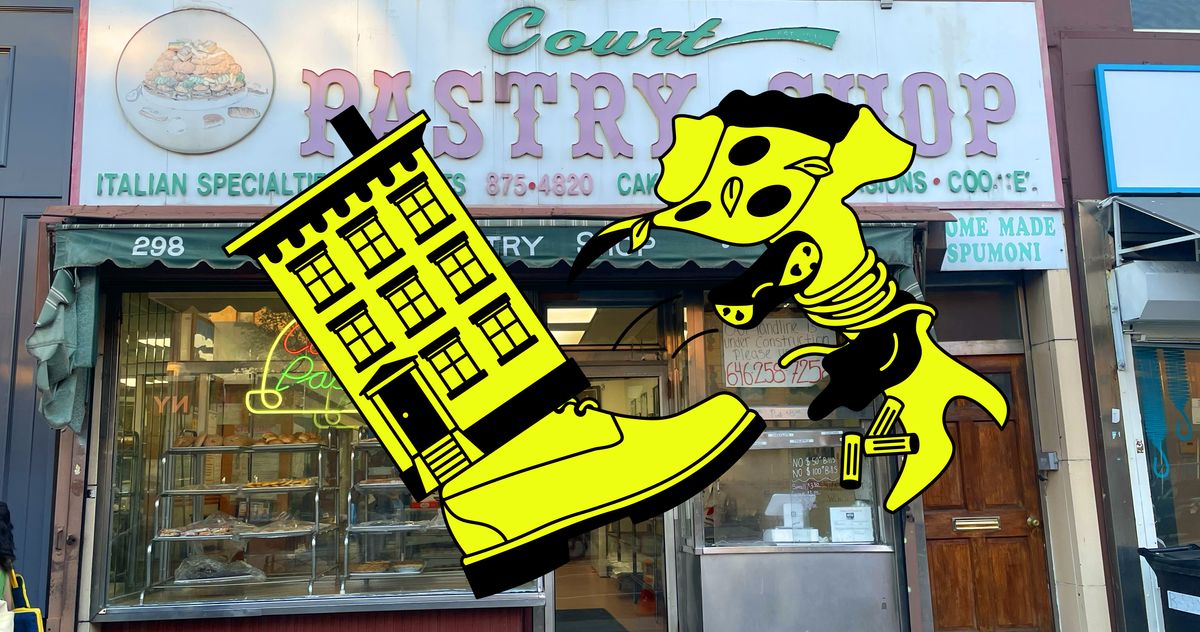
Where Did the Italians of Carroll Gardens Go? Amid an exodus of longtime residents and eateries, the neighborhood has lost much of its old-world charm. Illustration: Emma Erickson; Photo Benjamin Lorr Illustration: Emma Erickson; Photo Benjamin Lorr Over a lunch of fettuccine cooked in Chianti and stirred in a wheel of Parmigiano-Reggiano, Joe Chirico, the 81-year-old founder of Marco Polo Ristorante in Carroll Gardens, tells me all the ways the place has changed since he opened 35 years ago. “We’re the last of this style of restaurant,” says Chirico, who has a Calabrian accent and a heavy gold cross around his neck. Over the years, Marco Polo has adapted to the neighborhood’s changing demographics by downplaying its old-world Italian extravagance. The white tablecloths are gone and the clientele no longer wear tuxedos for dinner, nor do they order three-course lunches with wine. The veal marsala has been replaced by lighter fare, including salads as well as vegan and gluten-free options. Pizza, once found strictly in casual pizzerias, is now on the menu. And old-timers like the actor Tony Sirico — a.k.a. Paulie on the Sopranos — whose family spent Thanksgivings and Easters at Marco Polo for years, have died. Marco, Chirico’s son and the restaurant’s chef, who took over for his father after finishing culinary school three years ago, is committed to evolving with the times, but admits “it’s been hard, business-wise.” Carroll Gardens has been an Italian stronghold since the turn of the 20th century, when waves of migrants moved into what was then simply known as South Brooklyn, encompassing Carroll Gardens, Gowanus, Cobble Hill, and Red Hook. When Chirico arrived in the early 1960s, he got his start washing dishes and went on to run three previous Court Street restaurants — Joe’s Luncheonette, Cafe del Sud, and Gage & Tollner, the landmark 19th-century steakhouse he restored in the 1990s. Many of his fellow immigrants worked jobs on the docks and opened small businesses. “The major decision,” recalls 83-year-old Michael Pesce, a retired New York Supreme Court justice who has lived in the same Carroll Gardens apartment for 50 years, was deciding where to buy your fruit, cheese, and meat. Do you “go to the vendor from Naples, or to the vendor from my hometown,” Mola di Bari? But the advent of shipping containers, which were too big for the Red Hook port, cost local longshoremen their jobs in the 1960s and ’70s and set off a steady Italian exodus — often to New Jersey, Staten Island, or Queens — that has continued ever since. Each subsequent generation has seen a new outflow of Italians from the neighborhood as children trade in their family apartments and businesses for bigger houses and paychecks elsewhere. Gone are the “old bronzed men in bathing trunks sunning themselves in lawnchairs” on the sidewalks, says the author Benjamin Lorr, a Carroll Gardens resident for the past 24 years. So are the Catholic lawn ornaments and gardens sprouting eggplants and figs. The changes were spurred in large part by soaring real-estate prices and Italian families cashing in. “The parents pass away and the kids sell the building,” says Chirico, who bought Marco Polo’s lot for $146,000 in 1981. In the mid-aughts, the children might get $1 million or $2 million and “thought they had a good deal,” but property values would only continue to rise. The “vacancy decontrol” law of 1971 allowed owners of rent-controlled homes to deregulate, and in the early 1980s, Penelope Karagias, a South Brooklyn real-estate broker, rallied Carroll Gardens landlords to collectively raise their prices, recalls Gaston Musella, who rents out a building his grandparents bought after immigrating to the neighborhood from Italy in the early 1900s. “She went around and basically campaigned to make the neighborhood more expensive, literally, and she succeeded.” “I was disappointed that the immigrants were moving out. The fear back then, for some strange reason, was that the neighborhood was going down,” says Pesce, who was an assemblyman in the area from 1973 to 1980. “As soon as the Italian immigrant saved some money, they would move up to Bensonhurst or Staten Island, and from Bensonhurst to Long Island.” He tried to convince them to stay, telling them, “This neighborhood has a future. Look around you: The Americans are coming.” But they wanted to trade in their brownstone railroads for newer houses with yards. “By the ’90s, there was no question that this Italian neighborhood was gone.” The Italian population has managed to decline even more in the years since. According to Census data taken between 2019 and 2023, the number of residents of Italian ancestry in Brooklyn Heights, Carroll Gardens, Cobble Hill, and the Columbia Waterfront District was down 25 percent over the previous 13 years. Today, only a handful of Italian-owned businesses remain in the neighborhood. In just the past year, a trio of century-old Italian eateries have shuttered in Carroll Gardens. In April, a former server at Long Island Bar bought the neighborhood relic Sam’s Restaurant from Lou Migliaccio, whose relatives opened it in 1930. She has promised to preserve the pizzeria’s character — it’s known for its red vinyl booths and checkered tablecloths — but update the menu. “It would break my heart to hear that it was closed, or that it was taken over by some corporate restaurant group,” the new owner, Georgia Fulton, told Grub Street of her decision to buy it. That same month, Francesco “Frank” Buffa sold his family’s 104-year-old Sicilian restaurant, Ferdinando’s Focacceria, to Sam Lamboglia, the 41-year-old restaurateur behind the more polished, higher-end eateries Cafe Spaghetti and Swooney’s in the Columbia Waterfront District. “It was a tough, tough life,” Buffa says. After losing the longshoremen in the early 1970s, Buffa added dinner service to his usual lunchtime fare and ended up spending 14 hours a day, six days a week at the counter — for 54 years, he says. For a long time, the children and grandchildren of the neighborhood’s bygone Italians would come by on the weekends for a nostalgic vastedda (spleen) or panelle (fried chickpea) sandwich. “The kids, they all remember,” Buffa says. But the trendier the neighborhood became, the harder it was for them to visit. “It’s very hard to park,” he says. Buffa retired when he turned 75. He received several offers for Ferdinando’s, but ultimately chose Lamboglia. He liked that the younger man was Italian, if not Sicilian, and already owned businesses in the area. “He will continue the tradition,” Buffa says. “He keeps the name. He keeps the place the same — the history, the same floor, the same tile, the same paintings. The only thing he adjusts is the menu.” Lamboglia has preserved some Sicilian specialties, like the panelle, though Buffa’s tripe in tomato sauce is long gone (as is the spleen sandwich). Another shock to the neighborhood came in May, when Caputo’s Bake Shop, a Court Street landmark for 124 years, abruptly shut down. Its fifth-generation owner, James Caputo, called it “the most difficult decision I ever had to make” but said he ultimately couldn’t take the grueling hours — workdays sometimes started at 2 a.m. — and mounting bills. “That was a heartbreaker,” says Musella. “Not only were they there for many years, they made the best Easter bread.” Grief-stricken locals covered Caputo’s locked door with notes of gratitude. Chirico sourced the bread for Marco Polo from Caputo’s. Now he gets it from the nearby Mazzola Bakery, which has been open since 1928 but probably won’t make it to its 100th anniversary. The owners have listed the Union Street building, along with the one next door, for $9.75 million. Pesce sees the change first-hand at his social club, Van Westerhout Cittadini Molesi, which he founded on Court Street in 1960 for his fellow Mola di Bari natives and their descendants. Carroll Gardens used to be home to more than a dozen social clubs representing different cities in Italy: Palermo, Gaeta, Licata, and four alone for the people of Mola di Bari. Today, Van Westerhout Cittadini Molesi is one of just two clubs that remain. The other is 106-year-old Pozzallo, named for the southern Sicilian city from which its members hail. But those may soon disappear too. “We have to get rid of the bricks and mortar and set up a website where each club will have its own page and announce whatever activities they want to, but we don’t need to maintain real estate to do that,” Pesce says. A few Italian stalwarts remain with their family businesses: Court Pastry Shop, Monteleone Bakery, D’Amico Coffee, Mazzone Hardware, and Caputo Fine Foods (no relation to the Caputo bakery family). There was a time when some wondered about the fate of Marco Polo, too. In 2008, Chirico pleaded guilty to laundering money for the Gambino crime family. But sterling character references — then–Brooklyn Borough President Marty Markowitz called Chirico “a prince among men” — helped keep him out of prison. Marco Polo is “here for good,” Joe tells me over lunch. “I will never sell.” He insists that I try the stuffed zucchini flower, which, along with many of the vegetables on the menu, he grew on his farm upstate. Nowadays he spends much of his time there tending to the figs, tomatoes, and mint (for the gelato), though he can still often be spotted at the restaurant. “I love this neighborhood,” he says. But even he, it turns out, no longer lives here. “It’s a little bit complicated,” he says, but, yes, he’s got a nice place on Staten Island now. Where Did the Italians of Carroll Gardens Go? Your product is saved! You’ll receive emails when your saved products go on sale. Manage preferences.
Where Did the Italians of Carroll Gardens Go?
Full Article
Original Source
Read the full article at Curbed →KhanList aggregates and links to publicly available news content. We do not host full articles from third-party sources. Always verify important information with original sources.