
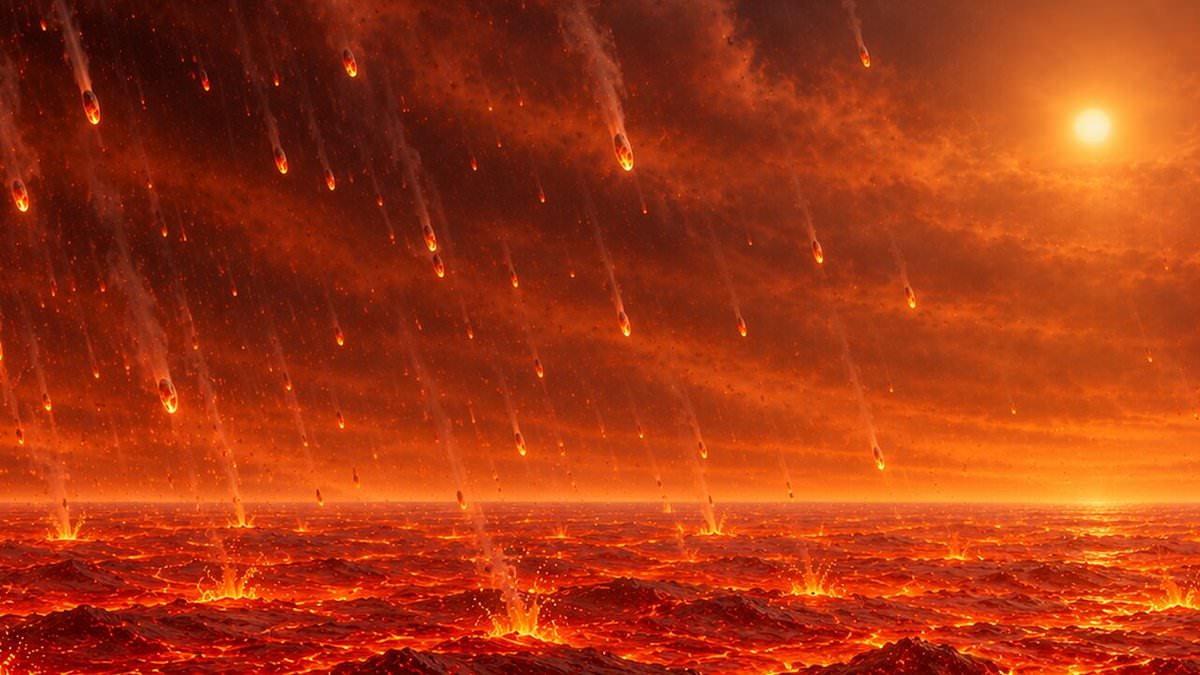
Scientists have made a major breakthrough in the search for the origin of Earth's water.Earth's oceans are unique in the solar system and essential for life, but experts say that our planet wasn't always so blue.In fact, researchers from the University of New Mexico say that the Earth may have been completely dry when it formed.However, in a surprising new suggestion, the scientists claim our planet may have formed all the water we see today directly out of its rocky raw materials.They suggest that rocky pebbles rained down from the sky during the young planet's early formation, reacting with the hydrogen–rich atmosphere.Iron oxide in these rocks reacted with hydrogen under extreme heat to create water and pure iron that would go on to form the planet's metal core.Based on the results of laboratory experiments, the researchers suggest that hundreds of oceans' worth of water could have been created in this way.Co–author Professor Zachary Sharp, a planetary scientist from the University of New Mexico, says: 'Looking out over a large body of water, it is hard to imagine that that water may have been produced 4.5 billion years ago in a hell–like atmosphere, but it very well may have.' Researchers say that Earth was once completely dry, but created its own water supply through the reactions between its hot atmosphere and falling 'pebbles' (artist's impression) The fact that Earth is abundant in liquid water is hardly a novel observation, but it does raise a perplexing problem for astronomers.Scientists believe Earth, and all the other planets in the solar system, formed out of a swirling ring of dust and rock called the protoplanetary disc.Near to the centre of the disc, where the inner planets are today, the radiation from the sun was so powerful that water molecules would have mostly been blasted back into hydrogen and oxygen.However, since water clearly does exist on Earth today, the puzzle is explaining where it came from.'Previous ideas about the source of water to Earth rely on an external source, such as comets or meteorites,' says Professor Sharp.These so–called 'icy pebbles' would have formed far out in the colder reaches of the solar system, and only came inwards towards Earth later on.However, this would require Earth to be hit by an enormous number of comets in its early formation, which some experts find unlikely.Instead, Professor Sharp and his co–authors propose that most of Earth's water was made on the planet itself out of rocky minerals and hydrogen. As Earth formed, rocky silicate pebbles fell through a hot, hydrogen–rich atmosphere. The iron oxide contained inside these rocks reacted with the hydrogen to create water and pure metallic iron, which formed the planet's core (illustrated) Many scientists now believe that the planet formed as small, rocky pebbles accumulated to form a larger planetary body – a process known as pebble accretion.When the planet became big enough, it developed a hot, high–pressure hydrogen atmosphere that could react with iron oxide in the falling pebbles to make water.To test this theory, the researchers heated rock samples at temperatures between 1,200°C and 1,400°C (2,190–2,550°F) in streams of hydrogen and, for comparison, helium.In their paper, published in Nature Geoscience, they found that 80 per cent of the iron oxide in the samples held under a stream of hydrogen was converted into metallic iron, producing water within minutes.No such reaction occurred in the samples held under helium, showing that the hot hydrogen atmosphere is key.Professor Sharp says: 'We had suspected and hoped that we would produce iron metal and water in our reduction experiments, but we really had no way of knowing how fast and how much.'We were quite surprised to find that extrapolation of our work suggests that hundreds of oceans' worth of water were likely produced in this way.'This suggests that the 'pebble rain' could have been critical to the formation of life–giving oceans in Earth's early history. To test this theory, scientists heated different silicate mineral samples to extreme temperatures and recorded whether they reacted to produce iron and water. Pictured: Rock samples seen under a scanning electron microscope after heatingHowever, it also has some big consequences for the search for alien life out among the stars.Scientists think that many rocky planets formed via pebble accretion, meaning they would have the chance to undergo those same water–producing reactions.Rather than waiting for water to arrive by chance in ice or water–rich minerals from space, a growing planet could simply generate its own oceans directly.That means many more rocky, Earth–sized planets could have abundant liquid water than had previously been suspected.'The idea of pebble accretion is still relatively new. It's only been around for the last decade. But it seems to solve many problems that exist with the existing paradigm for planet formation,' says Professor Sharp.'And now we see that it also can explain why our planet is habitable. By extension, it is reasonable to expect that other Earth–sized bodies circling other stars would also have water and possibly life.'KEY DISCOVERIES IN HUMANITY'S SEARCH FOR ALIEN LIFE Discovery of pulsarsBritish astronomer Dame Jocelyn Bell Burnell was the first person to discover a pulsar in 1967 when she spotted a radio pulsar.Since then other types of pulsars that emit X-rays and gamma rays have also been spotted.Pulsars are essentially rotating, highly magnetised neutron stars but when they were first discovered it was believed they could have come from aliens.'Wow!' radio signalIn 1977, an astronomer looking for alien life in the night sky above Ohio spotted a radio signal so powerful that he excitedly wrote 'Wow!' next to his data. In 1977, an astronomer looking for alien life in the night sky above Ohio spotted a radio signal so powerful that he excitedly wrote 'Wow!' next to his dataThe 72-second blast, spotted by Dr Jerry Ehman through a radio telescope, came from Sagittarius but matched no known celestial object.Conspiracy theorists have since claimed that the 'Wow! signal', which was 30 times stronger than background radiation, was a message from intelligent extraterrestrials.Fossilised Martian microbesIn 1996 Nasa and the White House made the explosive announcement that the rock contained traces of Martian bugs.The meteorite, catalogued as Allen Hills (ALH) 84001, crashed onto the frozen wastes of Antarctica 13,000 years ago and was recovered in 1984. Photographs were released showing elongated segmented objects that appeared strikingly lifelike. Photographs were released showing elongated segmented objects that appeared strikingly lifelike (pictured)However, the excitement did not last long. Other scientists questioned whether the meteorite samples were contaminated. They also argued that heat generated when the rock was blasted into space may have created mineral structures that could be mistaken for microfossils. Behaviour of Tabby's Star in 2005 The star, otherwise known as KIC 8462852, is located 1,400 light years away and has baffled astronomers since being discovered in 2015.It dims at a much faster rate than other stars, which some experts have suggested is a sign of aliens harnessing the energy of a star. The star, otherwise known as KIC 8462852, is located 1,400 light years away and has baffled astonomers since being discovered in 2015 (artist's impression)Recent studies have 'eliminated the possibility of an alien megastructure', and instead, suggests that a ring of dust could be causing the strange signals.Exoplanets in the Goldilocks zone in 2017 In February 2017 astronomers announced they had spotted a star system with planets that could support life just 39 light years away.Seven Earth-like planets were discovered orbiting nearby dwarf star 'Trappist-1', and all of them could have water at their surface, one of the key components of life.Three of the planets have such good conditions, that scientists say life may have already evolved on them. Researchers claim that they will know whether or not there is life on any of the planets within a decade, and said: 'This is just the beginning.'
Where did Earth's water come from? Scientists make major breakthrough as they find our planet was completely DRY when it formed
Full Article
Original Source
Read the full article at Dailymail →KhanList aggregates and links to publicly available news content. We do not host full articles from third-party sources. Always verify important information with original sources.