
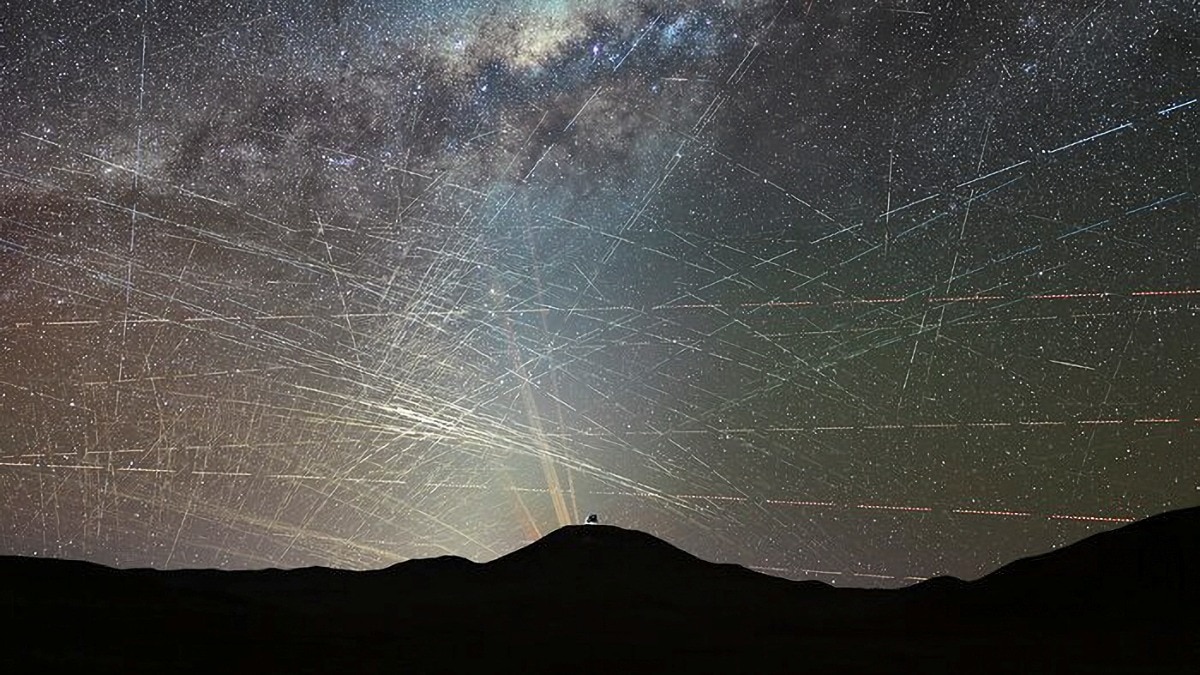
The sky above Earth's observatories could soon look very different as satellite constellations expand, potentially leaving astronomers with less usable data. Is there a solution?Satellite trails streak across the night sky above Chile's Atacama Desert. (Photo: ESO)The race to put more satellites into space could soon create a problem on Earth, making it harder for astronomers to see the cosmos and find the secrets it still holds.The plans to launch more than 1.7 million additional satellites could substantially affect astronomical observations, a new study by the European Southern Observatory (ESO) has warned. A string of SpaceX StarLink satellites passes over an old stone house in the US. (Photo: AP) Keep in mind that there are currently roughly 15,000 satellites in orbit, according to the study.The problem is not simply that satellites are visible in the night sky but also an obstructed view. “Each of these satellites, when it crosses a telescope's field of view, leaves a bright line,” ESO astronomer Olivier Hainaut, who led the study, told news agency Reuters. An artist's concept of a satellite in space. (Photo: Astroscale) THOUSANDS OF SATELLITED COULD PHOTOBOMB IMAGESThe researchers used simulations based on observations from ESO's Paranal Observatory in Chile's Atacama Desert, home to the Very Large Telescope. One model examined what the sky could look like with a constellation containing up to 1 million satellites.The simulations found that thousands of illuminated satellites could be visible above the observatory shortly after sunset and that their trails would cut across astronomical images, reducing the amount of usable data.Starlink has officially crossed 11,000 satellites in orbitToday’s successful deployment of 24 new Starlink satellites brings the estimated number currently orbiting Earth to around 11,003That makes Starlink by far the largest satellite constellation humanity has ever built pic.twitter.com/h1pSPmTQOZ— X Freeze (@XFreeze) August 19, 2026"A single streak of light may be a minor nuisance, but when the numbers multiply there can be major problems," Hainaut said. "Each streak wipes away a small part of a telescope's view of space."The severity depends on both the number and brightness of satellites.Hainaut elaborated that 1,00,000 satellites would represent a level of interference that is “bearable”, but at 3,00,000, some telescopes could lose most of their data.ESO's own simulations found that a large SpaceX constellation could produce dozens of trails in individual images taken two hours into the night, potentially causing field-of-view losses of up to 28% for the Very Large Telescope's FORS2 instrument.NOT JUST AN ASTRONOMICAL PROBLEMAstronomers use ground-based telescopes to study everything from distant galaxies and exploding stars to planets around other stars and potentially hazardous asteroids.Satellite streaks can therefore mean losing pieces of observations that may be impossible to repeat.The problem is also not just confined to individual streaks. Reflected satellite light can scatter through Earth's atmosphere and brighten the overall night sky, making faint objects harder to detect. A diagram illustrating a satellite constellation. (Photo: Generative AI/India Today) ESO added that keeping the total number of satellites below 1,00,000, provided they are faint enough to remain invisible to the naked eye, could keep losses at a level comparable with other technical problems faced by observatories.The rapid growth of satellite networks has been driven largely by internet services such as SpaceX's Starlink and Amazon's Leo constellation.The ESO study does not argue against satellite connectivity, but calls for a balance between technological expansion and scientific research."The problem is that this kind of research takes time," said Hainaut, "but the satellites are already being launched."- EndsPublished On: Aug 21, 2026 11:10 IST
Where are the stars? How satellites are destroying the night sky views
Full Article
Original Source
Read the full article at Indiatoday →KhanList aggregates and links to publicly available news content. We do not host full articles from third-party sources. Always verify important information with original sources.