
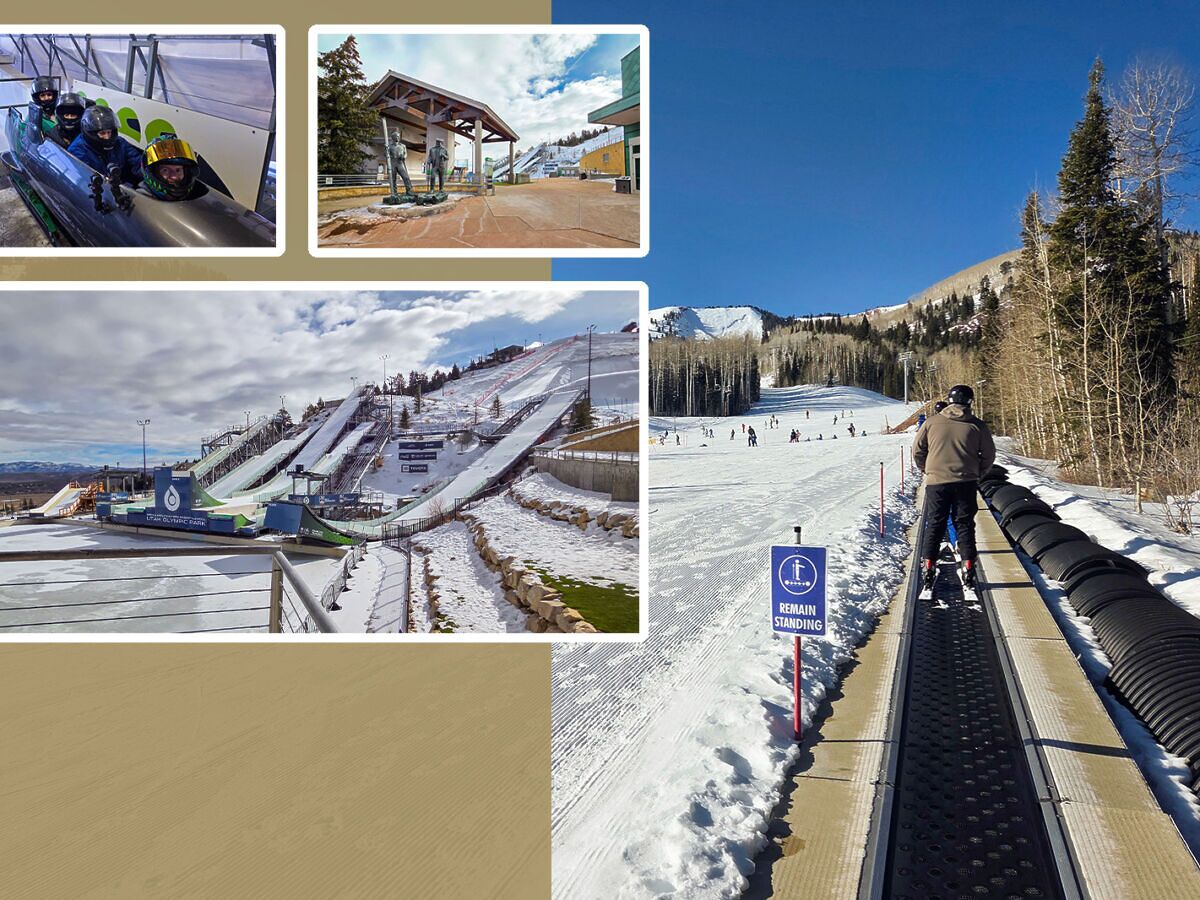
A rough winter opens new opportunities At the base of the Utah Olympic Park in Park City. Photo: Taryn Shorr-Mckee I visited Park City, Utah, with a group of friends for four days in early February 2026, in what’s typically prime ski season. I’d been looking forward to two full days on skis, maybe even squeezing in a bonus run on our last morning. Instead, we arrived to temperatures warm enough for short sleeves and no snow on the ground around town or at the resort bases. We knew it was bad, as the dismal ski conditions throughout the western US had made headlines for months. But seeing it in person was jarring. Up on the mountain, crews worked hard to make snow, but Mother Nature wouldn’t cooperate. By mid-morning of our first full day, conditions had deteriorated into a treacherous combination of slush and ice with exposed rocks and roots. Most of our group, myself included, managed a couple of laps or a lesson, but it didn’t take long before we threw in the towel. The two more advanced skiers stuck it out a little longer, but nobody was having the ski trip we’d envisioned. On our second day, I managed a single run before deciding I’d had enough. But rather than spend another morning struggling and cursing the conditions, I headed to Utah Olympic Park for a guided tour. It was, after all, gorgeous weather for being outside – just not for skiing. Built for the 2002 Winter Olympics, the park is home to ski jumps, a tubing trail, and a museum showcasing Olympic history. I was enjoying the tour, but didn’t expect to discover anything really out of the ordinary. Then our guide casually mentioned that visitors could ride in an actual Olympic bobsled on select evenings. She glanced at her watch. “Oh,” she said. “Tonight.” Looking down the bobsled track. Photo: Taryn Shorr-Mckee That was all it took. I didn’t stop to wonder why someone who sits out roller coasters was jumping at the chance to ride an Olympic bobsled. People who aren’t professional athletes can ride bobsleds at only a handful of tracks worldwide, just two of which are in North America. I was very literally in the right place at the right time. (The other place is Whistler, British Columbia.) I didn’t know what it cost or whether anyone else would join me – just that I was going. As soon as the tour ended, I raced to meet the rest of our group for lunch. I shared the news, and a couple of other women were immediately on board. Within minutes, we’d reserved our spots for that evening. A tiny detail, overlooked The writer and her fellow bobsledders getting ready to roll. Photo: Taryn Shorr-Mckee Only after committing did I start researching what, exactly, bobsledding entails. I’m a ’90s kid, and Cool Runnings was practically required viewing, so I was loosely familiar with bobsleds. But I’d never even imagined I’d be anywhere near one, much less inside one, so I’d never had a reason to look too deeply into it. What I didn’t realize was how similar the experience is to a roller coaster. The sled reaches about 80 miles per hour as it navigates a track with 15 curves, taking on forces of up to five Gs — all in less than a minute. My spontaneous decision suddenly seemed a lot more consequential. I don’t fear roller coasters: I just genuinely don’t enjoy them. Every couple of years, I try a new one, waiting for that magical “aha” moment to see what makes people think they’re so fun. It’s never come. What does come is that distinctive queasiness that others seem to relish. That part gave me pause, but only for a moment. But nothing was going to stand in the way of my newfound dream of becoming the world’s newest bobsled rider. The view from the top of the Utah Olympic Park. Photo: Taryn Shorr-Mckee I felt a twinge of nerves during the safety briefing, when we were warned about the potential for neck injuries from our heads bouncing inside of the sled even with helmets, and the pressure the ride puts on our backs. I happen to have an existing back problem, with three herniated discs in my lower back, and very little spinal fluid between them on a good day. Admittedly, I gulped and sent up a little prayer when I heard that, but still, I was resolved. Future bobsledders, take note: that warning is meant to be taken seriously, as the park explicitly discourages people with chronic back problems from riding. My injury is decades old and doesn’t cause issues 99 percent of the time, so I felt confident in my decision. But it’s a seriously physical activity. Get on up, it’s bobsled time Loading up at the top. Photo: Taryn Shorr-Mckee We got our helmets, then numbered off and split up among the sleds. Each bobsled carries a professional pilot and three passengers to properly distribute weight, so there’s no guarantee you’ll ride with your own group. One of my travel buddies and I ended up together, while our third rode with another sled. As the tallest passenger, I was assigned the rear seat: the one with nothing behind to brace against or prevent the person from flying out. In the moment, it seemed like a design flaw of enormous significance. In a real bobsledding competition, I’d have been the brakeman, responsible for stopping the sled at the finish line. But now, my only responsibility was to hold on. We tucked ourselves into position, our legs more or less hugging the person in front of us. I death-gripped the interior handles. Seconds later, we were off. There’s zero buildup. Because we were regular people, we had the benefit of other people giving us our running start, so we didn’t have to hop into the sled like professional athletes. But once the pushers let go, the sled rapidly gained speed. I remember holding on for dear life and telling myself to open my eyes, but realizing they were open when I noticed a clock. We rounded the curves so fast that everything was a blur. The ride was over almost as quickly as it began. Somewhere in there, I realized I was waiting for the queasiness that ruins every roller coaster for me, and it hadn’t come. Maybe it was that there was no slow climb to dread, no line to stew in. By the time my body caught up to what was happening, it was over. My head didn’t knock around much, and I mercifully escaped without any back trouble. My hands, however, were another story. I clutched the handles so fiercely that my fingers were bruised, some bloodied. Learn from my rookie mistake: bring gloves. The best word I can think of for the experience is exhilarating. All of us climbed out of the sled, buzzing with disbelief both that we’d just done something so intense and that something so intense could be so brief: we were done in about a minute. Hours earlier, we’d been commiserating over a mediocre ski trip. Now, somehow, we were celebrating an Olympic adventure. An unexpected souvenir A few months after the trip, my husband and I went to Silver Dollar City, an amusement park in Branson, Missouri. He usually doesn’t bother asking me to go on any type of fast thrill ride. But for whatever reason, that day, he did. I hesitated for maybe a second before saying yes — and had a blast. I even opened my eyes for part of the ride. We went on one more coaster before I decided not to push myself too much. But when I took my kids back to the park that summer, I willingly rode several more. To be clear, I’m still not the person in the front row of a coaster, and I’m certain I never will be. But I no longer automatically write them off, and I can even sort of understand why people like the sensation. That’s a small change, sure, but a real one. For years, I assumed that whatever made these rides fun for others simply wasn’t wired into me. The bobsled didn’t change me, but it reminded me that people can surprise themselves — and that sometimes, it’s worth reconsidering things we’ve decided about who we are. More like this
When Your Winter Trip Has No Snow, Find Your Inner Daredevil Instead.
Full Article
Original Source
Read the full article at Matadornetwork →KhanList aggregates and links to publicly available news content. We do not host full articles from third-party sources. Always verify important information with original sources.