
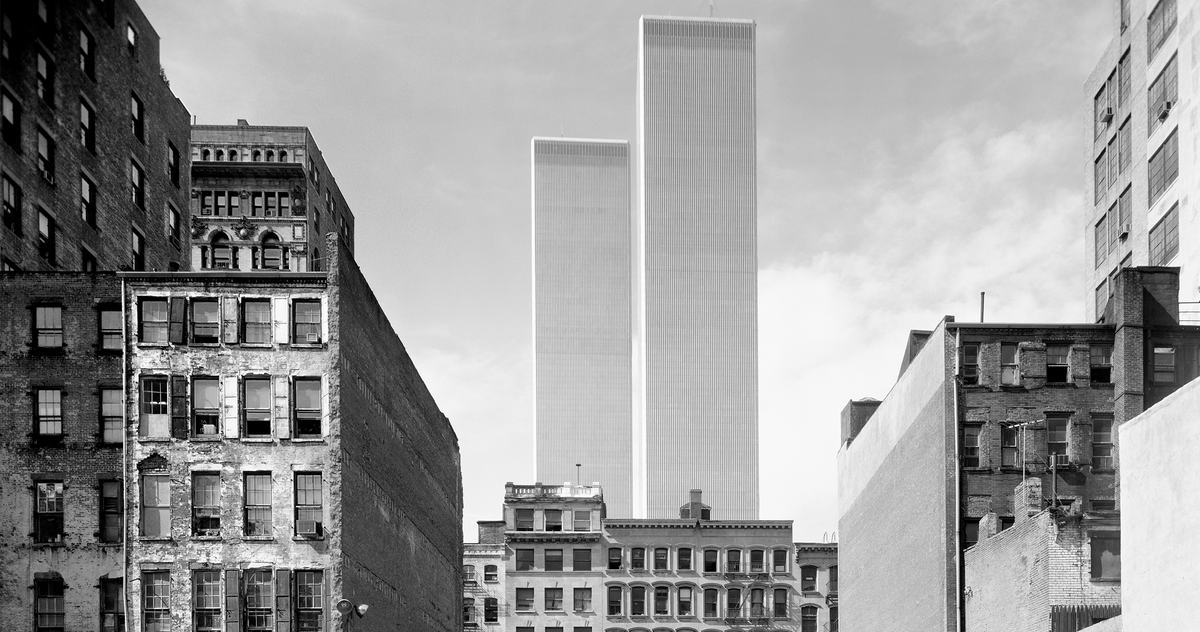
Baldwin Lee’s first body of photographic work documented a landmark that nobody expected to disappear. Cortlandt St. Photo: © Baldwin Lee. Courtesy Howard Greenberg Gallery and Hunters Point Press Cortlandt St. Photo: © Baldwin Lee. Courtesy Howard Greenberg Gallery and Hunters Point Press Baldwin Lee came to photographic renown pretty late in life, mostly for his in-close-and-intense pictures of small-town Black Southerners made in the 1980s and collected in an epic monograph in 2022. It took him a while to become someone who could make those photographs, he says, because he had been crushingly shy as a young person. ”I would turn red in the face anytime anything was about to happen,” he recalls, “and I set out to try to rid myself of this. I thought, as a photographer, one way to try would be to approach people to ask permission to make photographs of them. And to my surprise, almost nobody said ‘no.’” Once he broke through, the pictures began to really speak. As a young adult, though, he made an entirely separate body of work, one that didn’t require as much personal interaction: From 1975, the year he graduated from Yale, until 1979, Lee photographed the downtown streetscapes of lower Manhattan, within walking distance of where he’d grown up in Chinatown as the son of a noodle manufacturer. These are highly composed photographs, made with a large-format 4x5 camera on a tripod. In them, again and again, peering over the shoulders of the dirty loft buildings and overscale Cadillac Eldorados, the twin towers of the World Trade Center appear. The towers were new then—”I remember the excavation of the foundation, and had always been just really fascinated and impressed with them,” Lee says—and their reflective metallic sheathing reads almost pure white in the photographs, doubly so against the sootiness of their beat-down neighbors. They reflect a basic principle of museum display: Putting something aged and grimy against something crisp and new creates drama. Mulberry St. and Park St. Photo: © Baldwin Lee. Courtesy Howard Greenberg Gallery and Hunters Point Press Worth St. Photo: © Baldwin Lee. Courtesy Howard Greenberg Gallery and Hunters Point Press Why do the towers appear in so many of these pictures? “I can draw the analogy to photographing people,” Lee says. “I mean, there are countless people from whom you would pick somebody to pose, and it’s exactly the same for buildings — and certain buildings just stand out. They have a personality or some other special quality about them, and the Trade Center buildings had this for me.” Even though a lot of people used to disdain them as architecture, I remark. “Very true — they were the butt of jokes all over. People would refer to them as two silver butter sticks. And it was totally unfair.” Also of questionable fairness: the reception he first got for these pictures. Some of them were made for his master’s project at Yale. That year, the great Irving Penn was among the visiting judges invited to critique the images each student put up on the wall. “Irving Penn was looking at the audience and listening to what each student was saying and would then turn and very, very carefully look at each picture for several minutes. He knew what the rewards of looking were,” Lee recalls. “All of mine were of New York. And after he spent this time looking, he turned to the people in the room and said, ‘Uh, these are dead.’” Lee lets out a laugh as he says it, and I suggest that even geniuses get things wrong sometimes. “I wear that as a badge of honor,” he says. “You know, they got a rise out of Irving Penn!” Fifty years after they were made and 25 years after the catastrophe, these pictures take on a secondary layer of meaning because they document a city that (even aside from the destroyed towers) is so vastly changed. “New York was not the most pleasant place in the world then — dirty, trash everywhere. It just looked like another run-down town that was on the way out.” Was he conscious of recording a very specific time and place? Not really, he says: “You document what’s in front of you, and I tried to make honest, straightforward pictures of that.” Manhattan from Brooklyn. Photo: © Baldwin Lee. Courtesy Howard Greenberg Gallery and Hunters Point Press Park Row. Photo: © Baldwin Lee. Courtesy Howard Greenberg Gallery and Hunters Point Press Lee’s biggest influences, he’s frequently said, were Minor White and Walker Evans, under whom he studied as an undergraduate and then a grad student. If I see a direct predecessor here, though, it’s the “Changing New York” series that Berenice Abbott made in the 1930s. In those pictures, she often sets the weathered 19th-century city against the rising Art Deco one; Lee, a generation later, was shooting virtually the same buildings in the foreground, by then fully decrepit, and an even more shimmery Oz rising in the background. I asked him about the correspondence there and he lit up: “Oh, Berenice Abbott is one of my heroes! Her series from high vantage points looking down—they’re among my favorite photographs. For some reason, her name has sort of receded from people’s consciousness, but that is a total injustice.” And their motivations were not dissimilar either: “What I was aiming to explore with the [Southern] portraits was the individuality and the presence of the people I asked to photograph. What I was looking for in the pictures of the World Trade Center was entirely different: I wanted the photographs to be about a space that was extremely ordinary, where all the angles were right angles and the light was precise. I wanted each picture to be the definitive picture of the towers.” So definitive, he says, that it’d be the type of picture that might show up on Wikipedia. Also, those big four-by-five-inch negatives reproduce magnificently, and because they were made with long tripod exposures, they are sharp as anything. “They make really wonderful prints,” Lee says, “and the upcoming show at the Greenberg Gallery will have four-by-five enlargements of them.” Four by five inches doesn’t sound big, I say, puzzled. “No, feet!” he replies. “I can’t wait to see them.” Worth St. Photo: © Baldwin Lee. Courtesy Howard Greenberg Gallery and Hunters Point Press “Baldwin Lee: New York (1975–1979)” will be on view at Howard Greenberg Gallery from September 18 through October 31. When the Twin Towers Were New Your product is saved! You’ll receive emails when your saved products go on sale. Manage preferences.
When the Twin Towers Were New
Full Article
Original Source
Read the full article at Curbed →KhanList aggregates and links to publicly available news content. We do not host full articles from third-party sources. Always verify important information with original sources.