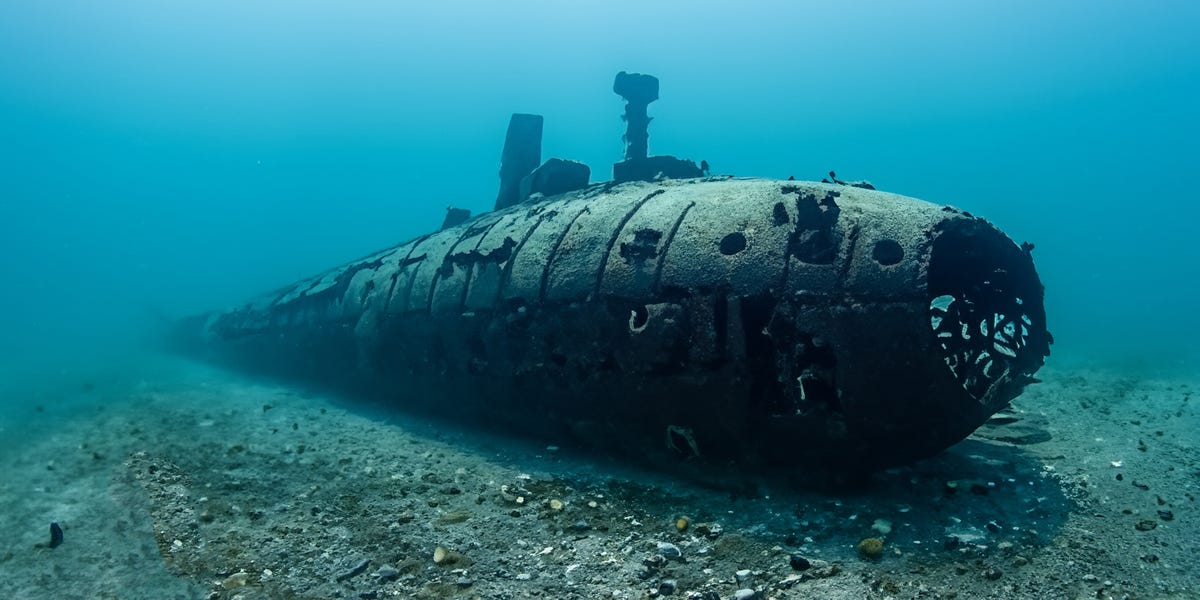
3 min readHere’s what you’ll learn when you read this story:The H.L. Hunley, a Confederate submarine that sank a Union warship, was lost at sea for over 100 years.When the sunken vessel was discovered, the Hunley’s crew members were eerily seated at their stations, puzzling researchers.A 2017 study revealed that the crew likely died instantly from their own torpedo’s shock wave, solving the mystery.It took more than 100 years to find the historic, sunken H.L. Hunley.The submarine, launched by the Confederate Army in the last full year of the Civil War, made history when it became the first combat submarine to ever sink a warship. But on the same night when the H.L. Hunley’s torpedo sent the USS Housatonic, along with two of its officers and three of its enlisted crew, to a watery grave in the depths of Charleston Harbor in South Carolina, the Hunley itself—along with its eight-man crew—was also claimed by the waves.The remains of those eight men, including Lieutenant George E. Dixon, would remain sealed in the wrought-iron casket that was the H.L. Hunley for over a century. In 1995, a civilian search effort by author Clive Cussler’s non-profit the National Underwater and Marine Agency (NUMA), led by underwater archaeologist Ralph Wilbanks, finally located the sunken submarine. It would take another five years for the vessel to be raised from its watery grave.When the sub finally resurfaced in the last months of the 20th century, the crewmen’s bodies told the story of their final moments; it was unlike anything the excavators could have imagined.U.S. Naval History and Heritage CommandInboard profile and plan drawings from sketches by W.A. Alexander, who directed the Hunley’s construction“Accounts of the Hunley’s sinking had assumed horrific scenes of the men trying to claw their way through the thick iron hatches, or huddled in the fetal position beneath the crew bench in their agony,” a 2020 article in Smithsonian Magazine noted. “Sinkings of modern submarines have always resulted in the discovery of the dead clustered near the exits, the result of desperate efforts to escape the cold metal coffins.”But the men aboard the Hunley evidently made no such effort. They were, instead, seemingly serene. “Each man was still seated peacefully at his station,” Smithsonian Magazine observed.What could explain this bizarre, moribund arrangement? In a letter written just 17 days before his death, Lt. Dixon called his “splendid crew” the “best I think I ever seen,” but could even the best of men knowingly sit at their stations and simply accept the aqueous grip of oblivion? Why did none of these eight men make even an attempt at an escape?It would take another 17 years before someone answered that question.U.S. Naval History and Heritage CommandMidships section drawing from sketches by W.A. Alexander, who directed the Hunley’s constructionIn a study published in PLOS One in 2017, a team of researchers affiliated with Duke University announced that they had solved the mystery of the H.L. Hunley’s crew. In their estimation, the men aboard the Hunley may have been felled by the very same weapon they deployed to take down the USS Housatonic. The torpedo they used to sink the ship was not “launched” the way we in the modern world envision submarine warfare. Instead, the 135-lb. black powder torpedo was attached to a pole 16 feet from the Hunley’s own bow.By constructing a 1/6th scale model of the Hunley, graduate student Rachel M. Lance was able to measure “black powder and shock tube explosions underwater” as well as “propagation of blasts through a model ship hull.” The data she and the team gathered, in tandem with archival experimental data, allowed them to determine what exactly had killed the Hunley’s crew. When the torpedo that felled the Housatonic exploded, it sent a secondary blast wave through the Hunley, causing a “flexion of the ship hull” on the submarine. By the team’s calculations, that blast wave was of such a magnitude that the chances of survival were “less than 16% for each crew member.”It should be noted, however, that not all interested parties agree with this study’s conclusion. Neither the Navy, nor the organizations involved with the Hunley’s conservation, have endorsed the lung blast hypothesis as the definitive cause of death for the men aboard the vessel.However, if the study’s lung blast theory is to be believed, then the reason that none of the men tried to escape the sinking submarine is that none of them were alive to know that they were sinking. They died, as they say, with their boots on, having just made naval history.Michale Natale is a News Editor for the Hearst Enthusiast Group. As a writer and researcher, he has produced written and audio-visual content for more than fifteen years, spanning historical periods from the dawn of early man to the Golden Age of Hollywood. His stories for the Enthusiast Group have involved coordinating with organizations like the National Parks Service and the Secret Service, and travelling to notable historical sites and archaeological digs, from excavations of America’ earliest colonies to the former homes of Edgar Allan Poe.
When the Navy Recovered This Sunken Submarine, the Crew Was Dead. Why Were They Just Sitting There?
Full Article
Original Source
Read the full article at Popularmechanics →KhanList aggregates and links to publicly available news content. We do not host full articles from third-party sources. Always verify important information with original sources.