
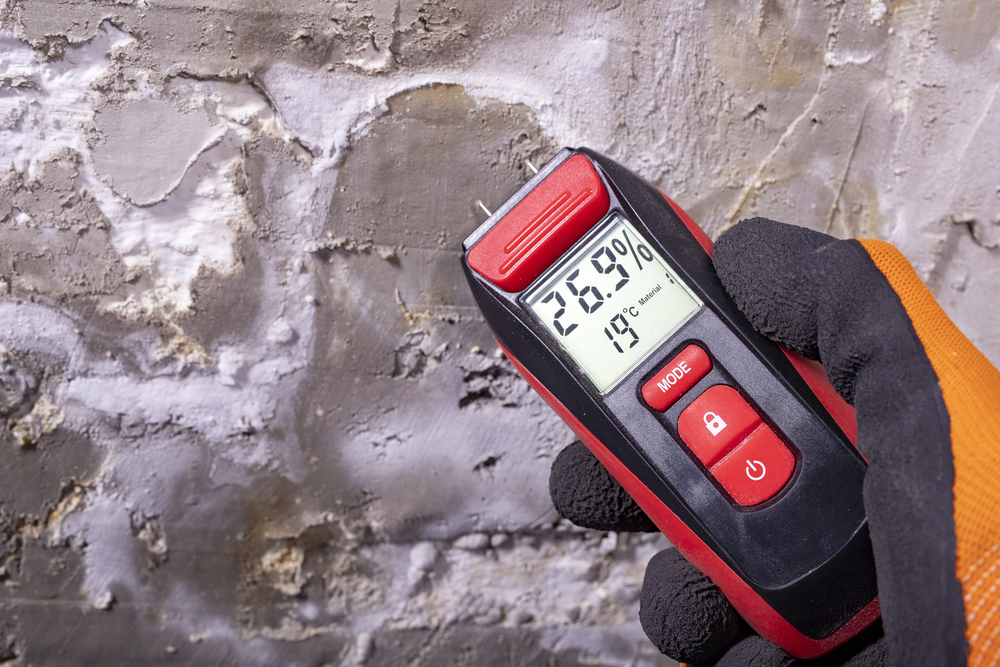
Property insurance claim reviewers and engineers frequently encounter a forensic anomaly: A mitigation contractor reports a roof leak, logs ceiling moisture readings of 40%, 60%, or 80%, drills a line of holes into the drywall, and runs mechanical drying equipment for several days. An invoice follows. However, a subsequent engineering or claims inspection reveals a ceiling that is perfectly flat and firm. An attic inspection shows clean back-paper, dry insulation, and roof sheathing without water staining. These two accounts are mutually exclusive. Gypsum board is a well-studied material with predictable water-response mechanics. Drywall that is genuinely wet suffers severe strength loss, sags under gravity, and develops permanent staining patterns. Gypsum wall board or ceiling board exhibiting none of these physical changes was never wet to the degree claimed. Physical Structure and Water Damage Mechanisms Gypsum wallboard is a composite system relying on two distinct structural components: a crystalline core and paper face sheets. Liquid water weakens both. The core consists of set gypsum—calcium sulfate dihydrate formed when calcined gypsum reacts with water to recrystallize into an interlocking mesh of acicular (needle-shaped) crystals. Flexural stiffness and compressive strength derive almost entirely from microscopic contact points between these crystals. Materials journal. (Ranachowski et al., 2020). Click to enlarge chart. Liquid water damages this structure in two ways: Dissolution and Lubrication: Water filling the pore network partially dissolves and lubricates crystal contact points, sharply reducing shear and compressive capacity. Pressure-Solution Creep: Research by the Fraunhofer Institute for Silicate Research demonstrated that under sustained mechanical load, wet gypsum experiences moisture-triggered pressure-solution creep. Gypsum dissolves at high-stress contact points and redeposits in low-stress voids, causing slow, permanent deformation. Because ceiling panels are under continuous gravitational load, creep causes immediate and progressive sagging. Water attacks the paper facing on drywall by: Delamination: Absorbed water causes multi-ply paper layers to separate. Core-to-paper bond failure: Liquid passing through the interface destroys the chemical and mechanical bond between the core and paper. Tensile loss: Saturated paper retains only a fraction of its dry tensile strength. When core stiffness and paper tension are compromised simultaneously, the ceiling assembly loses its ability to span framing joists. Physical Meaning of Moisture Levels Sound gypsum board in a conditioned indoor environment maintains an equivalent moisture content (EMC) well below 1% by weight as a baseline. Having a control value to compare tested areas is the key to determine if damage occurred. Baseline equilibrium: Measurements with a Delmhorst Instrument Co. moisture meter show an EMC of approximately 0.3% at 50% relative humidity (RH), rising only to 0.4%–0.5% at 80%–85% RH. Even in unconditioned humid environments, intact board remains under 1.0%. A reading of 2.0% is multiple times normal; a reading of 40% represents a free-water condition roughly 100 times baseline. Strength degradation curves: Laboratory testing published in Materials (Ranachowski et al., 2020) demonstrated a 70% to 80% reduction in three-point bending strength upon wetting. Triaxial compression testing at Duke University (Shi, 2025) confirmed progressive peak-strength failure at 10%, 20%, and 40% pore saturation levels. Across literature, fully wet set gypsum retains only one-third to one-half of its dry compressive strength. Mechanics of Ceiling Deflection and Forensic Evidence Ceilings are the most moisture-sensitive application of drywall because gravity imposes a continuous dead load. Gypsum Association guidelines (e.g., GA-216) limit standard half-inch board to 16-inch framing spans when water-based texture is applied, precisely because even the temporary moisture in a spray texture coat can induce permanent sag. ASTM C473 incorporates a humidified-deflection test to evaluate sag resistance. If the minimal water content of a texture coat causes measurable deflection, a ceiling panel holding water by weight will sag dramatically under its own weight. Instrument Mechanics and Pitfalls Moisture meters and thermal imaging cameras are diagnostic screening tools. Neither directly measures water percentage in drywall unless calibrated, referenced, and physically verified. Thermal imagery does not give a definitive answer to moisture application, only a temperature difference. Restoration firms’ meters frequently default to relative scales (0 to 100 or 0 to 300). A reading of “80” on a relative scale indicates 80 arbitrary units—not 80% moisture content by weight. Utilizing wood-scale modes on gypsum yields false high readings. Logs lacking meter model numbers, modes, and scales are scientifically uninterpretable. Pinless (capacitance) meters evaluate an electromagnetic field extending up to an inch into the substrate. On a ceiling, these meters read structural joists, steel truss plates, electrical wiring, foil backing, corner bead, and dense textured paint. High dielectric readings frequently reflect sub-surface metal or wood and not liquid water. Pin meters measure electrical resistance across two contact points. Contact resistance shifts significantly in the presence of surface salts, efflorescence, metallic paint pigments, or surface contamination. The IICRC S500 standard requires establishing an unaffected dry standard or taking baseline readings on identical, unaffected material within the same structure using identical meter settings. Without a dry standard, a high reading cannot be classified as elevated. Thermal Imaging Limitations Infrared cameras register surface apparent temperature (radiance), not moisture. While evaporative cooling makes wet drywall appear cooler, identical thermal patterns are created by: Missing, compressed, or displaced attic insulation. Thermal bridging through ceiling joists and fasteners. Exfiltration/infiltration at ceiling penetrations and fixtures. Cold HVAC supply air washing across ceiling surfaces. Variations in surface emissivity (paint sheen, texture differences). In warm climates where attic temperatures exceed 120°F, insulation voids create sharp thermal anomalies on infrared cameras that can mirror moisture patterns. Water damage application to gypsum board should never be based only on thermal imagery. Case Study Analysis: Central Florida Windstorm Claim Author’s photograph showing access holes drilled in the ceiling, but no water damage was visible. Click to enlarge Following a reported windstorm at a single-story residence in central Florida, a mitigation contractor identified allegedly elevated (78%) moisture conditions at ceiling areas within the kitchen-dining area, living room, and bedroom. The contractor drilled three access holes in each room, installed cavity-drying equipment, and operated air movers, air scrubbers, and dehumidifiers for approximately 72 hours. The contractor’s daily logs reflected substantial reductions in reported readings across all three areas during that period. Those readings cannot be interpreted as moisture content by weight without complete documentation of the instrument manufacturer and model, operating mode, material scale, calibration status, probe configuration, scan depth, and readings from comparable unaffected ceiling areas. If the reported initial values represented actual moisture content by weight, the drywall would have been at or beyond a saturated condition. Ceiling panels exposed to that degree of water would be expected to exhibit substantial physical evidence, including staining, paper-face deterioration, softened or friable gypsum core, visible deflection between framing members, fastener distress, and delamination. The documented physical conditions did not support that interpretation. Inspection found the ceilings to be flat, firm, and free of visible water staining. Gypsum exposed at the drilled openings was clean, dry, and powdery. Attic-side examination found dry and unstained back paper, with no corresponding moisture effects in the insulation, roof sheathing, or framing. Insulation displacement was observed above locations associated with thermal anomalies, providing a non-moisture explanation for those temperature differences. During the inspection it was found that the attic did not have any indication of moisture application. The discoloration on the ceiling appeared to be spray paint. A similar condition was found at the hole in the kitchen with no staining or discoloration. The reported rate of drying also was inconsistent with a heavily wetted painted gypsum-board ceiling assembly. A ceiling allegedly containing extremely high moisture levels would not ordinarily lose most of that moisture within one day through painted face paper, particularly without direct attic-side exposure or specialized high-capacity drying conditions. Further, the reported indoor humidity conditions did not reflect the substantial moisture release that would be expected if multiple ceiling areas had been saturated and actively evaporating. Based on the totality of the evidence, the physical observations did not support a conclusion that the ceiling drywall sustained liquid-water damage. The reported meter values, without complete instrument documentation and a contemporaneous unaffected dry reference standard, were insufficient to establish elevated moisture or quantify moisture content in gypsum board. The only confirmed physical alteration to the ceiling panels was the access drilling performed during the mitigation work Case conclusion: The ceiling drywall was never wetted. The physical damage to the ceilings was limited to the invasive drill holes created by the mitigation equipment installation itself. Forensic Checklist for Ceiling Moisture Claims When evaluating disputed ceiling moisture claims, physical evidence should take precedence over uncalibrated instrument data. Where disputes persist, laboratory testing under ASTM C473 (core hardness and flexural strength testing comparing core samples from claimed wet areas against known dry controls) provides definitive evidence of water damage. A control value in each area should be taken and documented. This value is in an area with the similar site conditions but dry. For example, a ceiling drywall moisture meter reading at the claimed moisture damage and in a different location of the room far enough away that it would not have been impacted by any leaks or moisture application. The control gives a baseline to compare a drywall at the damage area to determine the percent increase over dry areas. Conclusion Gypsum drywall acts as its own physical record. A ceiling assembly exposed to liquid water retains indelible structural and visual evidence: core softening, permanent creep deflection, and solute staining. An unstained, flat, and firm ceiling yielding a meter reading of “40%” or higher is not proof of water intrusion and it is usually proof of an erroneous, uncalibrated, or misapplied measurement. Forensic evaluations must prioritize physical evidence and basic materials science over unverified instrument readouts. A common practice seen in insurance claims is to claim damage without any real substantiated damage, then send the bill and demand payment for the dry-out services that were not needed. The problem is the lack of regulation and fallout is the insurance industry gets the blame for not paying. The number of times holes are drilled in an undamaged area seems to be on the rise. Until standards are set, it will continue. The real harm is the homeowners are left with damage to the drywall of their home that requires repair. The holes were not needed. George Miles, a regular contributor to Insurance Journal, and Steve Syrcle are consulting engineers who have inspected properties and drafted reports in multiple insurance claims lawsuits.
When the Meter Says Wet but the Ceiling is Dry: A Guide for Adjusters and Inspectors
Full Article
Original Source
Read the full article at Insurancejournal →KhanList aggregates and links to publicly available news content. We do not host full articles from third-party sources. Always verify important information with original sources.