
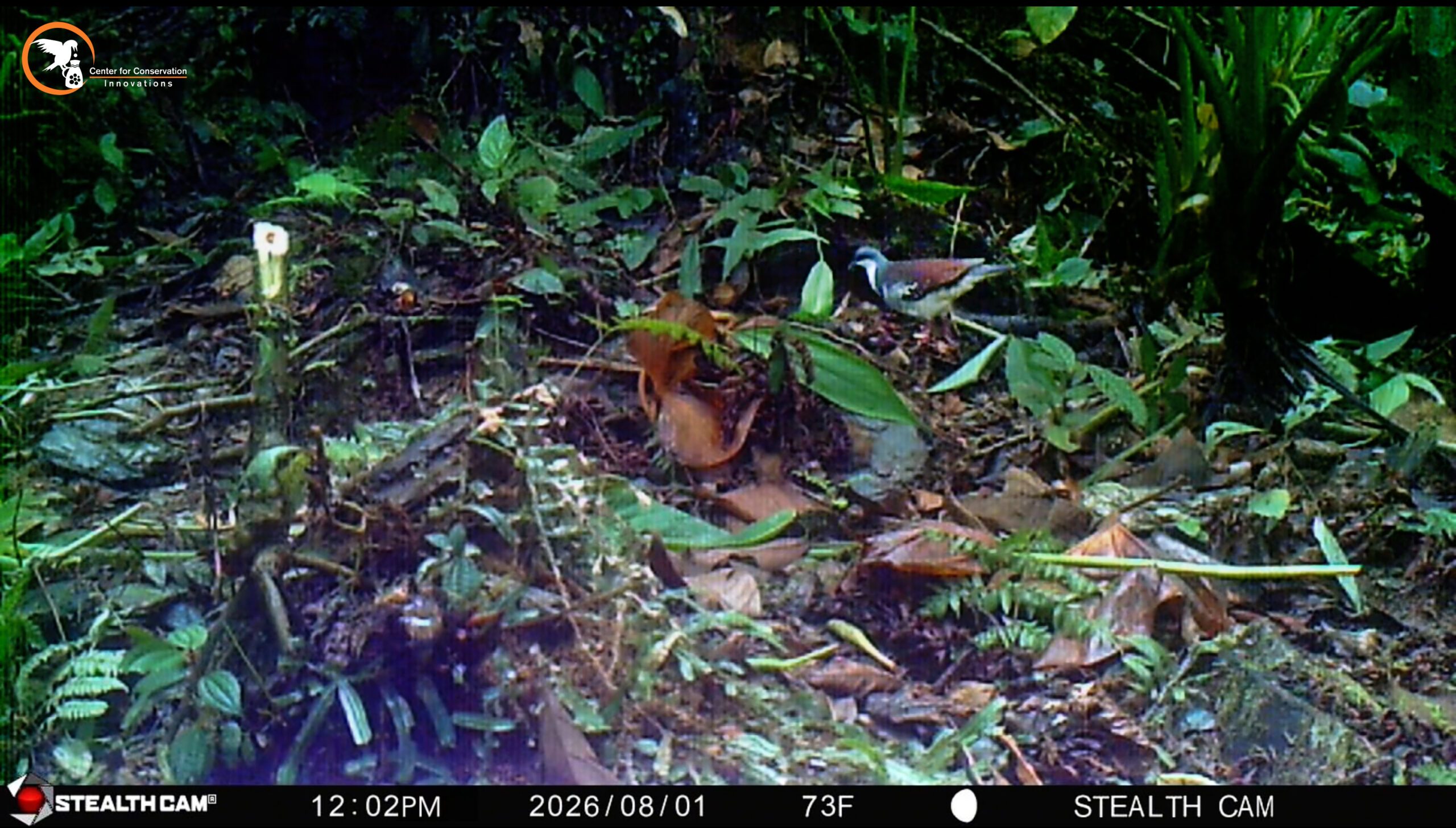
SIGHTED. The Mindoro bleeding-heart recorded in one of nine camera traps deployed in the forests of Mindoro. Center for Conservation Innovation The detection of the elusive Mindoro bleeding-heart twenty years later inspires hope and forebodes changing habitats A team set up nine camera traps in Mindoro to locate the critically endangered Mindoro bleeding-heart pigeon. After a week of fieldwork, they successfully recorded footage of the bird, which had not been seen since 2005, reigniting hope for its conservation. The bird's sighting at a higher elevation than usual highlights changing habitats, emphasizing the importance of protecting both the species and the ecological systems that support local communities. This is AI-generated. Read the article for full context. Report any errors. MANILA, Philippines – The team set up nine camera traps in the forests of Mindoro last August. They determined the locations of the camera traps based on knowledge of the Mindoro bleeding-heart’s habitat, behavior, and as well as what the Iraya Mangyan knew about the endemic bird’s previous whereabouts. “We combined historical data and then the biophysical and bioclimatic layers of Mindoro Island to create a [species distribution] model,” John Bibar, a researcher from the Center for Conservation Innovation (CCIPH) who was part of the field team, explained. “When we got the result and zoomed in, the area was an ancestral domain in the northern part,” Bibar said. Bibar and the rest of the team spent around two days scouring the forests of Mindoro to install the camera traps. They conducted transect walks and used bioacoustic devices. On the last day of their week-long fieldwork, the team, composed of Manila-based conservationists and Iraya Mangyan patrollers, checked the recorded footage. They had moderate hopes. It was the first time they had deployed the camera traps. Yet, there it was. In the footage from the last camera they checked. The Mindoro bleeding-heart, raising its right wing. A hello to the community of birders and conservationists it had inspired to wonder for 20 years. “We said, ‘It looks like it’s saying hello to us,’” said Jennica Masigan, conservation program director of CCIPH. For Masigan, the search for the Mindoro bleeding-heart was personal. FIELD. The expedition team at work in the forests of Mindoro last August. Photo courtesy of Center for Conservation Innovation Masigan is a wildlife biologist whose curiosity about the bird began when she started doing field research. She would often hear from others how elusive and rare the Mindoro bleeding-heart was. “But it wasn’t until I started leading field expeditions that I developed a passion for looking for this bird,” said Masigan. The last confirmed sighting of the bird was in 2005, inside the Siburan Forest Reserve in Occidental Mindoro. The ground-dwelling pigeon is critically endangered. Its name comes from the distinct red patch on its chest. Sightings of rare species are a cause for celebration for a community that has built a cause around them. More so among birders, a community of enthusiasts who travel long distances for the chance, however uncertain, to glimpse a rare bird. Birdwatchers help monitor the status of birds by sharing sightings within the community and documenting the species they spot. CAPTURED. The endemic Mindoro bleeding-heart (right) photographed twenty years since its last documentation. It was detected upland which was unusual as it was more known to have resided in lower elevations. Photo courtesy of Center for Conservation Innovation CAUGHT. Photos of the Mindoro bleeding-heart at the Sablayan Prison and Penal Farm in 2005, taken by Don Roberson. Courtesy of ebird Conservationists have launched a global effort listing “lost” birds in a bid to find and document them. The global initiative Search for Lost Birds defines a lost species as one “not confirmed alive by photographic, audio or genetic information for over 10 years in the wild and has no ex situ population under human care.” Before CCIPH was able to record the Mindoro bleeding-heart last August, the bird was among those considered lost. “Every year that passed without a trace of the Mindoro bleeding-heart pushed the conversation closer to that edge, whether continuing to search was still justified or whether it was time to let go,” the organization’s researchers wrote. “The bird, it turns out, was not ready to let go.” LOST. A screenshot from Search for Lost Birds, a platform that lists down lost birds across the world. Listed among them are the Mindoro bleeding-heart (Gallicolumba platenae) and the Sulu bleeding-heart (Gallicolumba menagei). Researchers say the pigeon’s reemergence should be understood in the context of changing habitats. The bird was traditionally known as a lowland species. But this particular Mindoro bleeding-heart appeared in front of a camera trap installed 900 meters above sea level. CCIPH takes note of the “warning.” Species don’t leave their habitats, researchers said, “unless something about that habitat has stopped working for them.” In 2020, CCIPH created the Mindoro Forest and Biodiversity Conservation Program. The conservation work involves the Indigenous Iraya Mangyan, as much of it covers their ancestral domain. “The Mindoro bleeding-heart, it’s part of a forest that also supports people,” said Masigan. She mentioned that a protected forest is “shared value” between conservationists and the indigenous people who live in these lands. “When we protect that bleeding heart, we are also protecting the ecological system that supports human well-being.” – Rappler.com Quotes translated to English for brevity. How does this make you feel? Loading
When the lost Mindoro bleeding-heart was finally photographed
Full Article
Original Source
Read the full article at Rappler →KhanList aggregates and links to publicly available news content. We do not host full articles from third-party sources. Always verify important information with original sources.