
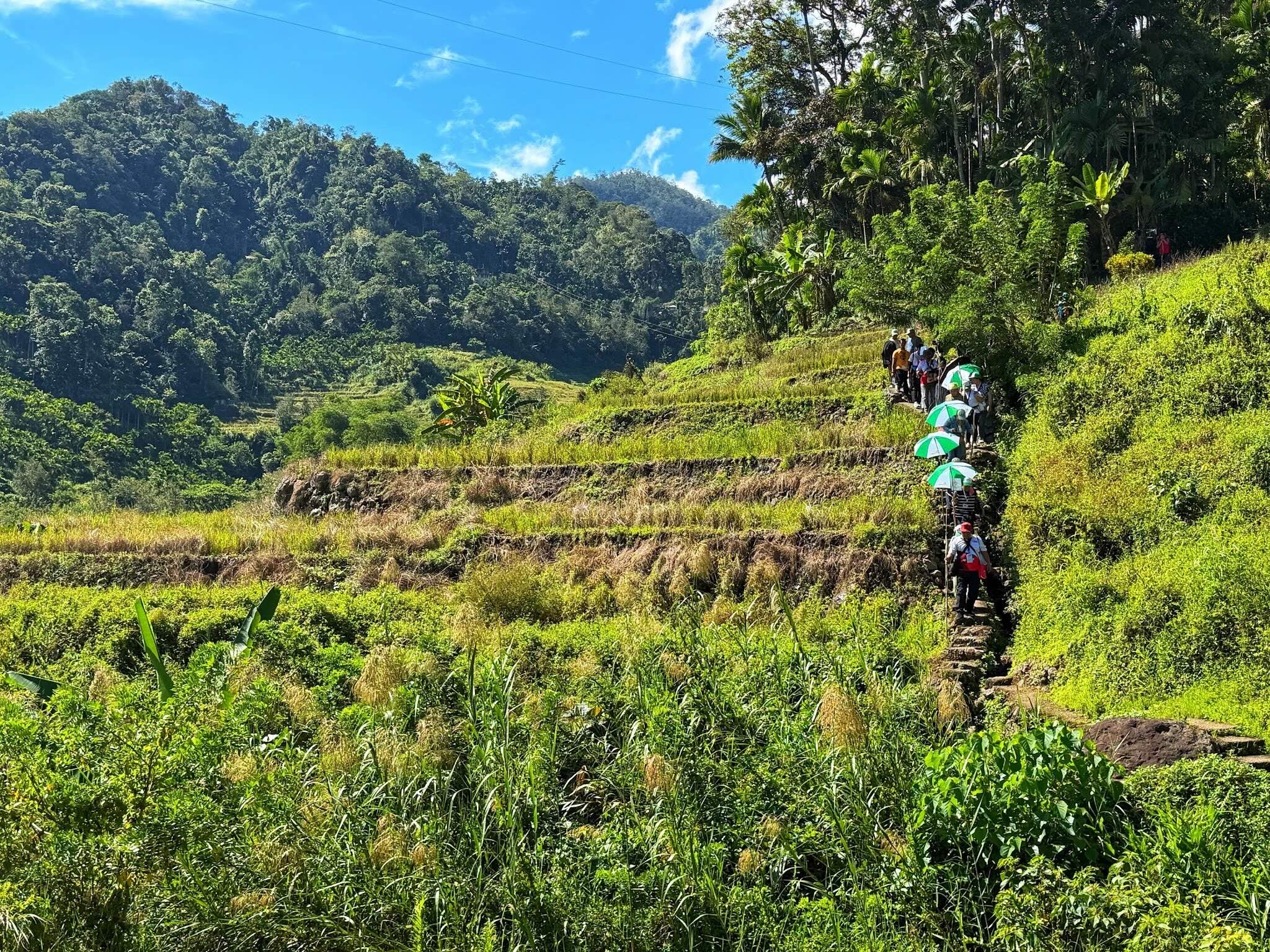
IFUGAO, Philippines – Nagacadan was not wearing its postcard face when we arrived. The terraces were not the bright green most visitors know from tourism posters. Some paddies were brown, others held shallow water, and several had already been cleared after harvest. For someone visiting Kiangan town for the first time, it was not quite the picture I had carried in my head. But the longer we stayed, the more the landscape made sense. Rice in Nagacadan is traditionally planted once a year. By October, much of the area is between harvest and the next planting cycle, with paddies resting or being prepared for planting again. What looked bare was not neglected land. It was farmland doing what farmland does. QUIET FIELDS. Nagacadan Rice Terraces in Kiangan, Ifugao, after harvest. All photos by Mia Magdalena Fokno/Rappler We had come as part of the Discover More to Love Homecoming Caravan in the Cordilleras. Community guides led us down into the terraces, across streams and the river that cuts through the valley, and along narrow paths between paddies. Nagacadan is one of the five clusters that make up the UNESCO World Heritage Site known as the Rice Terraces of the Philippine Cordilleras. Its form is striking from the ground, with two ascending rows of terraces facing each other across the river. From a viewpoint, the terraces can look almost sculpted. Walking among them changes the scale. You begin to notice irrigation, soil, stone walls, paddies at different stages, houses, granaries, and the ordinary work needed to keep the whole system alive. The terraces are not simply a view. They are farms. A first-time guide One of the people walking with us was Johntrey “Dandan” Dinamling. He grew up around the landscape we had traveled to see, but that morning was also a first for him. “I am Dandan Dinamling, and I am a local tour guide here in Nagacadan,” he told us in a mix of Filipino and English, nervous but smiling. “It was my first time to share my knowledge about our village.” Dandan had also put school on hold. He stayed home to help with farming and, in the process, began learning how to guide visitors through a place he had known all his life. He talked about the fields, heirloom rice, irrigation, traditional practices, and the need to preserve what remains. Sometimes he paused to search for a word. Sometimes people nearby helped him explain. That did not make his story weaker. It made it more honest. Dandan was not reciting a polished tourism spiel. He was trying to explain his own village to strangers, turning things familiar to him into something we could understand. “I experienced farming,” he said simply, before talking about the rice, irrigation, and the work needed to keep the terraces productive. For him, farming was not heritage in the abstract. It was work he had done with his own hands. SHARING. Johntrey Dinamling, a young local guide from Nagacadan, shares what he knows about the terraces, heirloom rice, irrigation and farming. Now, guiding gives him another way to stay close to the land while helping outsiders understand why it matters. He spoke about wanting more visitors to come to Nagacadan, not simply for the scenery, but because tourism could also provide a livelihood and give people more reasons to stay connected to the community. That matters in a place where the future of the terraces depends not only on conservation projects but also on people willing to keep farming, maintain irrigation, repair terrace walls, and pass on knowledge that cannot be learned from a brochure. Dandan, in that sense, was part of the story of Nagacadan itself. Put down the ladder Before we entered an Ifugao house, our guides began singing. Those among us who knew the song joined in. “Itetem ta humgopak.” (Put down the ladder so I can enter.) Traditional Ifugao houses are raised above the ground and accessed by a wooden ladder that can be removed. In the song, the request to lower it conveys the feeling of someone coming home after a long journey, asking to be let in, to rest, and to be welcomed. Then we climbed. TRADITIONAL HOUSE. A traditional Ifugao house in Nagacadan, raised above the ground and built around a way of life shaped by farming, family and community. Inside are reminders that heritage is not just something displayed but something lived. Nearby stood a traditional rice granary, another reminder of how deeply rice runs through life here. It is not only a crop. It has shaped work, storage, food, ritual, architecture, and the rhythm of the year. The song stayed with me because it made the place feel less like a heritage site and more like what it has always been: home. Kiangan welcomes you with food The night before, Kiangan Mayor Raldis Andrei Bulayungan had given us his own explanation of local hospitality. “We don’t simply say welcome,” he said. “We also ask, ‘Have you eaten?’” Even if visitors say they are already full, he joked, someone will probably insist that they eat again. He urged us to try bakkle, a local rice cake wrapped in banana leaves, and suggested that calories consumed while appreciating culture should count as cultural education. RICE CAKE. Bakkle, a traditional Ifugao rice cake wrapped in banana leaves, in Kiangan. Simple, filling, and very much part of the welcome. The laughter was easy, but his larger point was serious. Tourism, Bulayungan said, should not be only about “visiting beautiful places or taking photographs.” “It is about connecting with people, understanding their stories, appreciating their traditions, and creating friendships and memories that will last a lifetime,” he said. Visitors also mean income for homestays, guides, food producers, performers, and other small businesses in Kiangan. For a town that wants more people to visit without losing what makes it unique, that balance matters. Not always green There is a habit in travel of wanting places at their prettiest. We want the terraces green, the skies clear, and everything timed perfectly for the camera. Farming does not work that way. There is planting, growing, ripening, harvesting, clearing, preparation, and rest. A rice terrace is not failing when it turns brown. It is simply at another stage in the cycle. Along the trail, I also saw gumamela (hibiscus) growing beside the path. That took me straight back to childhood, when we used to crush the flowers and leaves, mix them with water, and make bubbles from the sticky liquid. You can travel to a UNESCO World Heritage Site expecting something grand, only to be ambushed by a flower you played with as a child. That may be one of the reasons Nagacadan stayed with me. It was not because it looked exactly as I expected, but because it did not. By the time we climbed out, the terraces no longer felt like a landscape, which I had come to check off a list. They had become a working place shaped by farmers, guides, families, water, soil, memory, and time. The green will return, and the rice will grow again. For now, Nagacadan is between seasons. And the land, like the people who depend on it, knows when it is time to work and when it is time to rest. – Rappler.com
When the Ifugao rice terraces rest
Full Article
Original Source
Read the full article at Rappler →KhanList aggregates and links to publicly available news content. We do not host full articles from third-party sources. Always verify important information with original sources.