
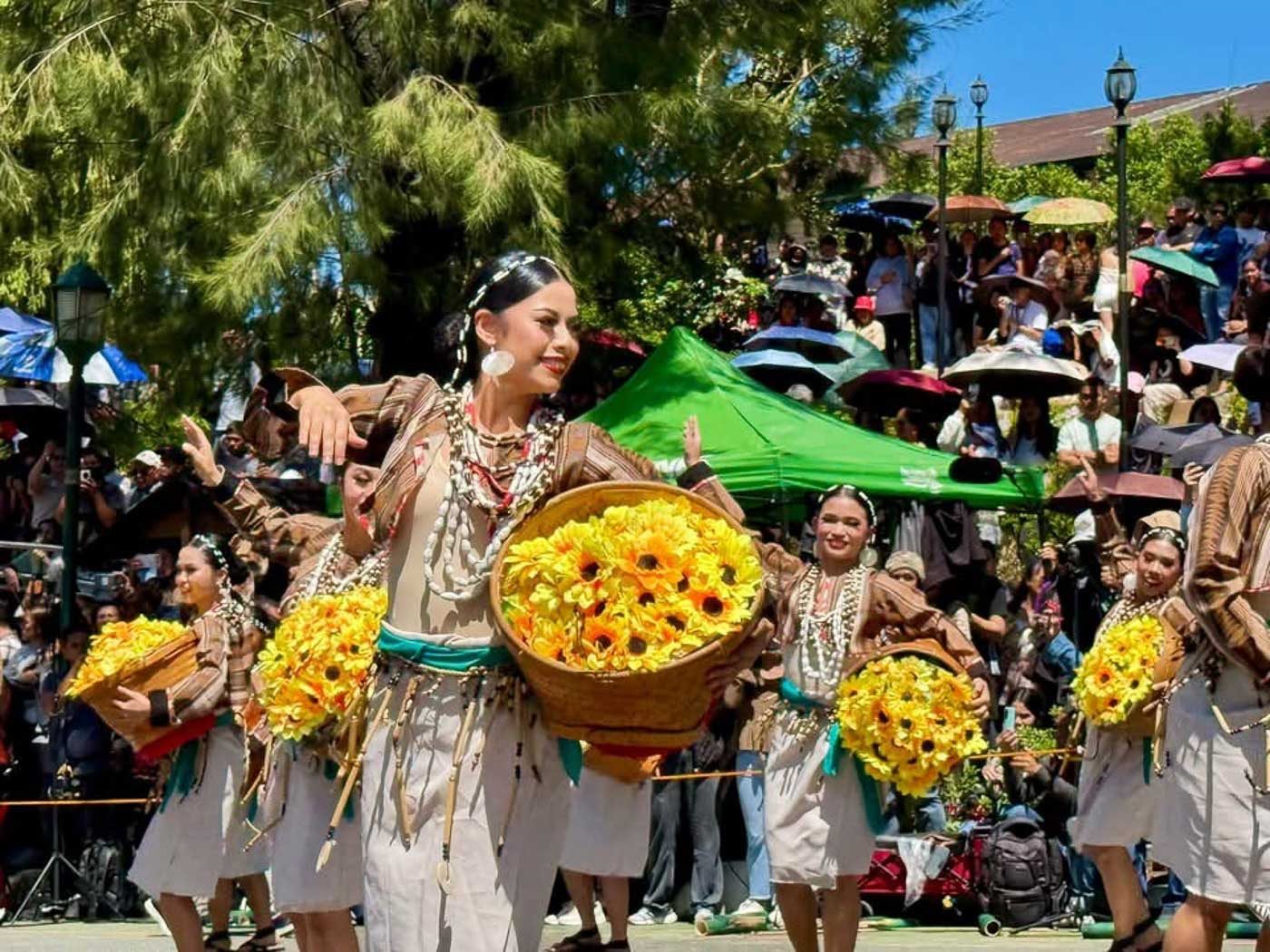
BAGUIO CITY, Philippines — The gongs came first, then the colors. Then came women balancing clay pots on their heads, men carrying shields and spears, dancers in woven skirts and feathered headgear, baskets of grain, bamboo, chants, prayer movements, and stories that usually live several mountain roads apart. On October 17, they all met on Session Road. The 5th Cordillera Festival of Festivals brought together the region’s six provinces and two cities, turning downtown Baguio into a living picture of the Cordillera’s diversity. BELIEF. Tabuk City performers present Gabbok, a traditional Kalinga thanksgiving associated with the birth of a first child, during the Cordillera Festival of Festivals in Baguio City on October 17, 2026. The performance used chants, music, dance, and scenes of family life to express gratitude, blessing, and hopes for the child’s future. Photo by Mia Magdalena Fokno/Rappler More than 500 performers joined the parade and cultural showcase, moving from the Melvin Jones area through Harrison Road, Magsaysay Avenue, and Session Road before gathering near Post Office Park. Abra brought the Kawayan Festival, while Apayao presented Say-am. Benguet was represented by Kabayan’s Bindiyan, Ifugao by Gotad ad Ifugao, Kalinga by Pasil’s Tachok-Salip, Mountain Province by Lang-ay featuring Pasuk-ey, Baguio by Panagbenga, and Tabuk City by Gabbok. It was easy to be dazzled. The more interesting part was figuring out what everyone was actually dancing about. TRADITION. fugao performers showcase Gotad ad Ifugao during the Cordillera Festival of Festivals 2026, bringing chants, traditional dances, agricultural symbols, and stories of ancestry, abundance, and community to Session Road. Photo by Mia Magdalena Fokno/Rappler Eight communities, eight ways of remembering Abra’s performance highlighted bamboo craftsmanship, resilience, and the intersection of the province’s lowland and Tingguian, or Itneg, traditions. Apayao’s Say-am was about thanksgiving, community, gongs, song, dance, and shared celebration. Kabayan’s Bindiyan brought the pulse of the gangsa and a circle dance tied to victory, thanksgiving, and communal life. Ifugao’s Gotad turned part of Session Road into a scene of ritual and daily life, with chants, rice, agricultural tools, baskets, woven objects, and movements tied to ancestry and abundance. Pasil’s Tachok-Salip featured gongs, chants, Banga dancing, and movements that spoke of joy, unity, and connection to the land. Mountain Province presented Lang-ay through Pasuk-ey, a Central Bontoc thanksgiving tradition rooted in Manerwap, an ancestral rain-calling ritual. Tabuk’s Gabbok celebrated the birth of a first child. Baguio’s Panagbenga performance drew on the story of Bangan, an Ibaloy woman whose offering to Kabunian is linked to the Benguet pine. Put all eight together and one thing becomes obvious. Mayor Benjamin Magalong said that even people who have lived in the region for years still have plenty to learn about one another. “We may be neighbors, but our customs, celebrations, languages, traditions, and histories are not all the same,” he said. Baguio itself, Magalong noted, has long been shaped by people from across the region who came to the city and eventually called it home. “So much of the region is already present here in our city,” he said. “And today, that becomes even more visible.” DANCE. Mountain Province performers present the Lang-ay Festival featuring Pasuk-ey: The Thanksgiving Summer Fest during the Cordillera Festival of Festivals 2026, bringing chants, prayer dances, and a Central Bontoc tradition rooted in Manerwap, an ancestral rain-calling ritual, to Session Road. Photo by Mia Magdalena Fokno/Rappler More than something pretty to photograph There were, naturally, phones everywhere. Session Road gave people plenty of reasons to point them. But the Festival of Festivals was never meant to be reduced to a reel of costumes, choreography, and pretty pictures. Department of Tourism (DOT) – Cordillera Regional Director Jovita Ganongan said the dances, garments, and traditions on display should be understood for what they are. “Our festivals are not merely performances of our culture,” she said. “They are expressions of our identity, living stories of our ancestors, and a legacy we must carry forward.” Ganongan also said the region’s cultural differences should not be mistaken for division. “We may be different in our traditions and expressions of culture, but we are united through our heritage and our pride in who we are,” she said. It is easy to turn culture into something decorative on a festival stage. But Cordillera traditions are tied to land, kinship, farming, ritual, memory, peace, conflict, survival, and belief. Strip away those meanings and what remains may still look beautiful, but it is no longer the whole story. Baguio Representative Mauricio Domogan said the harder part comes after the applause. “When the music subsides and the parade has passed, our responsibility to our heritage must endure,” he said. ABRA. Abra performers showcase the Abrenian Kawayan Festival during the Cordillera Festival of Festivals 2026, bringing bamboo traditions and the shared heritage of the province’s lowland and Tingguian or Itneg communities to Session Road. Photo by Mia Magdalena Fokno/Rappler Tourism without losing the plot The Festival of Festivals is also a tourism event, and nobody was pretending otherwise. DOT Secretary Judilyn Quiachon said the Cordillera has a distinct place in Philippine tourism because of its mountains, rice terraces, food, crafts, and living cultural traditions. But she said more visitors should not be the only goal. Tourism should create opportunities for local businesses, farmers, artisans, guides, accommodation providers, and other workers while respecting Indigenous cultures and protecting the environment. The point, she said, is for communities to “participate meaningfully in and benefit from tourism development.” Ganongan put it more plainly during an earlier briefing. Tourism should “entertain and educate, not exploit,” create livelihoods without sacrificing identity, and welcome visitors without pushing communities to the margins of their own stories. How do you invite people to look without turning culture into spectacle? How do you make traditions visible without reducing them to content? How do you welcome tourism without asking communities to perform a version of themselves that outsiders find easier to consume? But for that morning, the people carrying the traditions remained in the middle of the frame. TRADITION. Kalinga performers from Pasil showcase the Tachok-Salip Festival during the Cordillera Festival of Festivals 2026, bringing gongs, chants, Banga dancing, and traditions of celebration, unity, and connection to the land to Session Road. Photo by Mia Magdalena Fokno/Rappler A Cordillera too big for one photo Women moved in measured steps beneath foliage headdresses while young men struck gongs behind them. Rice was winnowed in the middle of Session Road. Farming tools became props but also reminders of where many of these traditions begin. Clay pots rose above dancers’ heads. Wooden bulul figures sat among grain and baskets. Men crouched low with gongs, then sprang back into movement. Elders danced beside students. Older women carried traditions beside younger performers learning to inherit them. Some spectators knew exactly what they were seeing. Others were encountering these practices for the first time. The festival did not ask Abra to look like Kalinga, Ifugao to move like Benguet, or Mountain Province to tell the same story as Apayao. Domogan summed it up in one line: “Identity does not require uniformity.” By noon, the gongs had quieted. Performers were resting, spectators were drifting away, and Session Road was slowly becoming Session Road again. After five years in Baguio, the Festival of Festivals will leave the city for the first time in 2027, with Kalinga set to host. – Rappler.com
When the Cordillera danced down Session Road
Full Article
Original Source
Read the full article at Rappler →KhanList aggregates and links to publicly available news content. We do not host full articles from third-party sources. Always verify important information with original sources.