
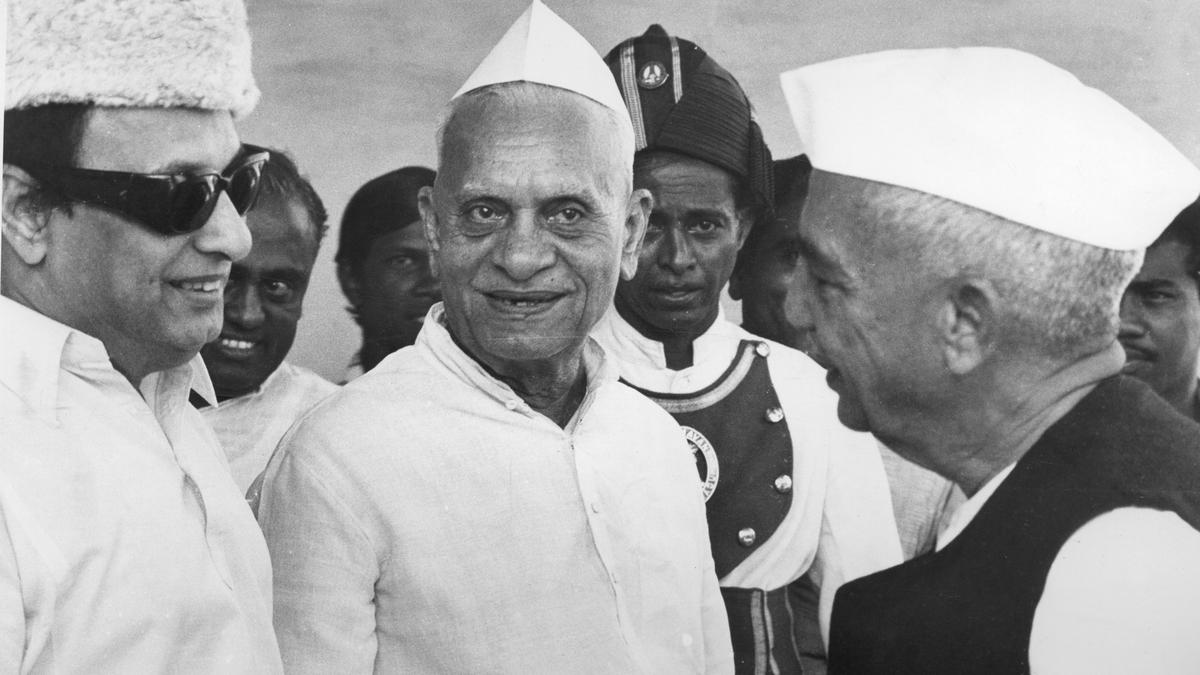
Governor K.K. Shah informed the Centre that the DMK government had, “by a series of acts of maladministration, corruption, and misuse of power for achieving partisan ends, set at nought all canons of justice and equity”. Here, he is receiving the Tamrapatra (given to freedom fighters) from Chief Minister M. Karunanidhi in Madras in October 1972. | Photo Credit: THE HINDU ARCHIVES One generation of people has grown in Tamil Nadu without experiencing what President’s Rule is. It was more than 33 years ago that the State last came under President’s Rule — January 30 to June 24, 1991.Also Read: During Emergency, DMK members were detained on vague grounds ‘against the spirit’ of MISA provisions: Shah CommissionSince 1952, Tamil Nadu came under President’s Rule on four occasions — January 31, 1976 to June 30, 1977; February 17, 1980 to June 9, 1980; January 30, 1988 to January 27, 1989; and January 30, 1991 to June 24, 1991. On all these occasions, the Ministries were removed from power with the dissolution of the Assembly.Chief Ministers dismissedBoth in 1976 and 1991, M. Karunanidhi of the DMK was the Chief Minister, while AIADMK founder M.G. Ramachandran and his widow Janaki Ramachandran were at the helm in 1980 and 1988. What was notable about MGR was that in 1980, eight other non-Congress (I) Chief Ministers along with him were dismissed. (The Congress(I) was the name of the Congress then). When elections to the nine State Assemblies were held a few months later, MGR was the only person to come back to power; in all other States, the Congress(I) captured power. In the case of Karunanidhi, it was after a year-long President’s Rule (1988-89) that he returned to power.In the four spells of President’s Rule, the State saw seven Governors, two of whom — Mohan Lal Sukhadia of Rajasthan and Surjit Singh Barnala of Punjab — were previously the Chief Ministers in their States. While Sukhadia had the distinction of having served as the Chief Minister for an uninterrupted tenure (1954 to 1971), Barnala was the Chief Minister for over one-and-a-half years (September 1985 to May 1987). Prabhudas Patwari, who was the Governor between April 1977 and October 1980, became the first to get dismissed by the President. Of the remaining four Governors, there were two former Union Ministers — K.K. Shah and Bhishma Narain Singh — and two former civil servants — S.L. Khurana and P.C. Alexander.At a low ebbWhen the Karunanidhi government was dismissed for the first time in January 1976, the DMK government’s ties with the Central government were at a low ebb. Governor Shah sent a report to the Centre, contending that the DMK government had, “by a series of acts of maladministration, corruption, and misuse of power for achieving partisan ends, set at nought all canons of justice and equity”. The Indira Gandhi government at the Centre had also constituted a commission of inquiry, headed by Supreme Court judge R.S. Sarkaria, to probe the allegations of corruption against the DMK government. In a few weeks, the Governor even conducted a conference of Collectors and police officers, impressing on them the importance of a “clean, impartial, efficient, upright and just administration”, The Hindu recorded in its editorial on March 1, 1976.In the third week of March, the State’s budget was presented in Parliament for the first time, as Tamil Nadu had never been under President’s Rule before. Interestingly, the budget presentation was made by the then Union Finance Minister, C. Subramaniam, who, as the Finance Minister of Tamil Nadu, presented the State budget for 10 years (1952-1962) before moving to the Centre.Committee of 60 MPsAnother key development then was Parliament’s approval to a Bill, conferring on the President the power of Tamil Nadu legislature. Under the legislation, there would be a committee of 60 MPs, whom the President might consult in making laws for the State. Piloting the Bill in the Lok Sabha, Deputy Minister for Home F. H. Mohsin said the proposed arrangement was in consonance with the Constitution and a “normal practice” as Parliament might not have time to deal with all the legislative measures. Senior leader of the Congress (Ruling or Requisitionists), O. V. Alagesan, who was the Minister of State in the Union government in the 1950s and 1960s, suggested that the committee of MPs act as “a [State] legislature for the time being”, reported The Hindu on March 19.‘Very pleasant experience’In an interaction with journalists in Tiruchi, Shah claimed that his experience in the last two-and-a-half months of President’s Rule was “very pleasant”, according to a report published by this newspaper on April 18. “I am struggling hard to tone up the administration. In two or three months, I hope I will restore the image of Tamil Nadu as the best-administered State.” Asked whether he still received petitions against DMK leaders, Shah replied: “Yes, anywhere between 100 and 200 petitions daily.” He added that “we have justified the dismissal of the DMK Ministry. Let us not go on talking about corruption. Let us now talk constructively on providing a better administration based on merit”.Three months later, one of his advisers, P. K. Dave, hailed “expedition in decision-making” as a major achievement of the five-month-old President’s Rule. Sukhadia, who succeeded Shah in June 1976, in a review of the administration’s performance on the eve of the completion of one year of President’s Rule, felt that political interference in the detailed functions of public administration had become so pervasive that it had become an almost accepted way of life. “But, after President’s Rule, we have endeavoured to correct this situation,” reported The Hindu on January 31, 1977.Before facing the Lok Sabha election in March 1977, the Congress government at the Centre got President’s Rule extended by another six months, a move that attracted criticism from the Opposition. Even the AIADMK’s P.A. Swaminathan, while supporting the government’s move, told the Rajya Sabha that President’s Rule was no substitute for a popular government.A few weeks later, the Janata Party dislodged the Congress from power. In late April 1977, Tamil Nadu saw the exit of Sukhadia and the entry of Patwari, who hailed from Gujarat. In late May, another adviser to the Governor, R. V. Subrahmanian, identified the sinking of over 8,500 drinking water borewells in villages as the “outstanding contribution” of President’s Rule. On June 30, 1977, MGR assumed charge as the Chief Minister, bringing to a close the first spell of President’s Rule.
When the Centre carried out a drive to ‘cleanse public life’ in Tamil Nadu
Full Article
Original Source
Read the full article at Thehindu →KhanList aggregates and links to publicly available news content. We do not host full articles from third-party sources. Always verify important information with original sources.