
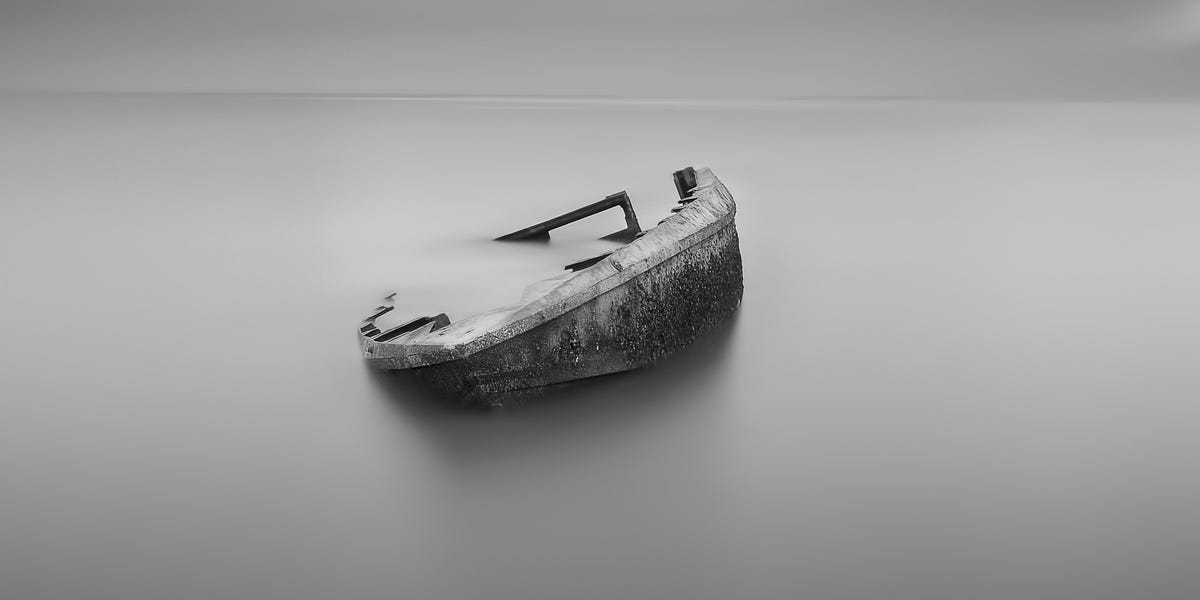
5 min readHere’s what you’ll learn when you read this story:The merchant vessel Joyita took off for what was supposed to be a 48-hour voyage from Samoa to the Tokelau Islands, but she never reached her destination.The supposedly unsinkable ship, which had been outfitted with cork to keep it afloat, was partly submerged when it was discovered by another merchant vessel.While the demise of Joyita came down to a corroded pipe that leaked along with malfunctioning engines, what took the lives of her crew and passengers is still a mystery.Dawn had barely broken over the South Pacific when Captain Gerald Douglas, at the helm of the merchant ship Tuvalu, eyed something unnatural in the distance. What appeared to be a ship was foundering just north of Fiji. Tilted heavily to one side with its windows shattered, it struggled to stay afloat as waves sloshed over the bow. There was no sign of human life.Douglas felt his own stomach sink as he approached and read the name on the hull of the obviously sinking ship: Joyita. The New Zealand Air Force had sent out a search and rescue mission to scour surrounding waters for this missing vessel several weeks earlier.Joyita had pulled out of Apia Harbor in Samoa on October 3, 1955. It made for the Tokelau Islands, manned by a crew of sixteen with nine passengers, and stocked with cargo and provisions. Then, everything and everyone on board vanished with no explanation. A journey that was supposed to take only 48 hours never reached its destination.Joyita was supposed to be an unsinkable ship (a designation that has historically never gone over too well). Built as a luxury yacht, its hull was made from cedar planks, and its holds were lined with cork for extra buoyancy, so it would always be lighter than the water beneath it. Hollywood director Roland West purchased the ship in 1931 and named it Joyita, meaning “little jewel” in Spanish, after his wife, Jewel Carmenille. The ship was later enlisted for service as a patrol boat, keeping watch on the seas around Pearl Harbor during World War II, and eventually became a fishing charter vessel after the war. Nothing was amiss with Joyita when it left Apia Harbor. Why it drifted out 600 miles west of where it was going confounded Douglas and his own crew.Besides broken windows, closer inspection of the shipwreck that refused to go down revealed there was also severe damage to Joyita’s wheelhouse. Power had been cut off. No cargo or other debris could be seen bobbing nearby. Investigating only deepened the mystery. For some reason, mattresses had been pushed up against the starboard engine, and the ship’s deck had been covered in a makeshift awning. Its lifeboats and dinghy had been lost. The last station the ship’s communications radio had been tuned to was international distress frequency 2182 kHz, but no broadcast was coming through. If a distress signal was transmitted, there would have been no response. It was especially eerie how all clocks were frozen at exactly 10:25 pm.David Wright, an Auckland academic whose book Joyita: Solving the Mystery was born from his fascination with the wreck, thinks he finally figured out what caused the tragedy 47 years after the empty ship was found. Wright was able to sink some of the rumors surrounding the Joyita. At the time of the abandoned ship’s discovery, the Cold War was getting underway, and rumors arose that forces from from a Soviet submarine had kidnapped the crew and passengers. Wright insists that visible damage to parts of the ship above the water is evidence against a submarine attack, and he saw no valid reason for murmurings of Soviets taking the crew hostage after the ship became waterlogged. Mutiny was unlikely. Rumors of the ship colliding with a fishing boat and the crew being murdered by rogue fishermen were also dismissed.Wright had read a newspaper report that further refuted any suspicions that the ship had been tampered with. It had apparently been traveling at night, since its electric lights and navigation lights were found switched on and the switches that controlled the navigation lights were difficult to manipulate. What was left were the inner workings of the ship. During World War II, some parts of Joyita had been replaced, and when one of the replacement pipes corroded and ended up constantly leaking, it went unnoticed. The fatal leak is thought to have begun after 9 pm and therefore wouldn’t have easily been detected after dark. As Wright sees it, the leak would have probably been easier to identify in daylight. He surmises that the crew must have attempted to send a distress message through the broken radio.The evidence makes it clear that the Joyita had been disintegrating for years. Possibly unbeknownst to the crew, both the port engine and starboard auxiliary engine had malfunctioned. Parts from one might have been used to keep the other running. But eventually the crew must have realized they were on a ship that had simply stopped working. With no sign of the Royal New Zealand Air Force Sunderland flying boat that would have rescued them if it received the signal, both crew and passengers most likely jumped on life rafts that were too small to hold them for long. The captain, Dusty Miller, would have grabbed his captain’s log, compass and other effects that were later reported missing from the engine room. After that, everyone was simply stranded in black waters.When the Royal New Zealand Air Force searched for signs of the passengers or crew, nothing surfaced. Their disappearance was reported as having no explanation despite all the evidence presented at an inquiry regarding the fate of the Joyita. Some crew members were regarded as missing instead of deceased. Few lifejackets had been taken on the ship, and it’s thought that those on board would have either drowned or possibly fallen victim to sharks. Whatever caused the deaths of those on board, the secret of Joyita’s demise is something the ocean is keeping to itself.Elizabeth Rayne is a creature who writes. Her work has appeared in Popular Mechanics, Ars Technica, SYFY WIRE, Space.com, Live Science, Den of Geek, Forbidden Futures and Collective Tales. She lurks right outside New York City with her parrot, Lestat. When not writing, she can be found drawing, playing the piano or shapeshifting.
When Sailors Found This Missing Ship, Every Clock Read 10:25—and Every Passenger Was Gone. Where Did They Go?
Full Article
Original Source
Read the full article at Popularmechanics →KhanList aggregates and links to publicly available news content. We do not host full articles from third-party sources. Always verify important information with original sources.