
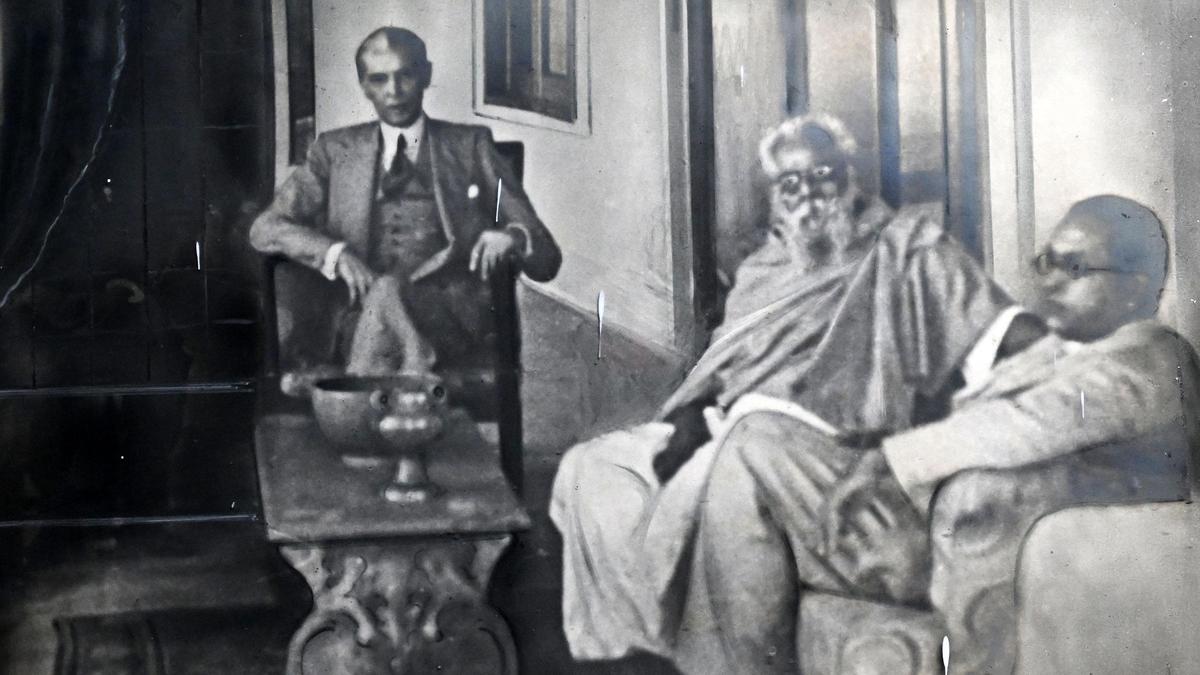
A change in the manner in which references to Dravida Kazhagam (DK) founder E.V. Ramasamy Naicker (EVR) and an icon of the Scheduled Castes (SC) B.R.Ambedkar have been made in this year’s policy note of the Tamil Nadu Backward Classes and Most Backward Classes Welfare department triggered a political row recently.Critics have held the Tamilaga Vettri Kazhagam (TVK)-led regime responsible for the omission of the references to EVR and Ambedkar, hailed by their admirers as “Periyar” and “Babasaheb,” in certain portions of the document as compared to the previous year’s policy note.The Minister for Backward Classes Welfare, V. Sampath Kumar, told journalists late last week that a revised policy note would be issued.Trio’s coming togetherIt is not just that the latest controversy has put the two leaders in the same league. But, there were attempts on their part to work together, as, after all, both the DK founder and Ambedkar ran a campaign politically against their common adversary, the Congress. At one stage, the two leaders and former president of the All India Muslim League, Mohammed Ali Jinnah, also called Qaid-i-Azam, had attempted to forge a united front.On January 8, 1940 in Mumbai, a few months after the Congress governments resigned in several States to protest against the British regime’s announcement of India being at war with Germany, EVR met Ambedkar and Jinnah. At that time, Jinnah had not formally come out with the League’s demand for Pakistan, even though the DK founder began propounding the concept of “Dravida Nadu.” An eminent historian of South Asia and a member of the UC [University of California] Berkeley’s history department (1964-2010) Eugene F. Irschick, in his work Tamil Revivalism in the 1930s (published by Cre-A in April 1986), mentions that EVR was elected president of the Justice Party in December 1938 and “Ramaswami Naicker’s presidential address, read in his absence [due to imprisonment], demanded a separate Dravidian state for the Dravidians.”The presidential speech in 1938 was the first occasion when the demand for Dravida Nadu was made, according to diplomat-turned-political writer R. Kannan and the Viduthalai Chiruthaigal Katchi (VCK) general secretary D. Ravi Kumar.Also read | Tracing the Jinnah connectionMumbai meetOne of the factors that must have facilitated the January 1940 meeting was that both Ambedkar and EVR had declared support to Jinnah’s call to Muslims to observe December 22, 1939, as a “Day of Deliverance” in the context of the exit of Congress regimes in the States. The extension of support was recorded in an academic paper - “The Historic Meeting of Ambedkar, Jinnah and Periyar,” - presented by an academician K.V. Ramakrishna Rao at the 21st session of the South Indian History Congress in Madurai in January 2001.On the meeting among EVR, Jinnah and Ambedkar, The Hindu, on January 16, 1940, reported the event and reproduced a statement of the DK founder, who was the then chief of the Justice Party. “Both Janab Jinnah and Dr. Ambedkar hold views about the Congress, identical with my own, and all three of us are agreed that a united effort should be made to counteract the evil influences of the Congress.”The release, as reproduced by this newspaper, did not refer to the Dravida Nadu demand of the Justice Party. However, on the issue of making Hindi language compulsory in schools, the news report said Jinnah and Ambedkar had supported EVR’s viewpoint. “They considered the scheme to be nothing short of a shrewd scheme for inculcating and strengthening Brahmin religion and culture to the detriment of our own culture. “You will have my fullest support,” said Janab Jinnah when I broached the subject of the renewal of the anti-Hindi agitation in our province, and Ambedkar was one with me in this matter,” The Hindu reported quoting EVR.However, Dr. Kannan, in his “Anna: The Life and Times of C.N. Annadurai,” (Penguin, 2010), observes that Annadurai (CNA) had “pleaded” with EVR to have a “definite plan and seek Jinnah’s support” for the plan. “Anna said the delegation [led by EVR] returned with ‘bitterness,’” the biographer writes. The delegation included P. Balasubramaniam, T.A.V. Nathan, Thiruvasagamani K.M. Balasubramaniam, T.P.S. Ponnappa, C. Panjatcharam and CNA.Separate StatesContrary to the impression given by the biographer that EVR did not pursue the subject of Dravida Nadu, the academician’s paper mentions that the demand for separate States for Mahars, Muslims and Dravidians was among the subjects discussed by the three leaders. At the same time, the biographer also records that EVR told a public meeting in Dharavi, Mumbai, on January 7, 1940 that “Tamil Nadu was as populous as England and as large as Germany and that with Jinnah’s and Ambedkar’s help he would establish its freedom.”Fifteen months after the Mumbai meeting, Jinnah visited Chennai to address the 28th annual session of the Muslim League on the SIAA grounds, behind the Puratchi Thalaivar Dr. MGR Chennai Central Railway Station. Though this newspaper reported extensively the proceedings of the meet on April 13 and 15, 1941 wherein Jinnah had ridiculed stalwarts of the national movement - Mahatma Gandhi, C. Rajagopalachari and Tej Bahadur Sapru, there was not a word about the Muslim League chief speaking in favour of the demand for “Dravida Nadu.” A galaxy of leaders of the Justice Party, including EVR, R. K. Shanmugam Chetti, A P. Patro, K.V. Reddi and M.A. Muthiah Chettiar attended. C.R. Srinivssan, Editor of the Swadesamiitran, was one of the special invitees.Jinnah’s distancing actWith all the bonhomie, the relationship between Jinnah and EVR did not serve the purpose of the latter. In a reply to EVR in August 1944, the Muslim League leader wrote: “if the people of your province really desire Dravidasthan, it is for them to assert themselves.” At the same time, he mentioned that “you will find me supporting any just and fair claim or demand of any section of the peoples of India, and particularly the non-Brahmins of South India.” Even years after the death of Jinnah in 1948, EVR did refer to him on many occasions. In June 1956, he earned the wrath of the then Prime Minister Jawaharlal Nehru, who complained to the then Chief Minister K. Kamaraj about one of his speeches that had a reference to Jinnah. “I think that this is going completely beyond any possible limit and this kind of speech should not be allowed to go without some action being taken. I should like you to consider this matter,” Nehru wrote to Kamaraj on June 18, 1956, according to The Nehru Archives. (https://nehruarchive.in/documents/to-k-kamaraj-18-june-1956-v9lexg)As for the EVR-Ambedkar ties, the two continued to interact with each other. A month after the split in the Justice Party at the Salem conference in August 1944 which led to the establishment of the DK, EVR called on Ambedkar at the Chettinad House here in Chennai and discussed the political situation, including the deliberations at the conference, reported The Hindu on September 25, 1944. However, Ambedkar, to pursue his agenda of social reforms aimed at uplifting the plight of the SCs, had decided to work with the Congress at the time of Independence and he became Law Minister in the first Cabinet headed by Nehru. It was another matter that he developed differences later with the Prime Minister and quit. But, Ambedkar’s cooperation had brought a pause in the relationship with EVR initially. Many years later, the ties came to an end with the death of Ambedkar in December 1956.
When ‘Periyar’, Ambedkar and Jinnah sailed together politically
Full Article
Original Source
Read the full article at Thehindu →KhanList aggregates and links to publicly available news content. We do not host full articles from third-party sources. Always verify important information with original sources.