
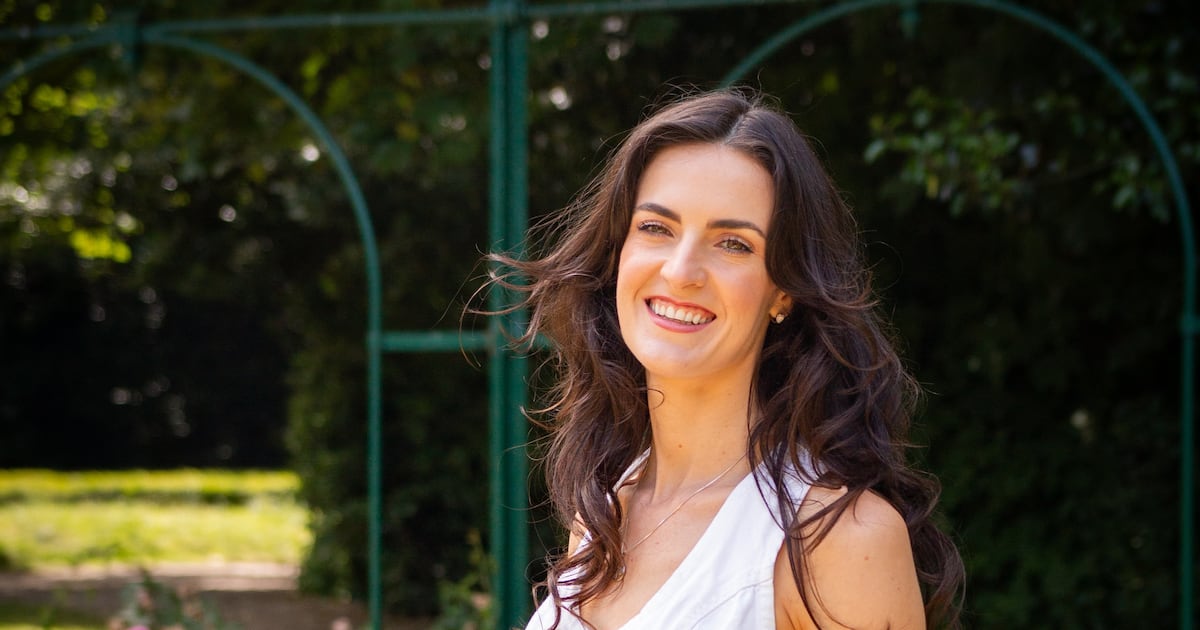
I’m an Irish-language writer, performer, film-maker and poet. I grew up in Clontarf in Dublin speaking English and went to English-medium schools, but I had teachers in sixth class who really made Irish a living language, and I was interested in learning more. I went to Coláiste Chamuis in Connemara every summer in secondary school and then I studied English and Irish in Trinity. I could see that if I didn’t keep the language in my life, I would lose it. So I knew I had to study it in college, and I knew I had to create a community. College was the first time I, apart from the three-week stints in the Gaeltacht, was using Irish every day. I remember it was someone’s birthday when I was in first year, and we went up to the siopa leabhar on Harcourt Street and we bought them a card in Irish. I was like “God, you can really do a lot of things in Irish”. I had never even thought about that.Now the whole landscape is changing. You can go online and you can buy thousands of products in Irish. I take little pictures when I see products or advertisements using Irish, because that used to be so rare. If the capitalists are using it, the tides have turned. If Irish wasn’t cool, they wouldn’t be doing it. There has been a very noticeable change in the zeitgeist. But at the time you had to go to Conradh na Gaeilge and could only buy whatever they sold in the siopa leabhar. I got into the habit of always engaging with the State in Irish because you are entitled to do that, but everything takes longer. Sometimes things just go missing and you have to be really careful to keep copies of everything.READ MOREI applied for my driver’s test in Irish. I waited and I studied away, learning how to say “dipstick” and “full-beam headlights” in Irish, but then when I got my test, they just gave me an English test. I said I wanted an Irish examiner, and I had to wait longer. I made a social media post about it just so people would know that, first of all, it is a bit difficult, but also that you can do it. Because that’s what happens with these things. The Government will say, “Well, it is available in Irish, but nobody takes it up”, but that is because they make it very difficult. It is just a constant thing of having to revert back to the question of, “Why is English the norm, and how can we fight against that?” The Irish language, whether people speak it or not, can be quite a sensitive aspect of their identity as an Irish person. People often come up to me, and they want to talk about curriculum and how Irish was taught. Just because you speak Irish doesn’t mean you have any opinions on that. When people hear you speak Irish and they want to tell you about their teacher, it is very draining. People don’t meet actuaries and start telling them that they hate maths. What does it mean to be Irish? People will say Barry’s Tea and Tayto crisps or whatever, but all of those things didn’t exist a couple of hundred years ago. There is some kernel of the Irish spirit that I think prevails, and I think we’re coming back to that now. We are stripping away these layers of colonial shame or postcolonial shame.There is a pride in Irishness, in our native Irishness, that is coming back, which is really beautiful to see. When I started college, the language was associated with being really uncool, and people would kind of laugh and make jokes about it.[ Adventures as Gaeilge: The bestselling Irish-language author who captivated young readersOpens in new window ]Someone said to me recently, “Oh, you’re a cool Irish-language poet”, and those words were not put together before two years ago. I set up REIC, a spoken-word night through Irish, 11 years ago, and people said, “Are there enough people to do an Irish-language poetry night?”Last year I ran a hip-hop night in the Cobblestone with Imram Féile Litríochta Gaeilge (Irish Language Literature Festival), and this year we are bringing it to The Sound House. They’ve gone bigger this year: more tickets, more acts. You get a little taste of so many different hip-hop acts in Irish.[ There’s been a large generational shift in attitude to the Irish languageOpens in new window ]That was so much of my learning about Irish culture: going to festivals. I think a lot of people struggle with Irish because they learn it as a subject and they don’t integrate it into their lives. I was so lucky that I got to go to college at 18, and my entire social life was through Irish. People were like, “Where did you learn the word for that?” and I responded, “I think it was at 3 o’clock in the morning at a rave?” In conversation with Niamh Browne An Hip-Hap Gaelach is on in The Sound House Dublin on November 12th. Tickets are available from imram.ie
‘When people hear you speak Irish and they want to tell you about their teacher’
Full Article
Original Source
Read the full article at Irishtimes →KhanList aggregates and links to publicly available news content. We do not host full articles from third-party sources. Always verify important information with original sources.