
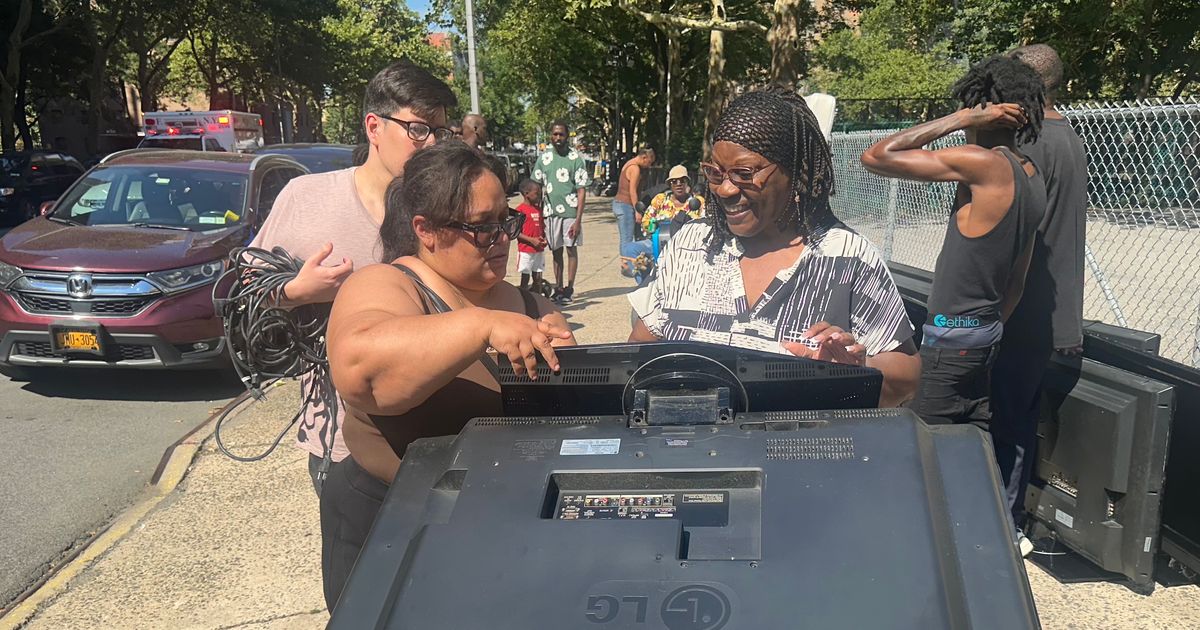
When Offices Don’t Want Their Furniture, She Brings It to Public-Housing Residents By , a contributing writer at Curbed and author of the Substack newsletter Café Anne On a recent Saturday afternoon, Regina Carter parked a U-Haul van in front of the Morris Houses — the Bronx public-housing project where she lives — and began unloading 55 big-screen LG TVs onto the sidewalk to hand out to her neighbors. Taking a break from the operation, Carter had to admit it might seem a little suspicious. “I know it looks like we’re stealing these things,” she told me. But the two community cops observing the scene knew better. In these parts, the 38-year-old is known as the Furniture Queen for the pop-ups she runs through her tiny nonprofit, Repurposed Life. When offices and college dorms want to get rid of their used furniture and appliances, they call her, and she collects and redistributes them for free at housing projects around the city. That morning’s big-screen windfall had come from a former Hilton Hotel in Rye that’s being converted into a residential apartment complex. “They had to get rid of everything,” said Carter. “So they called me.” She couldn’t take it all at once, so she took what she could the first time and came back for a second round. At the TV pop-up, residents could get the TVs that a former Hilton Hotel no longer needed. Photo: Anne Kadet Carter advertises the giveaways on her nonprofit’s Facebook page, and word gets around fast. By the time she and her crew of ten (a mix of volunteers and interns) had moved all the televisions onto the sidewalk, a line of locals — young and old, speaking English, Spanish, and Russian, dressed in everything from jeans to burkas — had queued up behind the card table she’d set up, piled with electric power cords. Among the first in line were Lola and Ashe, a middle-aged couple who live in the projects. They tried, with considerable difficulty, to load the 55-inch television onto Ashe’s handicap scooter. Carter encouraged them to return with a shopping cart. “We have two TVs in the house, but they’re both broken,” said Lola. “I didn’t want to throw them away because my son bought them for me, and he spent so much money on them.” “How long have they been broken?” I asked. “Maybe four years,” said Lola. “Now I’m going to throw them away!” At Carter’s pop-ups, it’s first come, first served. No one asks for names or poses any other questions. “We’ve had people roll up in nice vehicles and ask for things. It’s not really my place to say, ‘Oh, you rich? Why you over here looking for stuff?’” said Carter. “The point is to keep it out of the landfill.” She estimates her organization has redistributed more than half a million pounds of materials since its official launch two years ago. A truck filled with rescued items from another giveaway event. Photo: Repurposed Life Soon enough, a young woman named Laura drove up in a shiny white Land Rover and asked two of Carter’s volunteers to help her load a television into the back. The woman said her boyfriend had told her about the pop-up. He was no longer able to work after an accident: “He’s been talking about needing a TV, and somebody gave him one but it’s filled with roaches, so that didn’t work out.” Cassandra, a stay-at-home mom who heard about the giveaway from her cousin, took a television to replace the broken set in her son’s room. Radaisa, a social worker who claimed a TV for her bedroom, said she was a regular at Carter’s pop-ups. At another one a few weeks ago, she had gotten a free ironing board. “Sometimes people take it to sell it,” she said of the goods that Carter gives away. “But a lot of people really need it, so it’s appreciated.” Within an hour, all the televisions were taken, but Carter’s day wasn’t done. She and her crew were planning to drive the U-Haul down to Alphabet City to retrieve another load of goods. Carter, who has a full-time job answering the phones as an information-service agent for the city’s Human Resources Administration, said she typically devotes 25 to 30 unpaid hours a week to her nonprofit. It’s a lot. “I think I was born tired,” she said. “I’ve never been well rested in my life. But I like it.” Plus, she notes, “I’d probably be a hoarder if I didn’t give the stuff away. I used to go to thrift shops and pick things up that I knew I didn’t need, but I knew someone needed it. So now I get to do it, but it doesn’t stay in the house.” Carter was inspired to launch her service based on her experience growing up in the foster-care system and trying to make it on her own. The native New Yorker bounced from family to family and then to a group home. She had her first child when she was 15 and her second at 17. When she was 21, the city moved her into an apartment in the Morris Houses with her two children, but it had no furniture. “We were sleeping on the floor,” she said. She slowly furnished her new home with thrift-store finds. Fifteen years later, during the pandemic, Carter was volunteering for the local tenant association when she got an email from Materials for the Arts asking if residents might be interested in 15 racks of nearly new clothing that had been used on television and film shoots. Carter arranged for a pickup and distributed the clothing through the tenant association office. Inspired by the success of the clothing giveaway, she reached out to Green Standards, a company that helps offices dispose of used furniture such as desks, break-room tables, chairs, and small appliances such as microwaves. “And we just started getting one truckload at a time of things,” said Carter. As her list of suppliers grew, she was soon organizing pop-ups several times a month at housing projects all over the city, focusing on low- to medium-income neighborhoods. Demand is highest for air conditioners in the summer, heaters in the winter, and mattresses all year round, she said. Two years ago, she got nonprofit status and started collecting monetary donations, but it’s still a bare-bones operation — it has no office and no warehouse, and she doesn’t draw a salary. Last year, Repurposed Life collected $5,500 in donations. Carter spends her own money — about $12,000 a year, mostly for van rentals — to cover operating expenses. As far as she knows, her nonprofit is the only organization of its kind in the city. “The resources are there, the need is there,” she said. “It’s connecting the two that I think New York needs to work on.” Carter was recently named a finalist for the David Prize, an award given out by the Walentas Family Foundation (the same family behind the developer Two Trees) to New Yorkers with ideas for solving local problems. If she wins, she would get a $200,000 cash injection that she could use any way she pleases (results will be announced on September 15). She said that if she got the prize, she’d start paying stipends to volunteers and invest in a digital inventory and tracking system. And while a warehouse space would be great for storing items, so far the lack of storage has not been an issue — whatever she can cart in a U-Haul, whether it’s a cracked filing cabinet or a used mattress, is useful to someone. Regina Carter Saves Your Office Chair From Going to the Dump Your product is saved! You’ll receive emails when your saved products go on sale. Manage preferences.
When Offices Don’t Want Their Furniture, She Brings It to NYCHA Residents
Full Article
Original Source
Read the full article at Curbed →KhanList aggregates and links to publicly available news content. We do not host full articles from third-party sources. Always verify important information with original sources.