
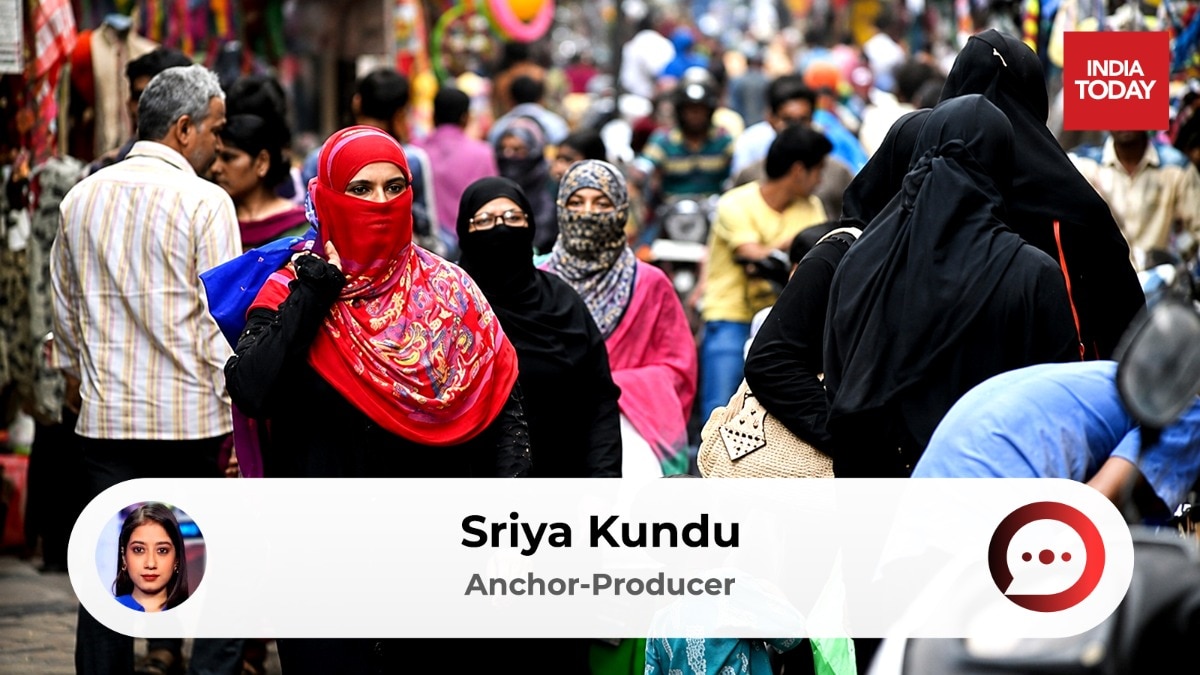
From Europe's anxieties over immigration and radicalisation to India's debate over majoritarianism, the changing arithmetic of faith reveals a deeper crisis of belonging.In his seminal 1972 book, Folk Devils and Moral Panics, sociologist Stanley Cohen wrote: “A condition, episode, person orgroup of persons emerges to become defined as a threat to societal values and interests.” He argued that perceived threats can be exaggerated and amplified by the media, political figures and influential institutions until they occupy a disproportionate space in public consciousness.Over five decades later, Cohen's theory offers a compelling lens to examine the growing politicisation of religious demography. Perhaps the most revealing moral panic of our times is not about what people are doing, but about how many of them areexpected to exist.NUMBER, NUMBER ON THE WALL; WHO IS THE STRONGEST OF THEM ALLThe latest projections by the Pew Research Centre offer an interesting starting point. Its November 2026 report, The Future of World Religions: Population Growth Projections, 2020–2070, projects that Muslims will overtake Christians as the world's largest religious community by 2035, with an estimated 2.57 billion Muslims against 2.52 billion Christians. Both populations, however, are expected to grow. Hindus, too, are projected to increase in absolute number, even as their share of the global population declines modestly. The reasons are largely demographic: younger age profiles, higher fertility rates, mortality and migration patterns. Pew estimates that Muslim women had an average of 3.1 children between 2020 and 2025,compared with 2.5 among Christian women and 1.9 among Hindu women. These projections point to demographic change, not an ideological expansion. A higher fertility rate is not evidence of political mobilisation; a declining share of the global population is not evidence of cultural erasure.Yet, in an increasingly polarised world, the distinction is often conveniently blurred. A population projection becomes a political prophecy, a statistical shift a civilisational warning. The numbers themselves do not necessarily produce conflict. It is the meaning attached to them, and the anxieties built around them, that can turn demographic change into an existential threat.EUROPE'S 'WHO WE ARE' CRISIS: A GUISED SECURITY DEBATE? Europe offers a particularly instructive case study. Immigration, integration, cultural assimilation and religious identity have become increasingly contentious political questions, with right-wing populist movements invoking the preservation of national identity and Christian heritage. Concerns around Islamist extremism and radicalisation have further complicated the debate.But it would be intellectually convenient to explain every European protest or social upheaval through the prism of religious radicalisation. Their grievances can be reduced to a single religious fault line. And that’s something I have explained in a different article.The problem arises when legitimate concerns around security and integration become a broader suspicion of entire communities. Extremism cannot be dismissed, but neither can the actions of a few define millions. There is a difference between scrutinising radicalisation and treating religious identity itself as a security concern.This is precisely where Cohen's moral panic becomes relevant. It does not necessarily begin with an imaginary threat; often, it begins with a genuine social concern. What changes is the scale of the threat as represented, the stereotypes that emerge around it and the political capital extracted from public anxiety. The debate, therefore, is not merely about immigration, but about cultural displacement, political control and who gets to define the idea of belonging.WHO SAYS CHECKMATE IN INDIA?Let’s look at India. For a country whose constitutional foundations rest on religious plurality, the debate around majoritarianism is particularly consequential. Allegations of communal polarisation, discriminatory treatment of minorities and the political mobilisation of religious identity have raised questions about the relationship between numerical dominance and national belonging. The government and its supporters reject several such allegations, but the larger constitutional debate remains important.There is a distinction between majority and majoritarianism. The former is a demographic reality; the latter is a political idea that can convert numerical superiority into a claim of greater cultural ownership or entitlement. Electoral majorities have the mandate to govern, but constitutional democracies are designed to ensure that minority rights do not depend on the goodwill of the majority.Political sociologist Rogers Brubaker's work on group-making offers an interesting perspective here. Religious communities are not necessarily cohesive political entities; they can be constructed and mobilised through political narratives and competing claims of collective belonging. People who may have little in common beyond their religious identity can be persuaded to see themselves as opposing political camps.Benedict Anderson's idea of nations as “imagined communities” adds another layer to this argument. Nations are sustained by shared histories, symbols and narratives of belonging. But who gets to define that belonging? Can a nation accommodate multiple religious and cultural identities, or does it gradually become the exclusive inheritance of one?ALL ISN'T FAIR IN DEMOCRACY AND DEMOGRAPHYThere is a larger democratic paradox at play. Democracies function through numbers, but constitutional democracies cannot be reduced to them. A majority can decide who governs; it cannot acquire an unlimited claim over who belongs. The strength of a democracy lies as much in how securely its minorities can exercise their rights as in how effectively its majority exercises power.The Pew projections should therefore prompt a more nuanced conversation than one centred on which religion is growing faster or which community might eventually outnumber another. Demographic change does not automatically translate into political unity, ideological dominance orIN THE NAME OF ALLAH, AND OTHER POWER PLAYSBut this conversation isn’t lopsided. Earlier, in 2020, Pew estimated that Muslims were the majority in 53 countries and territories, a number projected to rise to 54 by 2070. Yet a shared religious identity has hardly translated into a shared political experience. Several Muslim-majority countries continue to grapple with authoritarian rule, restrictions on civil liberties and the suppression of political dissent. The Economist Intelligence Unit's 2025 Democracy Index classifies Iran, Saudi Arabia, Pakistan and Afghanistan as authoritarian regimes.The use of religion to legitimise state power, restrict individual freedoms or marginalise minorities deserves scrutiny. So must extremist movements that seek to impose their ideology, radicalise individuals and incite acts of terrorism in the name of faith. But holding governments and political movements accountable is not the same as holding an entire religious community responsible for their actions.At the same time, the 57-member Organisation of Islamic Cooperation represents countries with vastly different political systems, national interests and interpretations of faith. A shared religion is no guarantee of a shared political agenda.Muslims are not a political bloc, nor are citizens of Muslim-majority countries uniformly represented by the regimes that govern them. Equally, a Muslim majority does not automatically guarantee the rights of religious minorities within those societies.MAJORITY RULES, UNITY DROOLS?The question, then, is not whether Muslims will eventually outnumber Christians. Pew's projections suggest they will. The more consequential question is what follows. Will a larger Muslim population translate into greater political representation, cultural influence and geopolitical weight? Almost certainly, in some parts of the world. But will it automatically create a more powerful or ideologically unified Muslim world? That is far less certain.A changing religious balance will inevitably reshape conversations around representation, migration, identity and the place of religion in public life. For Christian-majority societies, this may bring anxieties about cultural continuity and political influence. Such concerns deserve democratic debate, but not the presumption that the growing Muslim population is, by itself, a civilisational threat.Equally, Muslim-majority societies must confront an uncomfortable question: what kind of political and social order will accompany their growing demographic presence? Will greater numbers strengthen pluralism, individual freedoms and equal citizenship, or will some political movements seek to convert demographic confidence into religious entitlement? The experience of several such states offers enough reason not to treat this question as irrelevant.Perhaps this is where the caution must be universal. A community's numerical strength cannot become a licence to dictate the terms of belonging, just as its minority status cannot become a reason to question its loyalty. The rights Muslims seek as minorities in onepart of the world must be rights they are willing to uphold for minorities elsewhere. The same standard must apply to every faith and every political majority.Demography may favour one faith. Democratic civilisations must favour none over another.- Ends
When numbers scare: The politics of faith and fear
Full Article
Original Source
Read the full article at Indiatoday →KhanList aggregates and links to publicly available news content. We do not host full articles from third-party sources. Always verify important information with original sources.