
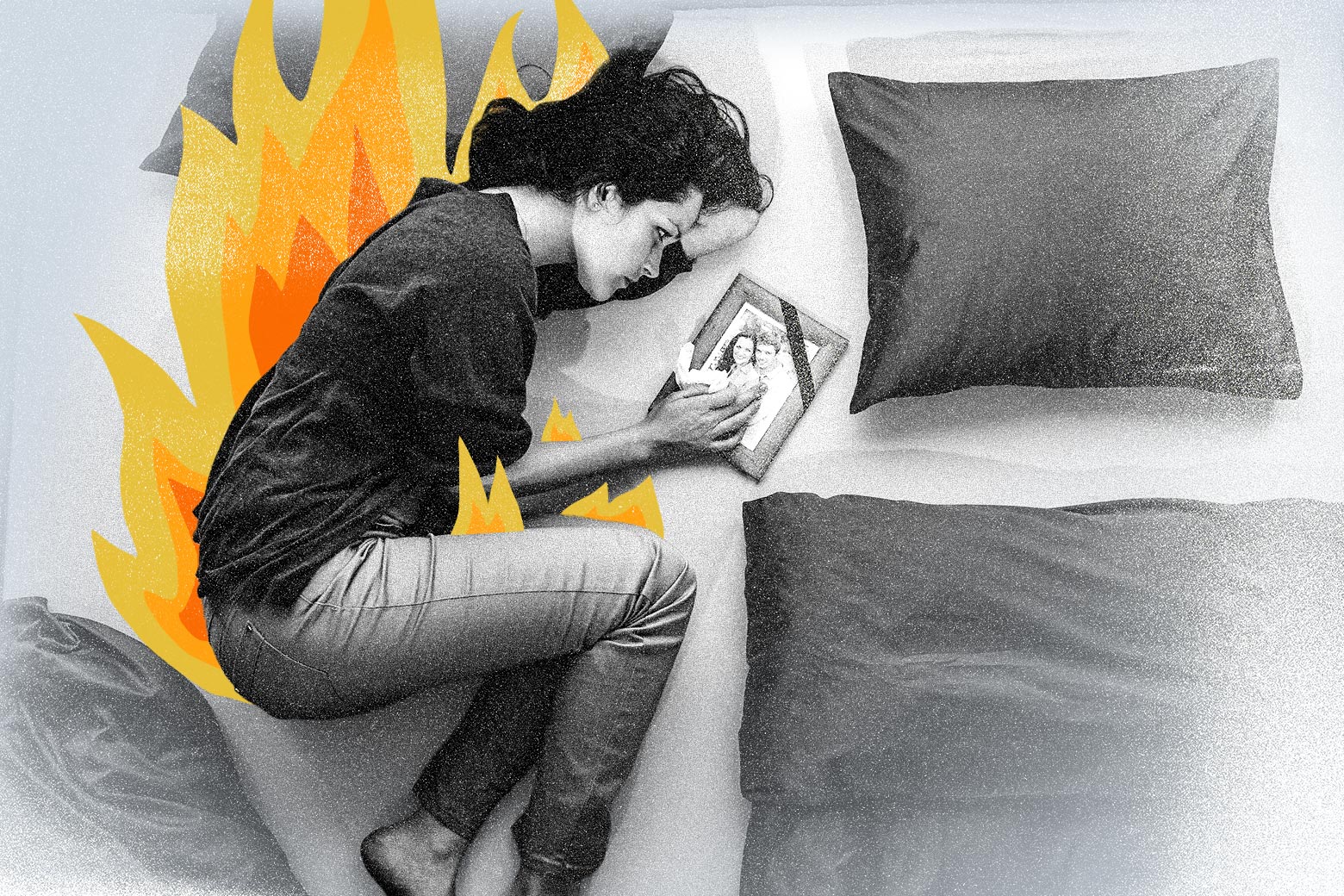
Relationships Widow’s Fire What no one tells you about wanting sex after your spouse dies. Photo illustration by Slate. Photo by CandyBox Images/Adobe Stock. Sign up for the Slatest to get the most insightful analysis, criticism, and advice out there, delivered to your inbox daily. By the time I was in my second trimester of pregnancy, I could barely touch my 32-year-old husband. Everything was about managing his pain through Stage 4 bowel cancer. At one point, he felt the need to address why he hadn’t gone down on me since starting treatment. The same guy who’d spent years face-down between my legs was worried about nausea because he struggled to eat anything at all. The tongue that had once been so busy was reduced to dissolving higher and higher doses of fentanyl. The last form of sexual intimacy we shared was when I suggested a hand job in an attempt to distract him from his pain. He managed to get hard, but his penis was unusually hot to the touch. I drenched my hands in coconut oil and monitored him like a doctor, carefully stroking until he came. The ejaculation was a deep orange with a thick, gooey, gluelike texture. We looked at it with both surprise and sadness. He was pumped so full of chemo cocktails it had turned him into a radioactive man. When he died, we hadn’t had sex since I’d gotten on top of him at home in our bed after his first round of treatment. He was hooked up to a chemo pump through his PICC line. He was lying in our bed, and I rode him gently. He pulled out, worried about chemo drugs in his system being near the baby after hearing the heartbeat at our first scan. “How did you just do that?” he asked right after, with the sweetest, most vulnerable look on his face. “How did you even get turned on by me?” “Because it’s you,” I said. It was a no-brainer. “I just … love you.” A few weeks after my son was born, my husband passed away. It was an immensely painful and confusing time: My body was healing from childbirth, I was covered in stretch marks, and sleep seemed almost entirely out of the question. Alone at night with a screaming baby, I would end up screaming too. The blood-boiling, heart-wrenching despair was consuming, yet despite it all, I still wanted sex—badly. A lust stronger than I could ever have imagined began to assert itself among the grief and despair. It wasn’t until much later that I learned there was a name for this phenomenon: “widow’s fire.” Widow’s fire is the burning desire for intimacy following the death of a partner or spouse. It can hit anyone at any time during their grief—even before a partner has passed, like it did for me. This sudden, uncontrollable desire for physical connection almost always comes as a surprise, and it’s often judged or misunderstood. You’re grieving, the conventional wisdom goes. The last thing you should be thinking about is sex. But neither grief nor lust is a logical process. Sometimes, you just feel what you feel. In my case, I needed to be touched—now. There was only one problem: I wasn’t going to settle for just anybody, and the pool of men interested in a recently widowed new mother was small. What would my dating profile say? “I’m 31, just had a baby, husband just died. Call me!” Luckily, there was another option. When my husband was sick, we spoke only once of his hypothetical death. It was then that he half-jokingly preapproved a man he knew, a friend and colleague going through a divorce, whom he thought I’d be lucky to date. A few months after my husband died, I started seeing him. This decision was not based on connection or chemistry—it came from sheer desperation to be with someone, to have anything that resembled partnership, which felt far more normal to me than being alone as a new mom. When I invited him over, he already knew the drill. He kissed me the moment he stepped inside—my first first kiss after loss. We disentangled to eat dinner, then made out on the couch, but agreed it was too soon for sex. He couldn’t drive home after drinking, so he went to sleep while I stayed up to pump my boobs. When I got into bed and cozied up to him in my cute silk pajamas, he stirred. For what felt like ages, he gently touched and teased me, stroking different areas of my skin and kissing my ears, neck, and shoulders. I wasn’t nervous, only slightly concerned about my recovery after childbirth, unsure if there might be pain from penetration. He was keen but considerate, letting me know more than once that there was no pressure to go any further. I’d already decided, however, that I was going to have sex. I felt no shame or guilt. I was going after what I wanted. That night, his touch felt vital. With enough relaxation, breathing, buildup, and longing, I was ready. It was good, slow, a relief. I savored the sensation of being temporarily off the roller coaster of motherhood, my thoughts, the loneliness, and an aching heart. Instead of the dissociation I used to get through the day, sex made the present moment worth being in. Being a mom was completely new to me, but being in a man’s arms was not. After that, I wanted sex all the time. What I didn’t want was to talk. I had been doing so much talking for so long—to counselors, to doctors, to family, and to friends—that long discussions had lost their appeal. I was emotionally and conversationally drained. This strained our dynamic and made him feel used. There were times we’d be having sex and, out of nowhere, he’d want to stop. Once, when I was all over him yet again, he stammered, “You’re not a piece of meat.” My stomach sank. All I could think was, Please, please let me be meat. I wanted nothing more than to be eaten. One night, when he refused to bend me over my dresser after I had pleaded with him, I started screaming at him in a fed-up, grief-stricken state. He admitted to some complicated feelings of guilt about banging his friend’s wife. Our strange new relationship, my cravings, and my demand for sex became a literal and figurative bone of contention between us, and we parted ways. But he had scratched the surface of an ever-increasing itch. I was quickly back on dating apps. It felt urgent, as if I had to make up for lost time. I wanted a big, romantic life before I died too. I paid to join a site, something like widowedsinglesnearme.com, and started getting notifications from men twice my age: George, 74, winked at you. Soon after, I swiped right on Michael. A friend babysat, approving my outfit before I went to meet him at the pub. Sitting down across from a new man felt surreal, but what hadn’t since my husband died? The moment I opened my mouth, I could tell it was a lost cause. I had just given birth and watched my husband die—it was hard not to mention that. I excused myself, saying I needed to get back for the babysitter. I cried while I walked home, then crawled into bed. I don’t want to be here, I thought. I don’t want to do any of this. I pulled the duvet over my head and stayed under the covers until I felt as if I were suffocating. On another date, I drank too much and didn’t want the night to end. I followed my date to the train station like a lost puppy, afraid to go home to my empty flat alone. The next day, he told me he didn’t want to see me again. He was “done with his wild years” and was looking for something serious. I didn’t blame him. I was drowning in wine, unprocessed grief, and resentment over having to start over. Dating was starting to seem like a terribly frustrating and inconvenient chore, done purely in the hopes of obtaining some of the physical touch and affection I was deprived of. I began to masturbate religiously. It helped me escape, gave me a sensation to focus on and an orgasm to work toward. As exhausted as I was, pleasure made me feel alive. “You’re insatiable,” I was told while locked away in a cabin, enjoying a holiday fling in the Costa Rican jungle. I hadn’t thought of myself that way before, but it sure named the feeling. The fear of going without, of having no one touch me, kept activating my libido, encouraging me to get what I could, when I could, any chance I got. I savored and appreciated it, but I always panicked afterward. Without a committed partner, I couldn’t be sure where romance and affection was coming from next. The uncertainty kept me stepping back out into the world. It also kept me fixated on the phenomenon of lust after death. Curious whether others were experiencing the same thing, I started a site called Widow’s Fire, an online community and dating site for widows and widowers who were ablaze, burning with discomfort and cravings for sex after losing a partner. Though I was still struggling with it myself, I wanted to spread excitement about dating, loving again, and being alive. I shared the highs and lows of my forays, as well as all the insights I was gaining. The more I dated, and the more I connected with others who were in the same boat, the more I got to know the new me. But to do so, I had to say yes—not just to sex but to any new encounter that might give me some perspective. A human-platter experience had me eating and licking food off naked women, prepared by a Michelin-star chef. It did nothing for me. I went to a shibari workshop and didn’t mind it. I made friends with a woman who hosts butt-plug brunches, had threesomes, had a fivesome, even let a boyfriend pee on me, just in case it unlocked something new. It didn’t. But I was glad I knew. In the middle of it all, I went to therapy. I traveled with my son. I learned new hobbies and spent time with friends. Eventually, they started to set me up with their friends and colleagues. An executive chef in his 40s took me to one of his high-end restaurants, made out with me, then ghosted me. There was a professional tennis player and an assistant director, both in their 20s, the extremely wealthy older widower, the paratrooper, the real estate agent, and the other real estate agent. There was a guy who screamed when he orgasmed, a hockey player, and a nice guy I just wasn’t attracted to. I had my first yearlong relationship, my first breakup after loss, my first play party, and a peek into polyamory. A situationship surprisingly evolved into a best friend. I learned about kinks, attachment styles, love-bombing, and, sadly, abuse. It wasn’t always pretty, but I was taking chances. And the more chances I took, the less it mattered where any one connection went. Life had become an exciting maze, and if I hit a wall, I could just turn around and try another route. I remember the moment all of this crystallized. I was on a date with a firefighter, a single dad, who confessed that I was his first date in 12 years. “I just want to meet someone and be able to stay in and watch Netflix on the couch,” he told me. He had recently divorced and had a young daughter. As he spoke, I realized that just skipping ahead to that easy, comfortable coupledom was no longer the goal for me, at long last. “You should date. A lot,” I told him, feeling wise from my years of widowhood and self-discovery. “There is so much we can find out about ourselves just by going on dates. Who we are now. What we like or don’t like now. We aren’t always still who we think we are. You aren’t the same person you were a decade ago.” It dawned on me then: Eight years after becoming a widow, dating had been one of the greatest tools I turned to in grief. Most of all, I found that seeking companionship and new romantic experiences has not diminished what I had with my husband. Instead, it was proof of the resilience of the human heart, which is capable of expanding to accommodate both the echoes of the past and the flames of the future. The heartache of absence can co-exist with the potential for new beginnings. Sex with someone new can and will come again. I wish someone had told me this every single day to reassure me. That was the real message I wanted and genuinely needed to hear: that my sex life wasn’t over. In fact, it’s only just begun. Dating and Relationships Marriage Sex Death
When My Husband Died, I Thought I’d Grieve Forever. A Truly Unexpected Phenomenon Got Me Through It.
Full Article
Original Source
Read the full article at Slate →KhanList aggregates and links to publicly available news content. We do not host full articles from third-party sources. Always verify important information with original sources.