
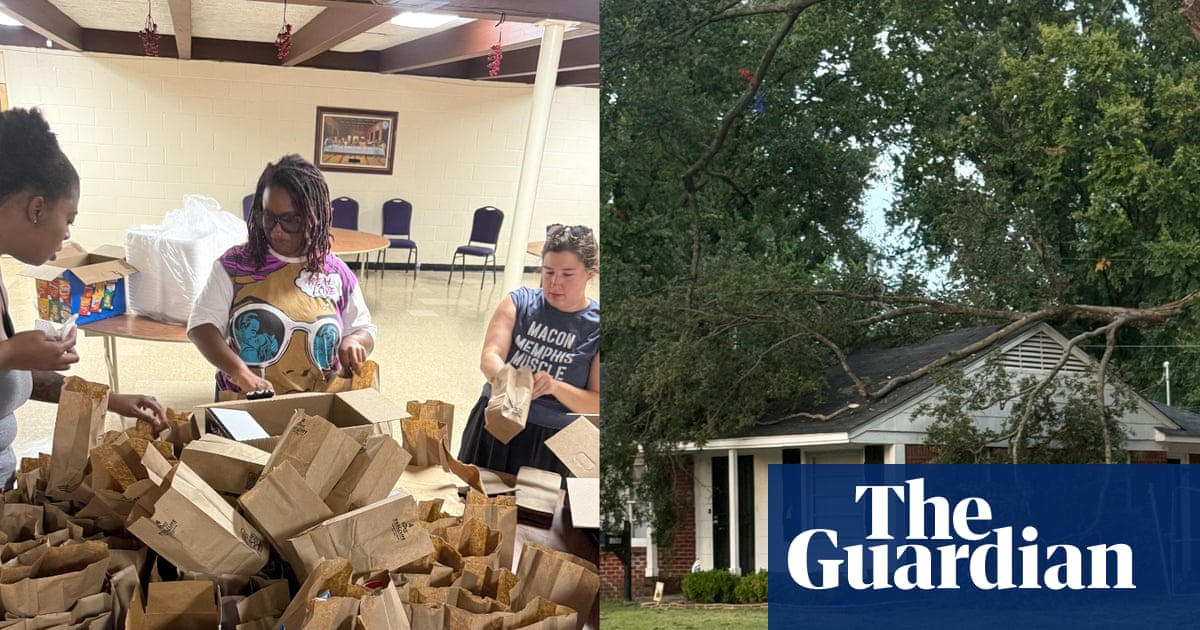
The storm that hit the Memphis, Tennessee, area on 22 August lingered for only about half an hour. But the destruction it left was lasting: $18m in damages, fallen trees and more than 100,000 people without power.Amber Sherman was one of the east Memphis residents who lost power, but her first thoughts were of her neighbors. “My main thought was that the power’s going to be out for a while and people aren’t prepared for that and it’s very hot outside,” Sherman, a coordinator for Black Voters Matter (BVM) in Memphis, said. Days after the storm, a series of rain showers and thunderstorms known as a bow echo storm, the high in Memphis was 91F (32.8C). Tens of thousands of households were still without power.As an organizer, Sherman knows how to connect with people. She contacted her boss at BVM, as well as other partner organizations, to talk about what relief efforts could look like. She checked on neighbors and helped with meal distributions. She also used her social media platform to update people on the situation.“I think a lot of times, people outside of Memphis don’t know what’s happening here, and I thought it was really important because of what was happening Gary, too,” Sherman said. Shortly before Memphis was without power, Gary, Indiana, a majority-Black city more than 500 miles to its north, lost power. Gary residents were without power for two weeks. Both storms came near the 21st anniversary of Hurricane Katrina, which prompted some people to draw comparisons between the majority-Black cities and what’s viewed as an inadequate governmental response. “Highlighting that this issue with infrastructure in Black cities is not a new problem, but a consistent problem that we really need to address.”Pastor Valerie Clarke and Connor Taylor of the Gospel Truth Apostolic ministry distribute food to residents out side of their church on 20 August in Gary, Indiana. Photograph: Scott Olson/Getty ImagesThe day after the storm, three community cooling centers were open from 1pm to 7pm. Eventually, many branch libraries, Memphis parks community centers and Memphis parks senior centers were available as places to cool off, charge devices and get food or water for residents. The city’s mayor Paul Young, and the Memphis city council chair, Jana Swearengen-Washington, announced MemphisCares, a partnership between the city, city council and United Way of the Mid-South that would coordinate relief efforts. Through MemphisCares, the city made up to $100,000 available to help residents replenish groceries and receive food assistance.“For many Memphis families, days without power also meant losing groceries they simply can’t afford to replace,” Young said in a statement. “We know recovery looks different for every family. Through Memphis Cares, we’re working with City Council and United Way to get help to the Memphians who need it most.”But impacted residents were only able to begin calling MemphisCares’s hotline on 31 August, more than a week after the storm hit. Just hours after the hotline became available to residents, funds were depleted. Memphians who called were automatically directed to a message that said, in part: “We have received more requests for assistance than funds available. The staff at United Way is currently processing the requests and will distribute assistance beginning tomorrow until all fundable requests have been met.”In the absence of governmental resources, the organizers relied on skeletal plans and protocols for what to do in rapid response scenarios. They were able to respond to the crisis almost immediately. Derrick Tillman, a Memphis small business owner who runs the Detailers Multi-Service, a home contracting company, drove 85 miles (136 km) down to Oxford, Mississippi, to purchase generators from Ace Hardware. About 15 generators, including some sourced from Jackson, Mississippi and Nashville, Tennessee, were distributed from Tillman’s home.He went across the city, servicing people without lights. He set generators up for them, running the cord through their homes and explaining to them how to use the machine. His own neighborhood was hit pretty badly, with trees down, but his power was only out for two hours. “I was able to still operate, to just help people, because I wasn’t stressed out on my end, mentally or physically,” Tillman said. He said that he expects communities to come together in times of crisis as those in Memphis did. “We all stick together and make things happen and use our resources, most likely, we can take care of each other with no problem.”‘We know recovery looks different for every family. Through MemphisCares, we’re working with city council and United Way to get help to the Memphians who need it most.’ Photograph: The Washington Post/Getty ImagesMultiple groups and businesses across Memphis and the mid-south, including Young, Gifted & Green, an environmental justice organization, Da Sammich Spot, a restaurant and resource hub, the Mid-South Environmental Justice Center and the Tennessee Immigrant and Refugee Rights Coalition coordinated hot meal distributions, in addition to passing out water. Sherman said that the Mississippi Rapid Response Coalition, formed in 2020 in response to the Covid-19 pandemic and fortified under Jackson, Mississippi’s water crisis, responded quickly by helping to get generators into the city. Elders, pregnant women and children – were prioritised with regards to receiving donations. Some delivered groceries to families who were afraid to leave their homes due to their immigration status. The organizers and volunteers worked in local church kitchens to ensure that congregants were able to get something to eat.“I don’t think that there’s been a greater testament to the character of Memphis and Memphians than what we’ve seen,” said Richard Massey, a community organizer and environmental justice advocate. “Regular people pitched in, donated resources, pooled resources and prepared hot meals for the community for free. In addition to that, we also had two networks of generators flowing into the city from Mississippi and from Nashville, and we were able to reach capacity. It’s been an intensive, week-long effort across the board in every corner of Memphis.”But while Memphians are proud of their neighbors, of themselves, for immediately stepping in and working together to ensure that people didn’t suffer during the power outages, they’re frustrated that the work has been left to them.“Community is always going to keep each other safe, and we can’t depend on systems to do that because they’ve shown us time and time again that they won’t,” Sherman said. “In this instance, where I, as a regular citizen, had to recruit people in Jackson, Mississippi and Nashville to drive generators up and help to set up food distributions because our government isn’t doing that.”What’s more, in Memphis, xAI datacenters, including the largest data center in the US, maintained their power while residents were in the dark. In an Instagram video, state representative Justin J Pearson, whose campaign volunteers canvassed the Hickory Hill neighborhood to check on residents and share resources, said: “Working-class Black and rural communities are bearing the brunt of fallout from extreme weather events and the pressure that our grids are facing from the AI data center boom.”Demonstrators rally in opposition to a plan by Elon Musks’s xAI to use gas turbines for a new data center rally ahead of a public comment meeting on the project at Fairley high school in Memphis, Tennessee on 25 April. Photograph: The Washington Post/Getty Images“These AI datacenters are significant consumers of power. They demand significant amounts of electricity; they strain power grids, and they make power grids more susceptible to failure during periods of inclement weather,” Massey said. “That’s not to say that they were the prevailing cause. That wasn’t the case. But the fact that our public utility has prioritized these massive allotments of power and [accommodated] corporate expansion over the maintenance of the power grid that residents rely on speaks to a deeply structural issue. They are prioritizing the interests of corporations over people.”As of 2 September, most residents have had their power restored, though a small number remains without. With another heatwave brewing across much of the country, including in Memphis, where the “feels like” temperature is reaching 100F (37.8C), the US Department of Energy has warned of an increased risk of blackouts.Massey said that he’s proud of the community for “being able to step in and fill in the gaps”, but “it’s a sobering reminder that we have a lot of work to do to build out a more sustainable, resilient grid that’s able to endure periods of inclement weather like this.”
When Memphis went dark, community members brought the light: ‘We keep ourselves safe’
Full Article
Original Source
Read the full article at Theguardian →KhanList aggregates and links to publicly available news content. We do not host full articles from third-party sources. Always verify important information with original sources.