
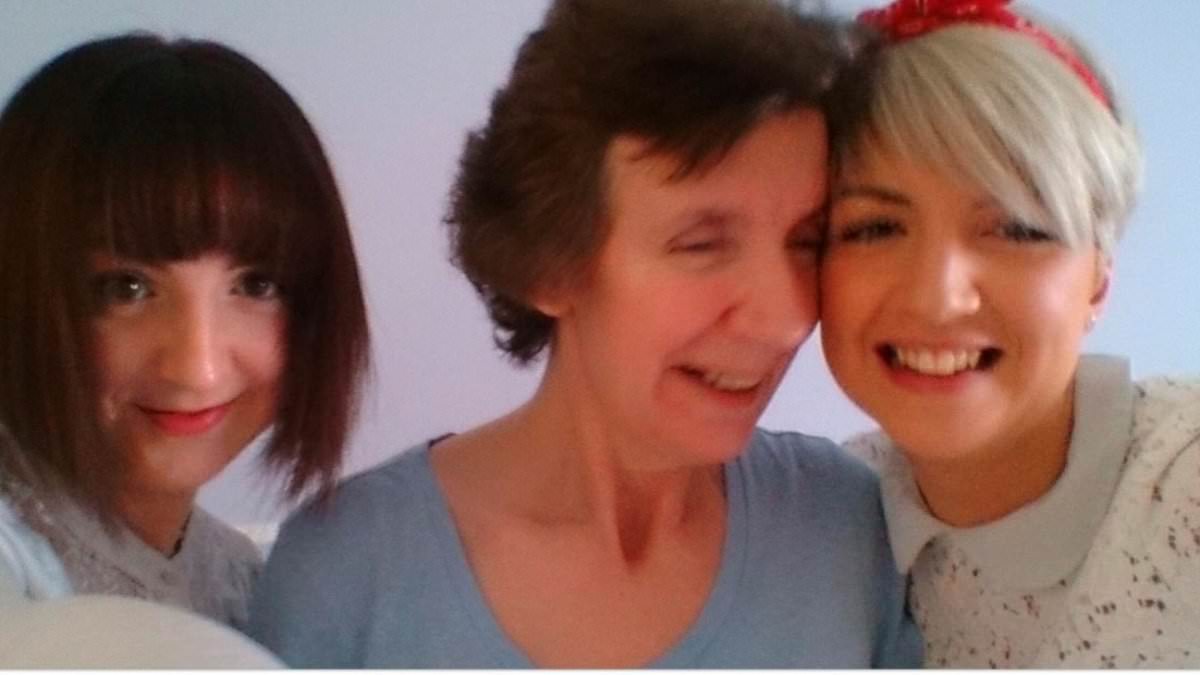
At the age of 17, when she might have expected to be out with friends and planning to leave home for university, Jenny Molloy became a carer for her mother, Laura, who’d been diagnosed with Alzheimer’s at 53.Initially, caring for her was a family effort, with sister Barbara, then 14, and their father – but within two years, unable to cope with the strain, he ended the 20-year marriage, leaving the girls to manage alone.The bewildered sisters had to take it in turns to act as a tag team, popping out of school during free periods or surrendering weekends to ensure one of them was there for Laura.It changed the entire direction of the young girls’ lives. Jenny had to abandon plans to go to university, while Barbara had to quickly mature and take on family chores. But neither girl resented it. And for the next three years the sisters remained Laura’s primary carers.Even when she eventually went into a care home, they visited at least every other day until Laura’s death in 2023.‘We loved Mum, we wanted to look after her,’ says Jenny, now 34, a business consultant who lives in Rossendale, Lancashire, with husband Josh, also 34, a pension administrator, and their daughter, Matilda, eight. Jenny Molloy (left) became a carer at 17 years old – alongside her younger sister Barbara (right) – after their mother Laura was diagnosed with early-onset dementia Before her diagnosis, ‘the most brilliant hands-on mum’ had juggled a full-time job alongside helping out with the school parent-teacher association and volunteering at the local church ‘It wasn’t easy, but we did the best job we could. I do often look back and wonder how we coped.’Her account is a moving reminder of the huge sacrifices made by those tending for loved ones with dementia – and starkly reveals how too often there’s little help at hand even for the most vulnerable of carers.It’s this shortfall that has inspired the Dementia Carers Together campaign by the Daily Mail with Mail Force and Alzheimer’s Society. The idea is to provide courses for carers to learn about their rights – medical and financial – along with practical help to deal with loved ones as they deteriorate.There will also be an opportunity to spend time with other dementia carers to help reduce the isolation and loneliness that so many encounter. Such help would have made a huge difference to Jenny and Barbara – whose mother had been the family glue.Before her diagnosis, ‘the most brilliant hands-on mum’ had juggled a full-time job alongside helping out with the school parent-teacher association and volunteering at the local church.As sociable as she was kind, Laura was known as ‘the hostess with the mostest’ for the laughter-filled evenings she and her husband held for the neighbours, where she served her famous meat and potato pie.But just after Laura turned 50, subtle clues emerged to suggest something was amiss.Seemingly trivial at first – adding boiling water to the tea caddy rather than the cup – the meticulous former Post Office worker then started making uncharacteristic mistakes on the tills in her new job at Asda.‘Mum must have known something was wrong because she went to the family doctor – and said, “Something isn’t quite right”,’ says Jenny. The doctor said at her age she was likely menopausal and suggested HRT.At work, Laura was moved from the tills to the clothes department – ‘but then she started to do odd things like putting shoes into the fruit and vegetables section’, says Jenny.Early-onset Alzheimer’s – that which occurs before the age of 65 – often begins with problems with vision, language or behaviour, rather than the classic memory symptoms, says Simon Wheeler, senior information officer at Alzheimer’s Society.It was Laura’s employer who suggested getting a second opinion – resulting in a brain scan and her diagnosis in 2010.‘Dad told me as we sat on the bed crying,’ says Jenny.‘Barbara was too young to know what was going on – she was only 14. It was horrible – there was no one my age I could talk to who could understand.’Mishaps – such as Laura turning on the gas hob without lighting it – became more regular.She needed constant watching as she would wander off and would quickly become lost outside the home.The day Jenny’s father decided he could take no more, Jenny returned from school to find him pacing in the garden.‘I do understand, it must have been so hard for him to watch the woman he had fallen in love with essentially change into someone else,’ says Jenny.But she didn’t hesitate to step up. She says: ‘I wanted to study languages at university and all my friends were going off to study or moving away – but there was no way I could leave Mum.’Instead, Jenny took a job as an apprentice at a travel agent and would look after her mum at weekends and after work, while Barbara would pop home between her school lessons.Their uncle, Laura’s brother Ronnie, and his wife Cath ‘became like parents, helping us with money and sorting out the bills, and they would come and sit with Mum when my sister and I couldn’t be there,’ adds Jenny.Jenny had to wait almost a year while the authorities transferred the power of attorney from her dad to her, so she could take charge of the family finances. The only advice they got about the help they might be entitled to came thanks to Cath, who took the girls to Citizens Advice.‘We had to be organised. I got a weekly online shop and Barbara and I would see to the cleaning, the cooking and the laundry,’ says Jenny. Even when Laura eventually went into a care home, they visited at least every other day until her death in 2023 – including Jenny's baby daughter who was able to meet her grandmotherRonnie had helped fix up visits from carers (funded by the local authority), who helped dress and wash Laura – but she ‘hated that’, says Jenny, so the two young girls kept her clean as best they could.There was no one to tell them what to do or how to cope – ‘we just had to pick it up as we went along,’ says Jenny. ‘It was lonely at times – and would have been much more so if I hadn’t met Josh at college when I was 17. He was so good with Mum.’By 2013 – three years after her diagnosis – Laura’s needs were ratcheting up. ‘She was doubly incontinent, which was hard for us to manage – and she was starting to wake up at night,’ says Jenny.‘We had a baby gate fitted to stop her going downstairs, but she’d then go into Barbara’s room and wake her up. She was studying for her A-levels so it was difficult.’With the girls clearly so stretched, Ronnie approached social services who found a care home for Laura. It was the bleakest of times for Jenny.‘People presumed I’d be relieved – but I really wasn’t,’ she says.‘She was still Mum – not in the sense of doing things for me, but I could sit and talk to her and give her a cuddle. Now the roles had reversed. I didn’t want her to go, but we couldn’t continue any more. To this day I regret that she went in when she did.’Laura moved into a care home in December 2013. The girls continued their unwavering care, visiting every day or every other day. ‘Initially, Mum refused to eat the food so I would take her in biscuits just to get something in her,’ says Jenny.Laura continued to deteriorate, and within four years she was spending most of the day with her eyes closed.‘But if I touched her hand she would squeeze it in response and she would smile when she heard our voices,’ says Jenny.‘I swear she knew who my sister and I were right up until the end.’Carers brought Laura to Jenny’s wedding in 2018 – and when Matilda was born later that year, Jenny proudly took her into the care home.Laura spent the last six months of her life in and out of hospital with lung infections, before dying in hospital in February 2023. She was only 65.Early-onset Alzheimer’s can have a genetic element – Jenny and Barbara, now a mother of two, have been offered testing to see if they’re at risk. ‘But I don’t want to know,’ says Jenny.She has this advice for anyone caring for someone with dementia: ‘Try to enjoy the nice moments. We had many with Mum – sitting on the couch with a pink teddy she took a fondness to and dancing to X Factor. It’s important to remember it wasn’t all bad.’ Dementia Carers Together Dementia Carers Together is raising money to fund new courses across the UK to give tens of thousands of struggling unpaid dementia carers vital emotional and practical support. For further information, visit dailymail.com/dementiaHow you can donateOnline: Click here.By Text: To donate £10, text CARER to 70115. To donate £20, text LOVE to 70115. To donate £30, text HEART to 70115. Texts will cost your donation amount plus your network charge.By phone: Call 0300 1234577. Standard charges may apply.By cheque: Send cheques made payable to Mail Force Charity to:Dementia Carers Together, 42 Phoenix Court, Hawkins Road, Colchester CO2 8JY
When Laura was diagnosed with dementia at 53, her teenage girls gave up everything to care for her...
Full Article
Original Source
Read the full article at Dailymail →KhanList aggregates and links to publicly available news content. We do not host full articles from third-party sources. Always verify important information with original sources.