
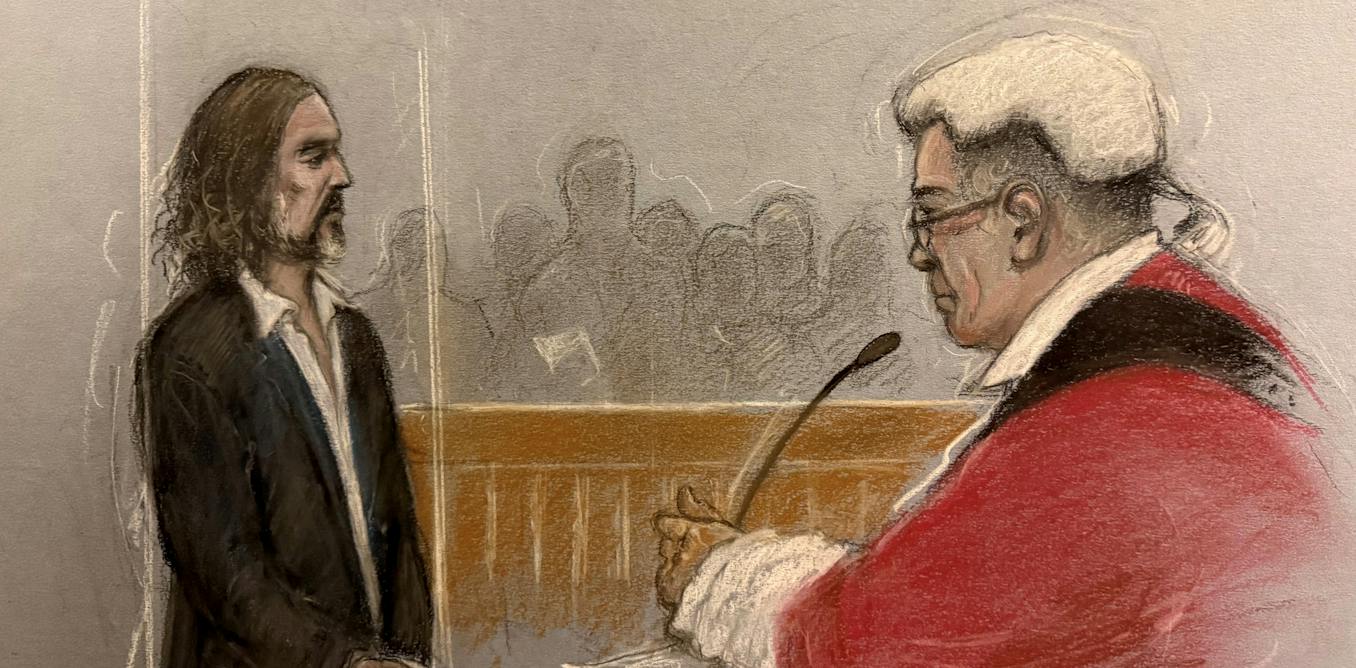
Russell Brand has been convicted of one count of rape and three counts of sexual assault and sentenced to ten and six months years in prison. The Age, The Herald Sun, The Guardian, the ABC and The Australian all reported extensively on the trial, verdict and sentencing. While it’s certainly newsworthy that another public figure has finally been held to account for years of predatory behaviour, the nature of reporting on celebrity rape trials is worth examining. As the UK’s Channel 4 reported, rape myths were a frequent and misleading feature in Brand’s trial. Read more: Rape myths shape how we respond to sexual violence. What are they and what impact do they have? Research in Australia has found rape myths are routinely relied on in rape trials, not only by defence lawyers, but also by prosecutors, judges, juries and police. One pervasive rape myth is the “monster myth”, the belief that rape is committed by monstrously deviant strangers who attack innocent young girls in public places. Research shows this myth is prevalent in media reporting of rape, which has an impact on public perception and acceptance of the monster myth. In reality, as Australian Bureau of Statistics data shows, the person most likely to rape a woman is a man who is her intimate partner. Rape myths in news media In my research (which has not yet been peer reviewed) I used the AustLii database to identify 32 rape cases in the County Court of Victoria that resulted in a guilty outcome between July 2025 and August 2026. Two of those cases were the Tom Silvagni trial and the Ralph Carr trial. I also searched for news reporting on those trials, finding 198 articles that fit the inclusion criteria. Between them, Silvagni and Carr received 85% of the media coverage of the entire dataset. Rape myths were present in almost 45% of the headlines in the dataset. They appeared in more than 60% of the non-celebrity cases (almost entirely centred on the monster myth) and just over 40% of the celebrity cases (where the myths that women commonly lie about rape and that men charged with rape are an object of pity predominated). Every publication in the study included rape myths in some of their headlines about rape trials. In other words, if media are reporting on a celebrity trial, too often the celebrity becomes the story, not the rape or the victim-survivor. If they’re reporting on rape cases, the monster myth is more likely to appear in the headline than the facts. Of the 32 cases I identified, 13 were cases of rape in a family and domestic violence (FDV) context. Less than 3% of the articles were about the cases involving rape in an FDV context. Journalists cannot identify the complainant (the legal term for the victim-survivor) in a rape trial, so if they report an FDV related rape case, they often cannot name the perpetrator because it can identify the victim-survivor. The courts often use pseudonyms for both people when they publish sentencing remarks. Journalists could report these cases using those pseudonyms, preserving the victim-survivor’s anonymity while still informing the public about the rape. I could not find a single article in my dataset that did this. Focusing such breathless attention on celebrity cases and the rare stranger-danger rape endorses exactly the kind of monster myths that The Guardian yesterday praised the judge in Brand’s trial for dispelling in his sentencing remarks. Suppression orders and the principles of open justice In both the Silvagni and Carr cases, the men involved had been granted suppression orders that prevented media identifying them before they were convicted. The Age, the Herald Sun, The Guardian, The Australian and the ABC all published editorials or opinion pieces on the principles of open justice and how suppression orders prevented journalists reporting on the functioning of criminal courts, an essential component of journalists’ role of keeping the public informed about the functions of a democratic society. The media cannot claim to be serving the principles of open justice and ride a wave of their own self-righteous anger at suppression orders when those orders do not prevent them covering the trial. Particularly when they are failing to cover so many trials that do not feature a well-known perpetrator. The celebrity is not the story. The rape is the story. The victim survivor and the effect he had on her life is the story. The structures that allowed him to commit his crimes can be the story, but breathless sensationalism has no place in reporting on rape.
When it comes to rape cases involving a celebrity, the media too often miss the point
Full Article
Original Source
Read the full article at Theconversation →KhanList aggregates and links to publicly available news content. We do not host full articles from third-party sources. Always verify important information with original sources.