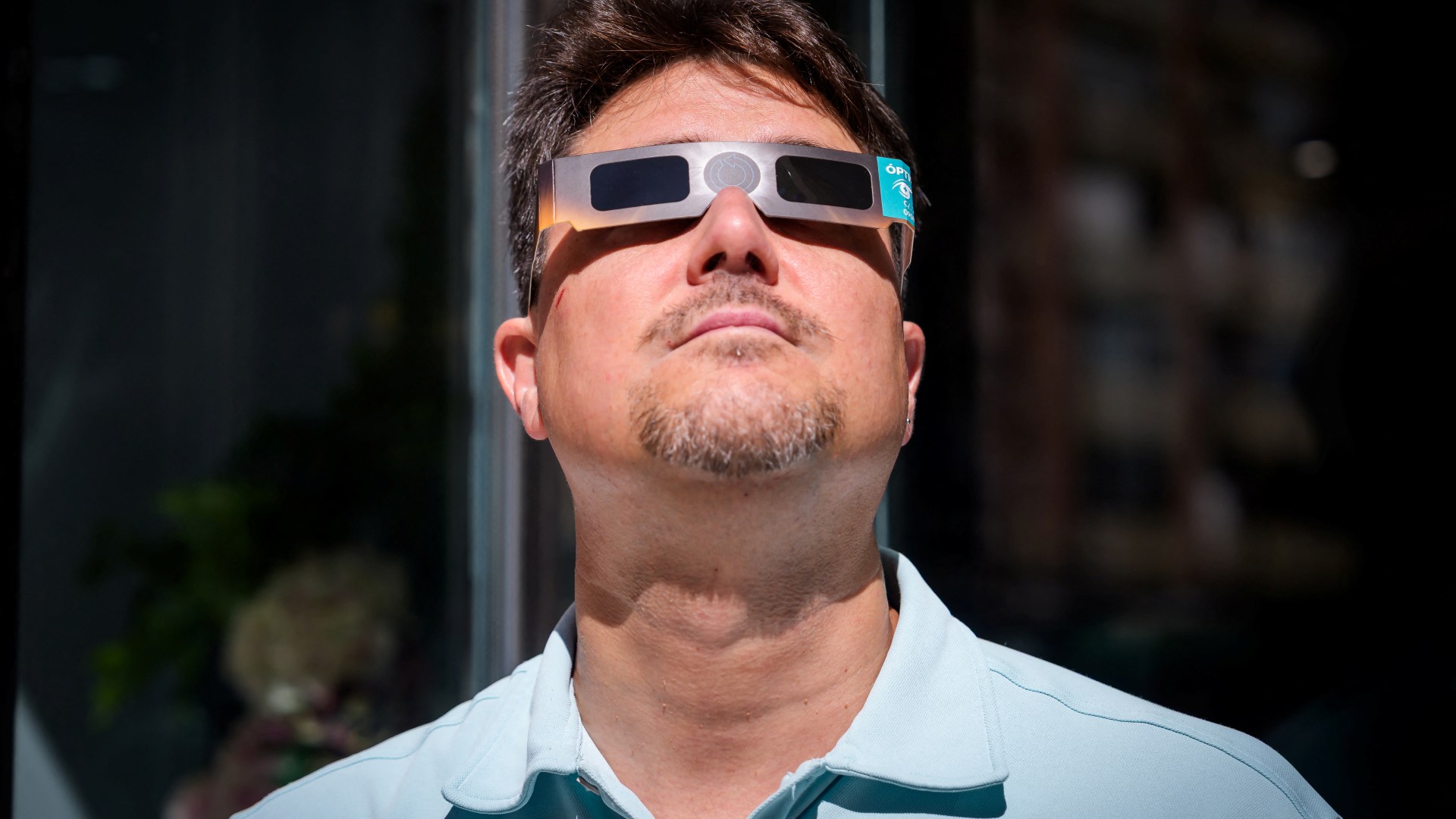
SKYWATCHERS are being urged to mark their calendars for what is being billed as the best solar eclipse the UK has seen in decades. Here is everything you need to know about the once-in-a-lifetime solar spectacle and how to view it safely. The next total solar eclipse to be visible from the British Isles will be in September 2090 Credit: Getty It is never safe to look directly at the sun during a partial eclipse Credit: AFP What time will the eclipse happen in the UK? A deep partial solar eclipse will sweep across the UK on Wednesday, August 12. Astronomers are calling it the most striking eclipse Britain has witnessed since 1999. Sign up for The Sun newsletter Thank you! The path of totality passes over northern Russia, the Arctic, Greenland, Iceland, the North Atlantic, large areas of Spain, and also a small corner of north-eastern Portugal. The path of totality is the narrow track across Earth’s surface where the Moon completely blocks the Sun, briefly plunging observers within it into total darkness. In the UK, observers will only see a percentage of the sun blotted out, but it will still be the vast majority of its solar disc. The moon will start to pass the sun at around 6.15pm, with maximum eclipse roughly an hour later between 7.05pm and 7.15pm, and the event finishing just after 8pm. Exact timings and coverage vary by location. The BBC‘s Sky at Night Magazine made a handy chart for the eclipse, complete with locations, timings and coverage: Most read in The Sun Valencia, Spain – total eclipse – 8.33pm CEST – 100% coverage Bilbao, Spain – total eclipse – 8.27pm CEST – 100% coverage Zaragoza, Spain – total eclipse – 8.29pm CEST – 100% coverage Valladolid, Spain – total eclipse – 8.30pm CEST – 100% coverage Madrid, Spain – partial eclipse – 8.31pm CEST – 99.97% coverage Barcelona, Spain – partial eclipse – 8.29pm CEST – 99.8% coverage Bragança, Portugal – partial eclipse – 7.30pm WEST – 99.9% coverage Lisbon, Portugal – partial eclipse – 7.36pm WEST – 94.5% coverage Porto, Portugal – partial eclipse – 7.32pm WEST – 98.2% coverage London, UK – partial eclipse – 7.13pm BST – 91.3% coverage Cardiff, UK – partial eclipse – 7.13pm BST – 93% coverage Edinburgh, UK – partial eclipse – 7.05pm BST – 91% coverage Belfast, UK – partial eclipse – 7.08pm BST – 93% coverage Dublin, Ireland – partial eclipse – 7.10pm IST – 94% coverage New York, NY, USA – partial eclipse – 1.54pm EDT – 9.5% coverage Boston, MA, USA – partial eclipse – 1.55pm EDT – 16% coverage Chicago, IL, USA – partial eclipse – 12.28pm CDT – 0.1% coverage Anchorage, AK, USA – partial eclipse – 8.21am AKDT – 27.9% coverage St John’s, NL, Canada – partial eclipse – 3.35pm NDT – 53.2% coverage Montreal, QC, Canada – partial eclipse – 1.45pm EDT – 18% coverage Winnipeg, MB, Canada – partial eclipse – 12.02pm CDT – 5.4% coverage Because the eclipse occurs in the evening in the UK, the sun will already be low in the western sky, meaning viewers will need a clear, unobstructed view towards the horizon. The last time any part of Great Britain saw a comparabe eclipse was March 20, 2015, when areas of Scotland saw as much as 98% of the sun obscured. Gibraltar, a British Overseas Territory, will see a total eclipse on August 2, 2027. The next true total solar eclipse visible from the British Isles will not occur until September 23, 2090. How can I watch it safely? It is never safe to look directly at the sun during a partial eclipse, even briefly. Certified eclipse glasses should be worn at all times if you intend to gaze skywards.. They should be checked carefully for scratches, tears or other damage before use, and children should be supervised throughout. Though they can help protect the naked eye, eclipse glasses must never be used to look through a camera, binoculars or a telescope. These instruments concentrate sunlight and require their own purpose-made solar filters. A safer alternative for those without glasses is to view the eclipse indirectly through a pinhole projector, which the Royal Observatory Greenwich says can be made using two pieces of paper, a colander, or even the natural gaps between tree leaves. The Royal Observatory Greenwich will also stream the eclipse for free from 6.15pm via YouTube and Facebook. Those hoping to make a night of it should also stay up well into the small hours, as the Perseid meteor shower peaks overnight between August 12 and 13, with the best viewing window between midnight and 5.30am. Comment now
When is the solar eclipse in 2026? Date, exact time and how to watch the phenomenon from the UK
Full Article
Original Source
Read the full article at Thesun →KhanList aggregates and links to publicly available news content. We do not host full articles from third-party sources. Always verify important information with original sources.