
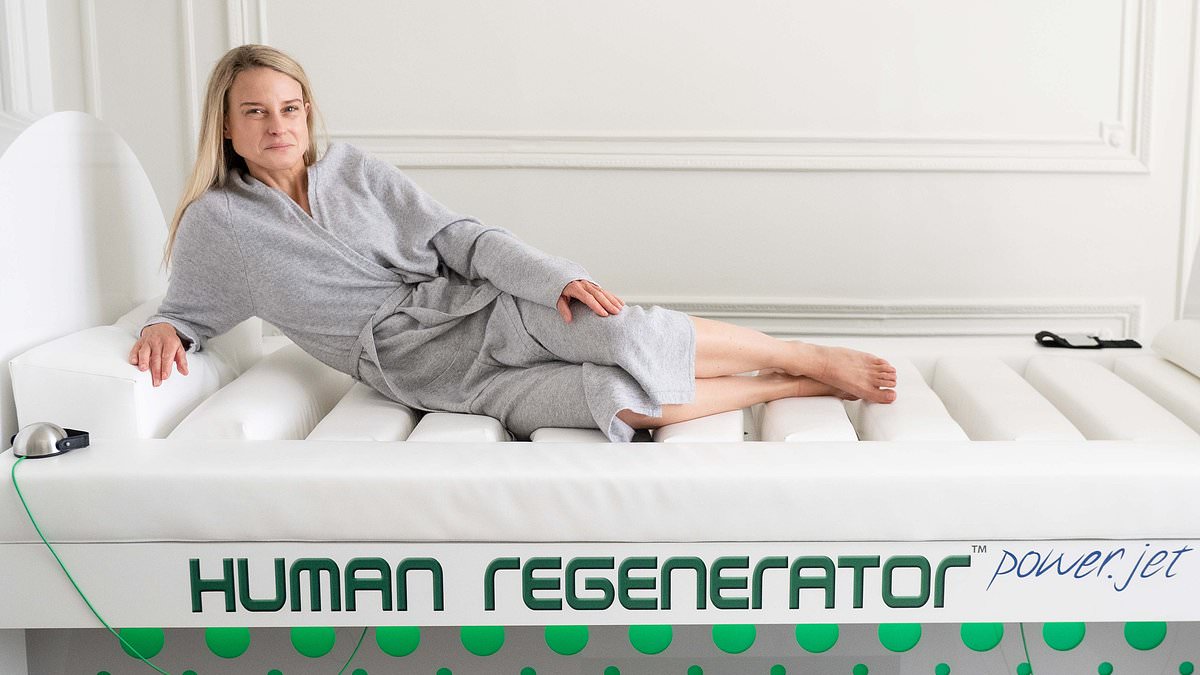
Jolting awake, I groan as I look at the clock and realise it’s only 3am. Yet again I’ve woken in the early hours.It’s unlikely I’ll drift off again now, meaning tomorrow I’ll be tackling another busy day while shattered.When younger I clocked up eight hours a night. Now, at 47, the pesky perimenopause has hijacked my sleep patterns.HRT patches curbed the dreaded night sweats but I rarely sleep well. Either my mind is whirring and I can’t nod off or I’m awake before dawn.Starting my day with three coffees has become standard as I try to jumpstart my body and brain. So when I heard about a new longevity device called the Human Regenerator dangling irresistible benefits – including better sleep and energy – it piqued my interest.So I arrive at Human Regenerator’s London office, one of seven UK venues, including spas and wellness clinics, to offer the treatment.As I step into the machine, which looks like a cross between an MRI scanner and a tanning bed, I have a vague notion of turning myself off and on again, like a computer, which sounds marvellous. But I am still not sure how that works on a human being.Originally designed in Germany, the Human Regenerator utilises Cold Atmospheric Plasma (CAP), a mixture containing electrons, ions and other reactive particles that behave differently from an ordinary gas. It’s found naturally in the sun, lightning and even the Northern Lights at extremely hot temperatures. Laura Stott tried out the Human Regenerator, which boasts benefits including better sleep and energyHowever, scientists have now learned how to create a cooler, more gentle version of it – an ionised gas which is safe and effective at room temperature.The Human Regenerator uses this to generate a controlled, cold plasma environment around the body.CAP technology is already widely studied and used in biomedical fields, including wound healing, dermatology, dentistry and cancer research.These applications are at differing stages of development and, as the Human Regenerator is a wellbeing, not medical, device, there’s no claim it can diagnose, treat or cure any conditions such as mine.But of notable interest for the wellness world is how CAP influences the body’s natural signalling processes, which help our cells to respond, adapt and maintain normal biological function. Still, physics isn’t my forte and, truthfully, I’m still a bit befuddled about what it does and how.Dom Jamieson, Human Regenerator’s CEO, attempts to explain it to me: ‘When you lie on the machine, you are surrounded by cold plasma that contains energised and charged particles that are invisible to the human eye. This interacts with the surface of the body, creating biological signals it can respond to.‘An analogy could be humidity in the air. You’re surrounded by it, and your body interacts with it, but you don’t absorb it.‘CAP helps create an environment that supports your body’s own repair processes and gives cells signals they can respond to, helping the body do the repair work it already knows how to do. Originally designed in Germany, the Human Regenerator uses Cold Atmospheric Plasma (CAP), a mixture containing electrons, ions and other reactive particles‘Issues women commonly struggle with during perimenopause and menopause, including poor sleep, low energy, brain fog and feeling generally “out of balance”, frequently improve. Women often report unexpectedly improved sleep after sessions, even if it wasn’t the reason for coming.‘It might be that CAP enables the body to shift into a calmer, restorative state. One previous client even experienced an end to her lifelong insomnia.’It sounds impressive, but I’m sceptical. And at £180 a session,with multiple treatments recommended, it is not cheap.GP Dr Helen Wall says I am right to be unconvinced.‘CAP is an interesting and emerging area of medical research, and there is some evidence for its use in specific areas such as wound healing and dermatology,’ she says.‘However, that is very different from saying that a whole-body device has been proven to improve sleep. There is currently very limited high-quality clinical evidence for these broader claims.’D espite this, I change into a cashmere dressing gown to minimise static and climb face-up on to the bed, hoping I’ll be just like that client who apparently cured her insomnia.My hands and feet are hooked up to stainless steel contact plates – I’m told these create a stable environment for the plasma exposure and help guide the flow of the CAP through my skin and into my body’s connective tissue – then, with a mild humming noise, it’s turned on.It’s not uncomfortable, but I experience a peculiar sensation of a low charge crackling beneath me, rather like mild pins and needles. This intensifies around my sore knees, which I’m advised can happen when there are existing aches.Then, lights dimmed, I’m left to relax for 40 minutes.There’s a temporary metallic taste, but otherwise it’s just like having a daytime nap.Afterwards I feel unchanged, but that’s quite common.It’s subtle but, come 9pm, suddenly exhausted, I go to bed and sleep deeply. I still wake early, but at 5.30am, not 3am. And I feel far more rested.For the next week I experience unarguably better sleep with fewer disturbed nights.Three weeks later, I’m not waking up in the early hours habitually any more, and it feels like the quality of my sleep has improved. For now, I definitely feel rebooted.
When I was younger I clocked up eight hours' sleep a night. Now, at 47, the perimenopause haunts my nights and turned me into an insomniac. So can a 'Human Regenerator' cure me?
Full Article
Original Source
Read the full article at Dailymail →KhanList aggregates and links to publicly available news content. We do not host full articles from third-party sources. Always verify important information with original sources.