
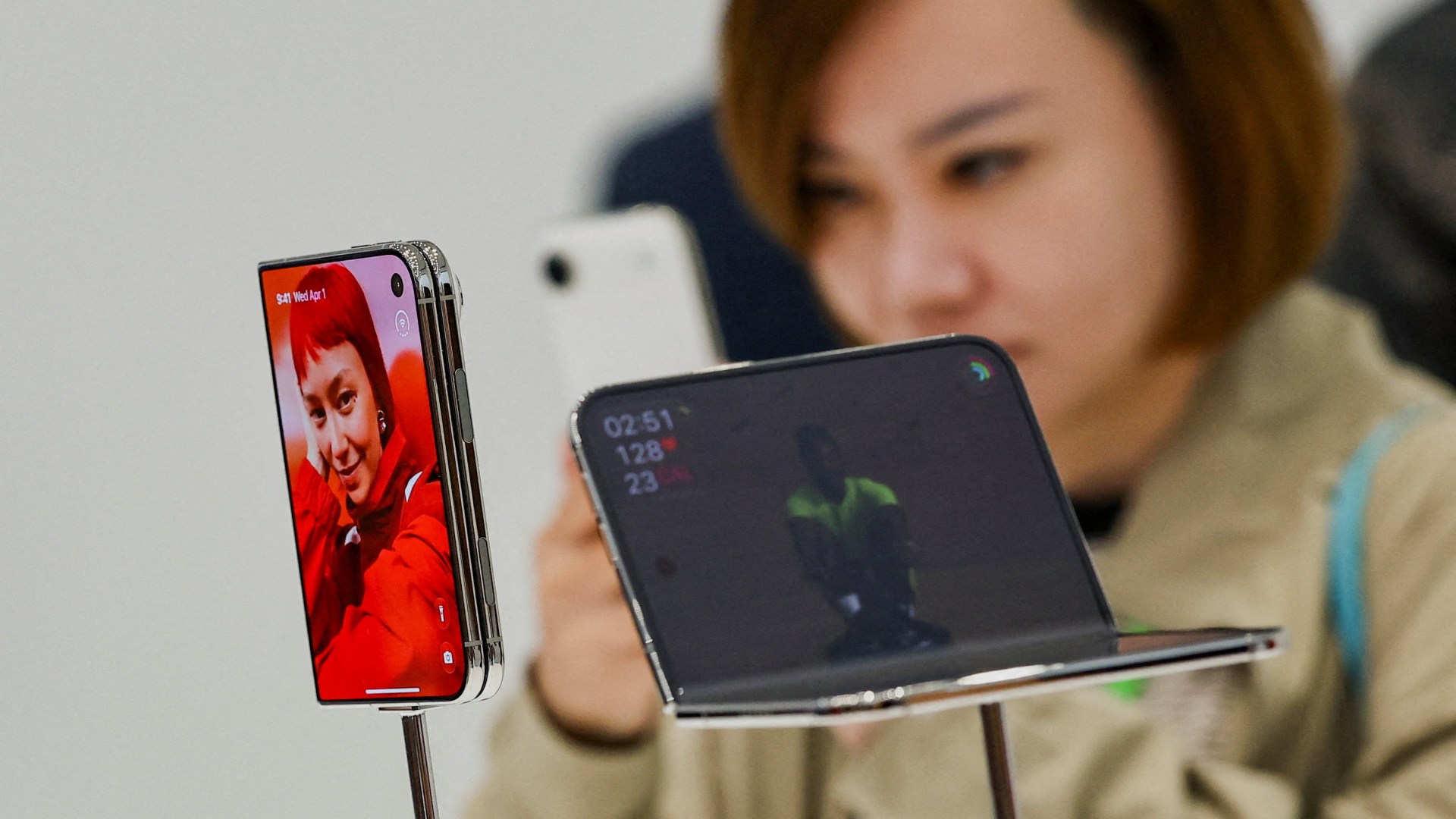
APPLE has ushered in a new era of smartphones following its ‘Surprise and Shine’ keynote event. Hosted for the first time by Apple’s new CEO John Ternus, the tech titan shocked the industry by pulling back the curtain on its long-rumoured first-ever foldable handset: the iPhone Duo. The iPhone Duo features a passport-style design that is wider than it is tall, opening and closing like a book Credit: Reuters UK pre-orders for the foldable open on October 16, with the phones hitting shop shelves full retail availability arriving on October 23 Credit: EPA Alongside this flagship foldable, Apple also unveiled its core workhorses for the year ahead, the iPhone 18 Pro and the top-tier iPhone 18 Pro Max. Here’s the full guide to release dates, UK prices, dimensions, specs, and standout new features across Apple’s latest line-up. Sign up for the Tech newsletter Thank you! What are the phones’ new features? Out of the box, all three handsets run on Apple’s iOS 27 operating system, bringing substantial speed and feature improvements to everyday tasks. Siri receives a long-awaited AI overhaul, transforming her into a far more capable digital assistant, and users can extend and re-frame photos post-capture using built-in AI tools. The iPhone Duo takes advantage of its 7.6-inch screen with side-by-side app multitasking, adaptable table positions (ideal for watching movies or joining Zoom calls), and a reconfigured lock screen with side-aligned widgets and StandBy mode. iPhone Handoff allows users to link one phone number across two separate iPhones simultaneously; EE is expected to support the feature before the end of the year. The phones also feature overhauled parental controls giving broader powers to limit access, while the Health app expands Cycle Tracking to support perimenopause and menopause monitoring. Screen measurements, dimensions, and form factor Apple has overhauled physical dimensions across the 18-series, introducing different screen designs for both the Pro handsets and the new Duo foldable. Most read in Tech iPhone Duo Unlike tall, narrow foldables, the iPhone Duo features a squat, passport-style design that is wider than it is tall, opening and closing horizontally like a book When the phone is ‘closed’, users have access to a standard outer cover screen with a traditional aspect ratio, allowing them to reply to texts, make calls, and browse apps without opening the device. But the phone can then open up to reveal a 7.6-inch tablet-style display. Once you’re done, the device can fold down again to fit neatly into pockets or purses. It’s all built from ultra-durable Grade 5 titanium, combined with Apple’s Ceramic Shield coating and full dust- and water-resistant certification. iPhone 18 Pro and iPhone 18 Pro Max The Pro lineup ditches the back pane cut-out block of previous years in favour of a smooth, seamless rear finish with a Burgundy colour option. The floating screen cut-out known as the Dynamic Island has also been shrunk significantly, maximising screen space. The iPhone 18 Pro features a sleek, lightweight body housing a high-refresh Super Retina XDR display with ultra-thin bezels. Meanwhile, the iPhone 18 Pro Max has a larger form factor designed for maximum media consumption while remaining slim in the hand. MagSafe support, processors, and technical specs All three new handsets support MagSafe wireless charging and magnetic accessories. The iPhone Duo features a re-engineered interior magnet array to allow MagSafe chargers, car mounts, and wallets to snap securely to the rear panel without interfering with the internal hinge mechanism. Technical Specifications Overview FeatureiPhone 18 ProiPhone 18 Pro MaxiPhone Duo (Foldable)ProcessorApple A20 ProApple A20 ProApple A20 ProCellular ModemHigh-Speed 5G ModemHigh-Speed 5G ModemApple C2 High-Speed ModemSIM SupportPhysical SIM + eSIMPhysical SIM + eSIMeSIM Only (Worldwide)BiometricsFace ID (Smaller Dynamic Island)Face ID (Smaller Dynamic Island)Touch ID (Side Power Button)ColorsBurgundy, Titanium, Black, WhiteBurgundy, Titanium, Black, WhiteStar White, Night SkyStylus SupportNoneNoneApple Pencil (USB-C) late 2026 The inclusion of Touch ID on the iPhone Duo marks the fingerprint scanner’s return to flagship iPhones after close to a decade. Apple has opted for a side-mounted fingerprint scanner on the Duo’s power button due to size constraints, avoiding the need for duplicate Face ID modules on both screens. You can enrol multiple fingers or unlock via your Apple Watch. What is the battery life like? Battery longevity takes a leap forward this year thanks to the energy efficiency of the new A20 Pro chip and refined internal thermal architecture. The iPhone 18 Pro Max leads the lineup with 45 hours of video playback, an all-time battery record for an iPhone. The iPhone 18 Pro can deliver up to 36 hours of continuous video playback, while the iPhone Duo offers tailored power distribution across both displays. Using only the outer display will give you up to 44 hours of playback, while the inner display can deliver up to 31 hours of playback. Using both screens will give you approximately 24 hours of charge, though the device can recharge to 50% in just 20 minutes via fast charging. What are the cameras like? The Pro models retain their raised camera plateau containing a triple-lens setup (Wide, Ultra-Wide, and Telephoto), but the main lens introduces a hardware variable aperture. This physical mechanism opens wider to allow more light in, enabling faster low-light shutter speeds, precise background isolation, and snappier autofocus performance. Apple has also introduced Apple Reference Image technology, a security feature that cryptographically signs photos at a pixel level at the moment of capture, allowing users to verify an image as an authentic photograph rather than an AI fake. Because of space constraints in its thin folded chassis, the Duo swaps the triple-camera setup for a streamlined dual-lens system. Its main camera is a 48-megapixel Wide lens using sensor crop trickery to replicate optical telephoto zoom, while the secondary camera is a 48-megapixel Ultra-Wide lens. The device includes a subtle under-display FaceTime lens on the inner screen, alongside a selfie camera on the outer display. And a playful new “Kid View” camera mode projects fun animations on the outer cover screen while you take a photo, helping to get kids to look at the lens. When can you buy the new phones? Tech fans won’t have to wait long to get their hands on Apple’s latest range. Though launch schedules vary depending on whether you are eyeing the “standard” Pro models or the foldable Duo. iPhone 18 Pro & iPhone 18 Pro Max: Pre-orders open in the UK on Saturday, September 12. High-street and online store availability begins less than a week later on Friday, September 18. iPhone Duo: UK pre-orders open on Friday, October 16, with full retail availability arriving on Friday, October 23. How much will the new iPhones cost? Upgrading your mobile this year will cost a bit more than previous generations. Apple has confirmed a price increase across its Pro line-up, driven by a worldwide memory supply shortage as AI firms buy up global RAM supplies. Industry expert Ben Wood from CCS Insight said: “The company has made no secret of the fact that prices would need to go up because of rising component prices. “Consumers can be relieved that Apple followed rivals such as Google and Samsung and only bumped up prices by $100 (£74).” iPhone 18 Pro and Pro Max UK prices iPhone 18 Pro: Starts at £1,199, a £100 increase over last year’s starting price. iPhone 18 Pro Max: Starts at £1,299. iPhone Duo UK prices 256GB: £1,999 512GB: £2,199 1TB: £2,599 2TB: £3,199 UK mobile networks including EE, Vodafone, O2, and Three will offer pay-monthly contract options, though the costs of those will likely reflect the increased hardware costs. Comment now
When do the iPhone 18 and iPhone Duo come out? Release date, price, dimensions, and features for Apple handsets
Full Article
Original Source
Read the full article at Thesun →KhanList aggregates and links to publicly available news content. We do not host full articles from third-party sources. Always verify important information with original sources.