
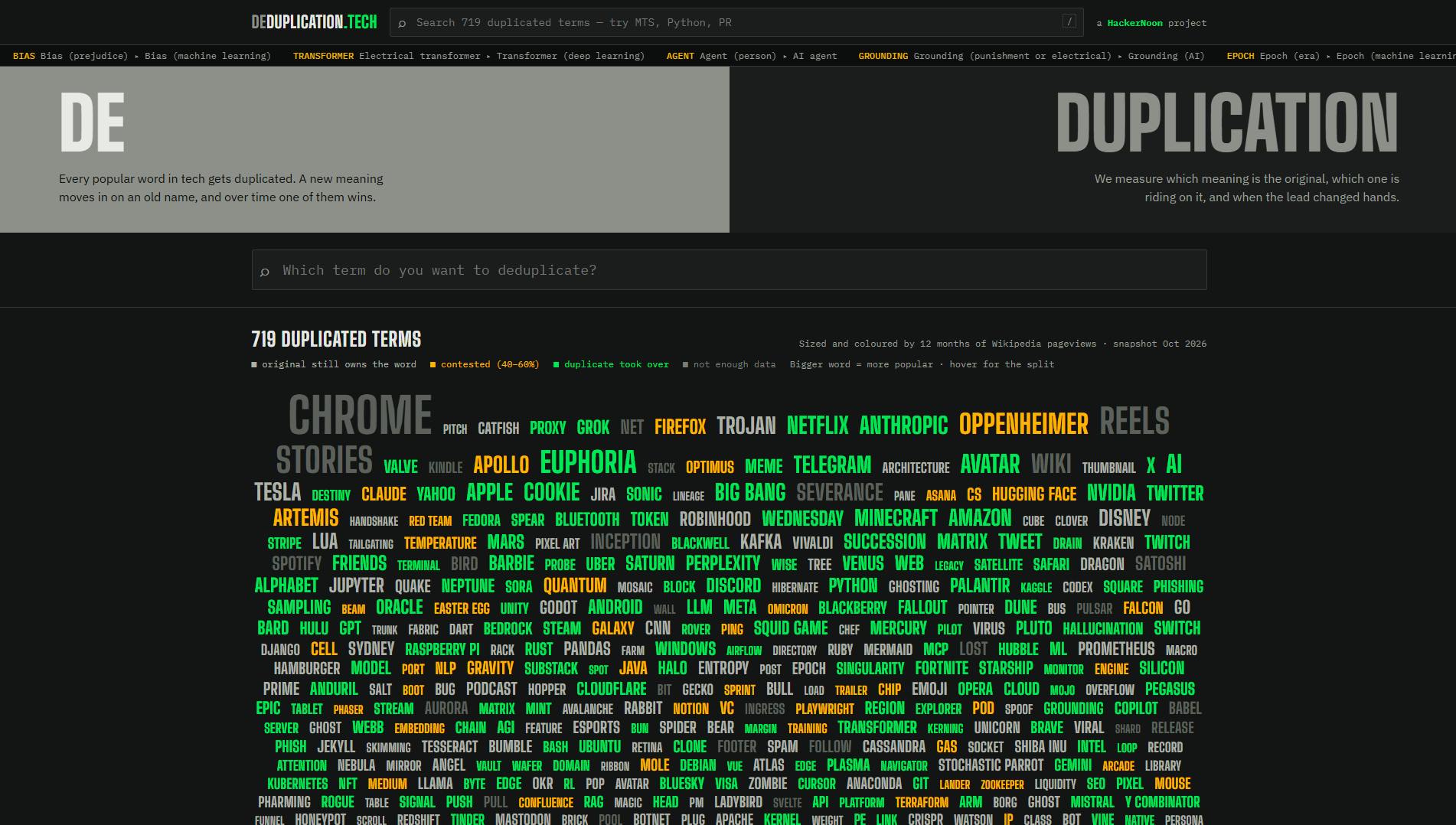
Words have a way of changing meaning, especially in tech. A bug used to be an insect. A mouse, an animal. A token, a coin. But as technology evolves, familiar words get borrowed, repurposed, and sometimes completely redefined. So, which meaning actually wins? Introducing Deduplication.tech, a new project by HackerNoon exploring the battle between original words and their tech-world duplicates. We’ve mapped 719 duplicated terms across 14 fields, from agents vs. AI agents, coins vs. LLM tokens, and snakes vs. Python to clouds vs. cloud computing, public relations vs. pull requests, containers, cookies, bugs, viruses, mining, wallets, threads, and NPCs. Each pair is scored using live Wikipedia pageviews to see whether the original meaning still dominates, the two meanings are competing, or the tech definition has taken over. You can explore the interactive word cloud, browse leaderboards, and dive into individual term pages to see how language is evolving across the tech landscape. 🔎 Take a Closer Look at Every Word Every duplicated term has its own dedicated page, where you can investigate both meanings and see how their popularity has changed over time. Each page includes: The original vs. the duplicate: Definitions, historical context, and when each meaning first appeared. Who owns the word? A visual breakdown showing how much attention each meaning gets, and whether the original, duplicate, or both are winning. Wikipedia pageview history: Interactive comparisons dating back to 2015, so you can see how interest in each meaning has shifted. The attention race: A timeline showing the duplicate's share of attention, including when it crosses the threshold to take over the word. The case for each meaning: Sourced definitions, usage statistics, and metrics such as pageviews over the past 12 months, year-over-year changes, and peak months. More ways to explore: Related terms, links to HackerNoon stories, and hashtags connected to each word. For example, take Surface: the original geometric concept versus Microsoft's hardware family. The page lets you see how the two meanings compete for attention and whether the tech duplicate has taken over. It's part language experiment, part data exploration, and entirely free and open. 🚀 Help Us Launch on Product Hunt! We're bringing Deduplication.tech to Product Hunt, and we'd love your support. Check out the launch, leave your thoughts, and give us an upvote to help more people discover the project. After all, words belong to whoever uses them. Or at least, that's what the pageviews will tell us.Happy exploring! 💚
When Did a Token Stop Being a Coin? Meet Deduplication 🔍
Full Article
Original Source
Read the full article at Hackernoon →KhanList aggregates and links to publicly available news content. We do not host full articles from third-party sources. Always verify important information with original sources.