
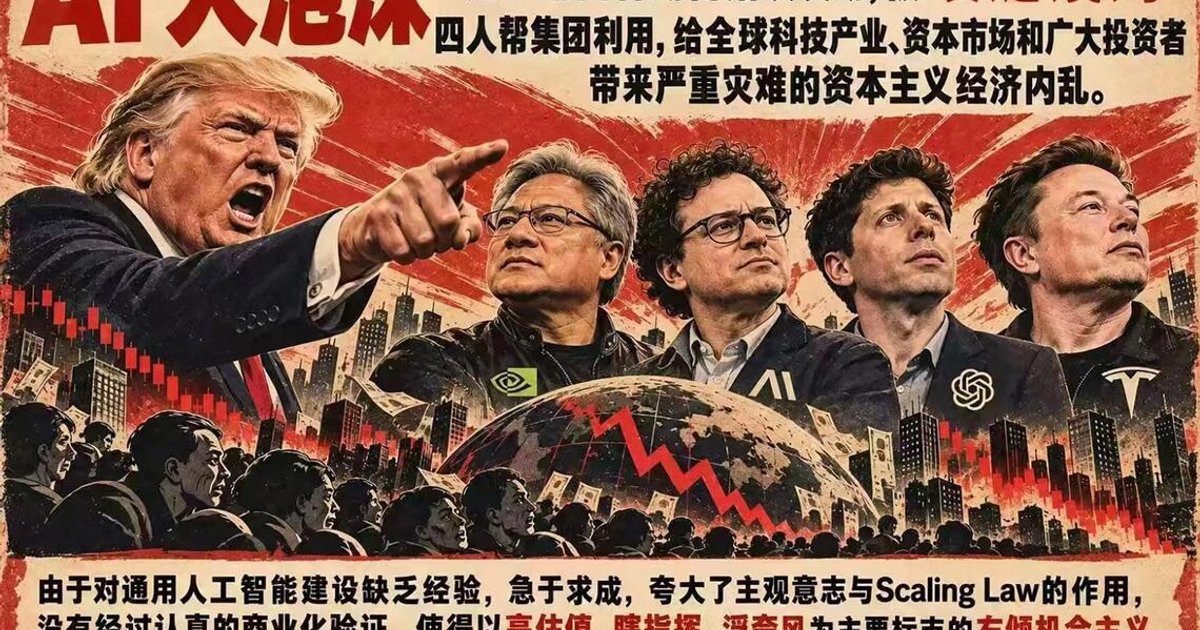
BEIJING – Days after the Nov 3 US midterm elections, a report on the Democrats calling for a crackdown on the country’s runaway artificial intelligence boom started circulating on Chinese social media.The report, which appeared on WeChat, seemed timely. After all, the issue of AI was a hot campaign issue in the 2026 midterms.But one detail gave it away: Purportedly from US news agency Associated Press (AP), the report urged US officials to “thoroughly study and grasp the important spirit” of the Democratic Party’s platform on curbing tech monopolies.The ponderous prose mimics the distinctive brand of officialese used by the Communist Party of China rather than anything US politicians would ordinarily say.That report was a spoof and one of several parodies in which Chinese netizens are having a field day mocking President Donald Trump’s AI ambitions following his Republican Party’s bruising midterm defeat.“Data centres are for computing, not speculation,” the “Democrat Party” declared in the fictitious AP report, echoing Chinese President Xi Jinping’s famous dictum that houses are for living in, not speculation.The Democrats, according to the spoof, would also impose “three red lines” to curb excessive borrowing by AI companies, just as Beijing did for heavily indebted property developers. It even calls for redeveloping obsolete computing facilities, borrowing language from China’s urban renewal campaigns.The target is American, but the political language – and the excesses it evokes – is unmistakably Chinese.Another parody, which first appeared in October but resurfaced after the midterms, takes the form of a Mao-era propaganda poster condemning the “Great AI Bubble”.It accuses Trump of launching a disastrous campaign, carried out by a “Gang of Four” comprising Nvidia’s Jensen Huang, Anthropic’s Dario Amodei, OpenAI’s Sam Altman and Tesla’s Elon Musk, that has brought “serious capitalist economic turmoil” to the global technology industry.The original Gang of Four comprised Mao Zedong’s wife, Jiang Qing, and three radical allies who helped lead the Cultural Revolution (1966-1976), a political campaign launched by Mao.Some netizens likened Trump’s AI push to Mao’s disastrous Great Leap Forward launched in 1958, when political zeal and unrealistic production targets contributed to a devastating famine.For example, in a lengthy satirical post on X on Nov 6, commentator Cui Mao gave a technological twist to a notorious agricultural slogan from the Great Leap Forward, changing “The bolder the people, the greater the land’s output” to “The bolder the people, the greater the GPU output”. GPUs, or graphics processing units, are powerful computer chips used to train and run AI models.The satire imagines Silicon Valley embarking on “backyard model training”, with AI companies forming “communes of 10,000 GPUs” – references to Mao’s people’s communes and backyard steel furnaces.The comparison casts Trump’s heady push for AI as another campaign mobilisation, evoking a history all too familiar to Chinese people, in which grandiose ambition and unrealistic targets brought suffering to regular folk.The mockery might resonate with Americans themselves, as a growing backlash against energy-guzzling data centres helped fuel a historic blue wave.US voters opposed data-centre development in 44 of 45 local ballot measures with complete counts held alongside the midterm elections, according to consulting firm Redbud.Democrats are now preparing legislation to protect consumers from electricity price increases linked to data centres and impose tougher AI oversight when they take control of Congress in January.What US AI setbacks could mean for ChinaFor China, which regards AI as critical to national strength, a sustained slowdown in the US’ computing infrastructure expansion could give it more room to catch up with the US.But not all of the US’ AI troubles spell good news for China.Take the case of Jensen Huang, one of the four tech titans lampooned in the Mao-style poster. On Nov 8, Nvidia announced an investigation into Huang’s affair with a Chinese businesswoman suspected by US intelligence of spying for Beijing, although the company said it had no evidence of any security breach.Beijing has previously dismissed the espionage allegations. Trump told reporters on Nov 8 that he would still take Huang to the APEC summit in Shenzhen, China, the following week.Still, the scandal could complicate the AI rivalry in unpredictable ways. Huang, a celebrity in China who was mobbed by fans and invited to address a major supply chain expo in Beijing in July 2025, has been a vocal advocate for selling US AI chips to China.If the allegations weaken Huang’s influence in Washington, Beijing could lose an important ally in its efforts to maintain access to US technology.Meanwhile, Chinese netizens have been busy “eating melon”, or gleefully following the gossip. Some joked about the inevitability of wealthy men having affairs, while others wondered whether Huang’s wife would claim half his collection of black leather jackets in a divorce.For all the amusement at the US’ expense, the mockery also carries an irony closer to home.China has had its own AI infrastructure excesses, with a frenzy of data-centre construction leaving less than 40 per cent of its computing capacity utilised in 2025. But Chinese residents have fewer avenues than their US counterparts to challenge data centres springing up in their neighbourhoods.In mocking the US, Chinese netizens are also holding up a mirror to their own country. Making the US the butt of their jokes gives some Chinese an outlet to poke fun at familiar political excesses without directly challenging their own authorities.The memes also offer Chinese readers a chance to revisit, however irreverently, historical upheavals that caused unspeakable pain to many. The Great Leap Forward and Cultural Revolution remain sensitive and contentious subjects, leaving critical discussion vulnerable to censorship.That is why the spoof of US Democrats speaking in Communist Party jargon feels so natural: Even as Chinese netizens laugh at the US, they are recognising something of their own country in the caricature.
When China laughs at America’s AI boom, the joke cuts both ways
Full Article
Original Source
Read the full article at Straitstimes →KhanList aggregates and links to publicly available news content. We do not host full articles from third-party sources. Always verify important information with original sources.