
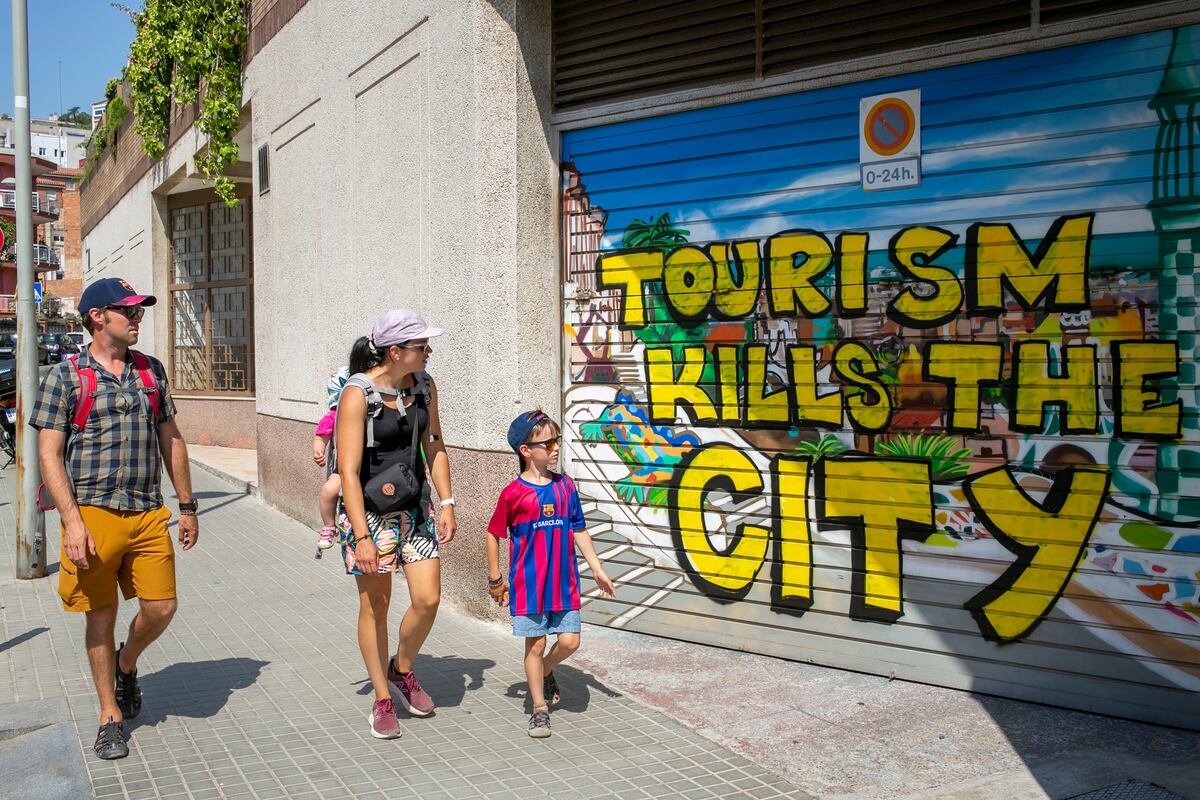
“What struck me most when I arrived is that Barcelona is crowded,” says Katie Boggs, a 26-year-old American content creator who uses her social media to record cultural differences with a humorous twist or to share her favorite corners of the Catalan capital. “I know it sounds funny to say this as an immigrant, but there’s a lot of tourism and that creates an artificial and low-quality vibe,” she adds. “Everything is so overproduced and so saturated with tourists that people don’t connect with Catalan culture.” Boggs is clear that her videos have “completely changed” after four years in Spain: “I arrived with that mindset of a foreigner who finds everything incredibly cheap. Now I think it’s quite the opposite, and I never make those clips where you simply recommend moving here or advertise a café as the best in town.”Like Boggs, thousands of Instagram and TikTok accounts record the daily lives of foreigners living in Spain on incomes higher than locals might expect. Some of these accounts are focused on humor, others on cultural outreach, and many are dedicated to promoting “authentic” spots — something which hospitality companies may pay for and tourists, travelers, expats, and immigrants may appreciate.Something similar was going on during the first half of the 19th century when travel books on Spain became bestsellers in France. At that time, travelogues such as those by Alexandre Dumas (From Paris to Cádiz) and Théophile Gautier (Journey to Spain) became popular; then there was A Winter in Mallorca in which the French writer George Sand, who published under a pseudonym, recounted the months of 1839 that she spent on the island with her lover, the pianist Frédéric Chopin. Today, social media is brimming with British and German recommendations of “the best Mallorcan spots”, unknowingly reproducing some of the clichés that were coined almost two centuries ago. If Sand flagged up the “slowness of the natives,” content creators refer to this laidback approach using adjectives such as “calm” and phrases such as a “Mediterranean lifestyle,” which amount to the same thing.I consider myself an immigrant. I moved to Spain in 2019 with the intention of staying, and I think those terms [expat and immigrant] refer to both class and the intention – or lack thereof – to integrateMaggie DickmannSo, to avoid reviving old clichés or a scenario such as happens in the fifth season of Emily in Paris, when the town of Solitano loses its charm because the protagonist — a prototype of American influencers in Europe — attracts thousands of disrespectful visitors with viral posts, many foreign influencers are beginning to wonder what to say about Spanish cities. After all, phenomena like mass tourism and gentrification have impacted them as well.From tourist to traveler and migrant to expat “For me, the difference between tourist and traveler is tricky and has a lot to do with elitism and our need for distinction,” says anthropologist Amarna Miller, author of Beyond the Map, in which she argues that travel can continue to have positive impacts. “We associate the tourist with derogatory and somewhat caricatured categories, while the traveler is perceived as more refined,” she says. “It’s an absurd distinction, because whenever we’re using certain infrastructures – flights, buses, restaurants, hotels – we form part of the tourism industry whether we like it or not.”Meanwhile, the boundary between immigrant and expat is actually a matter of class; many foreigners from highly developed countries like Maggie Dickmann, creator of @MurciaSecreto, want nothing to do with the expat label. “I consider myself an immigrant. I moved to Spain in 2019 with the intention of staying, and I think those terms refer to both class and the intention — or lack thereof — to integrate,” she says. “I always thought an expat was someone less willing to become a member of the local community. I suppose that translates to classism or privilege.” Now that protests against mass tourism or gentrification are targeting foreigners on high incomes settling in Spain, Professor Paula Simó, from the University of Valencia, points out that the phenomenon is not necessarily negative but rather “becomes regressive when the housing supply is rigid and regulation weak because then profits are made on land prices with the cost of that passed on to tenants, and a risk of social segregation emerges,” she says. “It is important that the debate should be framed in terms of income, not passport. A high-income local produces similar effects on a housing-stressed district.”Internet-optimized communication impoverishes the understanding of places, reduces their cultural complexity to a few visual codes, and turns residents into backdropsPaula Simó, University of ValenciaPeople like Boggs or Dickmann are perfectly aware of this impact on housing; they themselves struggled to find an affordable place to live in Barcelona and Murcia. They are also aware of the inconveniences caused by mass tourism, but they believe careful communication is possible. “I fully understand the fear and the desire to protect your favorite local spots. I get comments like ‘Guiri, go home’ and worse [guiri being the word for a white, north European or American tourist].”“But those nasty comments make me roll my eyes because those people don’t understand the purpose of my account and my content. Yes, it’s in English, but that’s only so it’s more accessible. In fact, the first two years of @MurciaSecreto were in Spanish because I started the account as a way to integrate. I only switched to English about a year ago because I realized there was a need for a bilingual gastronomic account in Murcia, and that’s when it started to grow. I think that’s evidence that many foreign visitors and residents want to participate more in Spanish life, but don’t have the tools to do so,” Dickmann explains.That city doesn’t need another reel At the Gates of Heaven, the name given to the Pura Lempuyang Luhur complex in east Bali, there is a well-known Instagram image of a lake that turns out to be an illusion created by a photographer who sits under an umbrella and holds a mirror underneath an iPhone to create the reflection. In reality, there is only a stone pavement. As journalist Kyle Chayka says in FilterWorld: How Algorithms Flattened Culture, the most popular destinations have been the subject of tricks designed to satisfy engagement metrics and achieve algorithm reward. “Internet-optimized communication impoverishes the understanding of places, reduces their cultural complexity to a few visual codes, and turns residents into backdrops,” says Paula Simó.However, for people as active on social media as Amarna Miller, it’s possible to reach a compromise, and treat algorithms in the same way as any other mass media outlet might: “I don’t feel like a slave to the algorithm, because for me the message is more important than going viral,” she says. “That said, any piece of entertainment always respects certain parameters in order to reach the maximum number of viewers. And I don’t think that’s bad; the problem arises when clichés are used or when complex cultural issues are simplified.”Although one might think that Spain, seen through the eyes of romantic travelers or given its own self-image as exotic — “Spain is different” — is now safe from simplification, what has happened is that the focus has merely been tweaked: “Now it is less about the primitive or picturesque and more about lifestyle. The recurring themes are siesta, partying, midnight dinners, street life, and above all, the low cost of living. Much of the appeal rests on economic asymmetry, because what is presented as quality of life is, in part, due to relative purchasing power versus lower local wages. The content is also designed for the audience of the country of origin, as a means of comparison,” explains Simó. That said, Simó perceives two important differences between now and the era of Dumas or Gerald Brenan: the first is that locals can correct or parody that content on social media, and the second is that some local content creators adopt those clichés because they have detected their algorithmic reward.The popularity of these platforms both among Spaniards and foreigners is confirmed by how often traditional media cite the opinion of a foreign traveler to achieve viral headlines such as, “An American influencer reveals Spain’s best-kept secret” or “The American influencer stunned by the Málaga Fair.” That foreigners are the best Hispanists is almost another cliché – an idea that was promoted by a scene starring Glenn Close in the award-winning movie La Bola Negra, directed by Javier Calvo and Javier Ambrossi. Besides apparently being able to capture Spanish culture and customs in an easily digestible format, they are also capable of generating business.David Díaz, head of social media at Minor Hotels, which has more than 84 establishments in Spain, explains that right now more than 60% of guests are inspired by social media to make the trip. He also says that his company has managed to access a different market thanks to influencers. Moreover, specialized creators, whether foreign or Spanish, “generate greater audience retention” and a real impact on the number of bookings, while more traditional national figures such as journalists affect brand image more. Dickmann points out that much of the feedback she receives comes from Murcia residents who have learned to see the restaurants in their city in a new light.Although the most numerous accounts are those focused on spectacular views or affordable leisure in Spain, many content creators who have been established in the country for a while are exploring other types of content. Boggs’s advice: “Above all, research, learn the language, and don’t come thinking you’re super rich because everything is very cheap: that’s a terrible mentality.” With this approach, there’s room for even the most traditional entertainment. Because sometimes it’s fun to see what surprises an American the most. For example, in Murcia, Dickmann talks about how genuinely warm and welcoming people are, while also mentioning “The Sidewalk Phalanx” — the lack of spatial awareness with groups of three occupying the entire sidewalk and people walking or stopping near you even when there’s space to give you a wider berth, treating “the street as an extension of the living room,” “the unfiltered gaze,” especially from the elderly, and “sheer devotion to [department store] El Corte Inglés,” and “the frenzy around Cortylandia.” She has our number.Sign up for our weekly newsletter to get more English-language news coverage from EL PAÍS USA Edition
When an American influencer recommends a bar in Spain: why Spaniards are fascinated by how foreigners see them
Full Article
Original Source
Read the full article at English →KhanList aggregates and links to publicly available news content. We do not host full articles from third-party sources. Always verify important information with original sources.