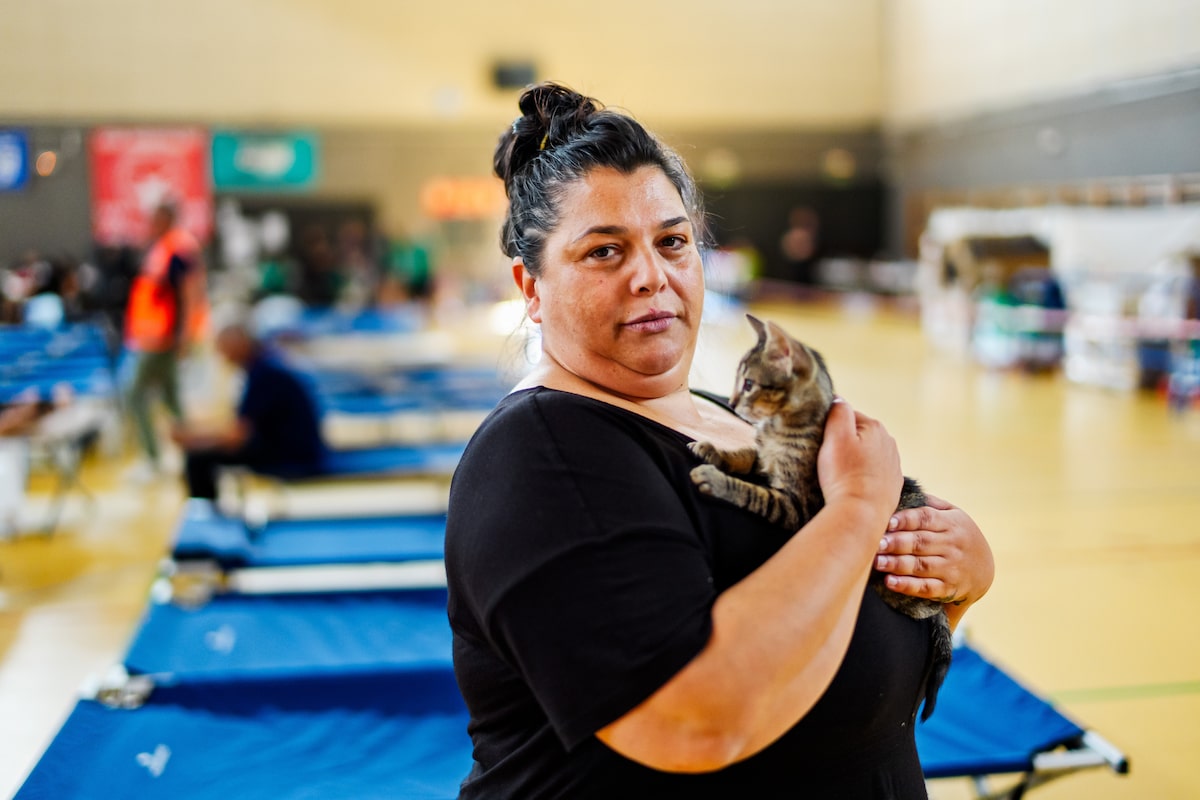
On a recent afternoon at the Beats Fitness Center in Móstoles, southwest of Madrid, performers set up stage lights and speakers to perform a children’s play at the makeshift wildfire shelter. A volunteer nurse checked evacuees with a stethoscope. Other volunteers distributed food from local supermarkets and painted children’s faces in a special “kid zone.” Some of the children told their parents they didn’t want to go home as they thought it was summer camp rather than a shelter for people fleeing wildfires. While firefighters battle Spain’s worst wildfires on record, a quieter operation has been under way in spaces such as the Beats shelter, as Spanish volunteers mobilize to help some of the 91,000 people across the country who were ordered to evacuate or remain in shelter by the fires that have destroyed at least 100 homes and reached 78,000 hectares. Volunteer Sandra Lara, 35, of Móstoles, had first tagged along out of curiosity to see how she could help the 175 adults and children housed at the Beats shelter. She soon found herself rolling up her sleeves, organizing donated clothes and helping to distribute them. She also gave out “a lot of hugs,” she added. “They are our people and they left their homes without anything.” And if the fires weren’t contained, her area could be next.Open this photo in gallery:Sandra Lara came to Móstoles to help the evacuees get a place to sleep, clothes to wear and hugs for comfort.Some 150 volunteers in Móstoles have spanned out across three sports centres turned into evacuation shelters for more than 400 people. They join police forces, civil defence units, Red Cross workers and other health emergency services who were stationed to help. This show of solidarity was a lifeline for Nuria Sanchez, 48, and her family from Fresnedillas de la Oliva, a small municipality more than 40 kilometres west of Madrid. Five days earlier, they complied with a government alert to prepare an emergency three day go-bag. But when they were dropped off at the shelter in Móstoles, a stranger immediately came up to her and asked: “What do you need?”“Some random guy got me everything we asked for,” she recalled of the volunteer. Ms. Sanchez had thought her village of 1,800 people was a good place to raise her daughter, but now she is re-evaluating staying in the countryside after the wildfires. “All of Spain is burning,” she said. Nuria Sanchez and Manolin the cat made it safely to the shelter in Mostoles; so did Enzo López Pérez, 6, who arrived from Cadalso de Los Vidrios with his mother, Tamara Pérez Calvo, 37, and grandmother, Maria Pérez Calvo, 56. Open this photo in gallery:Abdul Aziz, also from Cadalso de los Vidrios, ended up in a shelter in Alcorcón. He had never been evacuated for a wildfire before.Open this photo in gallery:Christina Dinu came to Alcorcón with 10 cats, plus a vial of holy water from a shrine dedicated to the patron saint of animals.Just seven kilometres away from Móstoles in Alcorcón, an arts community centre was transformed into a tentative home for more than 50 people. “We didn’t have beds, towels, nothing,” said Alessandra Romero Guijarro, a volunteer co-ordinator at the shelter. “So we roll up sleeves up and get to work.” The first evacuees to arrive days earlier had been elderly patients from a nursing home. The town mobilized to get them prescriptions left behind in the hasty escape. Officials allocated funding to procure necessary supplies and opened the town’s swimming pool for children. Local police offered rides. Malika Toudda, 43, and her husband Rashid El Koudire, 54, had seen fires before, but never of such a destructive magnitude. The couple – originally from Morocco – fled their town of Cenicientos, at the foot of the mountains to the west of Madrid, by car, carrying with them only their Spanish and Moroccan documents. “The clothes I can buy,” Ms. Toudda said. “The papers – I don’t want to go through the bureaucracy again.”Many evacuees brought their cats and dogs with them, but Ms. Toudda had to leave their dog, Kiara, and cats, Simba and Nala, behind. Their other relatives also had to fit in the vehicle. The thought of her pets potentially dying made her cry. The couple and other relatives returned home on Wednesday to see if their house was still standing. But the fresh empanadas, fried dough, macerated peaches and chocolate cake that volunteers distributed Tuesday night helped Ms. Toudda push aside her fear. “They make you feel at home, they make you feel like a small kid because they bring the things to your hand,” Ms. Toudda said. Outside the centre, other evacuees prepared to board a large green city bus that would take them back to their homes in towns deemed safe again. Volunteers hugged Abdul Aziz, 29, an electrician from Cadalso de los Vidrios, about 65 km west of Madrid, as he left. The father of three was anxious to know if his house was still in one piece. This was his first evacuation. On Wednesday, he sent an update: his house was untouched. But the road home was an expanse of land scorched by fire. Fires of the future: More from The Globe and MailThe Decibel podcastFirst Nations spent centuries managing forests with fire, though their practices were suppressed in much of Canada. Is it time to rethink that? Anishinaabe scholar Riley Yesno spoke with The Decibel about the history and politics of shaping the landscape. Subscribe for more episodes.CommentaryGlenn McGillivray: Why humans can’t outfight Canada’s boreal firesPeter Kuitenbrouwer: Canada’s forest industry plays a big part in the wildfire problem. Will it be part of the solution?Editorial: Ontario blows fiscal smoke on firefighting
When ‘all of Spain is burning,’ everyone pitches in at wildfire shelters
Full Article
Original Source
Read the full article at Theglobeandmail →KhanList aggregates and links to publicly available news content. We do not host full articles from third-party sources. Always verify important information with original sources.