
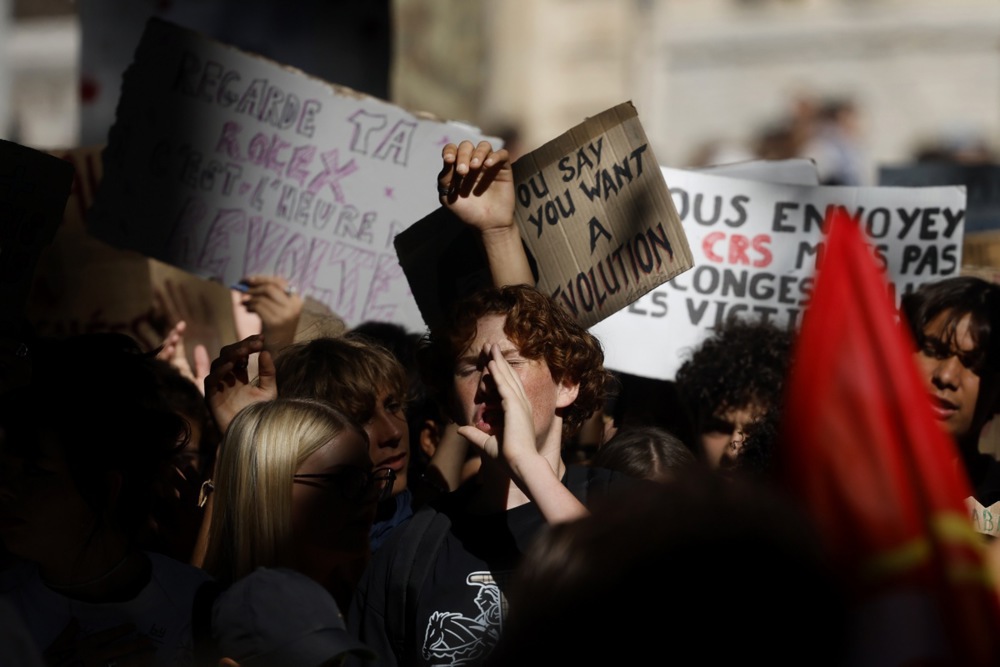
France’s lycée students have taken to the streets over shortages of teachers, crumbling buildings, and inequalities that determine educational opportunities and university admissions. Yet, as political parties and trade unions joined the protests and students found themselves confronted by riot police, the debate shifted from their demands to their inability to act for themselves. In France, adultism has deep roots, reflected in negative stereotypes of young people, their gradual exclusion from public spaces, and the persistent assumption that children are politically innocent and therefore easily manipulated by adults. Here lies a democratic paradox: children are expected to develop into politically responsible citizens, but when they start behaving like them, their political agency suddenly becomes questionable. Lost in this debate, however, is the fact that students are making political claims of their own, challenging not only their school conditions, but also the political decisions and budgetary priorities that perpetuate these inequalities and jeopardise their future. A right to speak, but who will listen? Beyond the political controversy, children are already political citizens, even without voting rights. The UN Convention on the Rights of the Child, ratified by every state except the United States, guarantees freedoms of expression, association and peaceful assembly, and requires children’s views to be given due weight in matters affecting them. The EU and France also have legal provisions recognising children's participation rights, including in educational governance. However, political citizenship extends beyond a formal legal status to participation in public life, where children can actively exercise political agency through expression, collective action, and political claims. Their exclusion from electoral politics does not diminish their political legitimacy, nor relieve states of their obligation to take their voices seriously. But can blockades and protests bring about the change children demand? Faced with hundreds of thousands of demonstrators taking to the streets across France in support of students, the French government appears to have rediscovered the virtues of listening to children, launching consultations and promising stronger student representation, more teachers, and funding for school renovations. Student representatives welcomed some of these commitments, but insisted on seeing actual renovations and additional teachers in classrooms. With the 2027 presidential election approaching in France, these commitments risk becoming entangled in campaigning, and potentially overshadowing children’s demands with competing political agendas. The question is what will come of the promises; and just as importantly, who will be held accountable, and how, if those promises are never delivered? Adults arrive, children disappear? The growing involvement of adults (teachers, parents, unions) in the protests also fuelled accusations of political instrumentalisation: the government was quick to accuse left-wing La France Insoumise (LFI) of manipulating the children. If there was any adult interference, it deserves scrutiny, but assuming that children must be manipulated whenever they organise politically is mere adultism disguised as paternalistic concern. Concerns over the criminalisation of children’s protests have also grown. While incidents of vandalism and violence overshadowed students’ demands, the crackdown was striking: by 14 October, 6,773 minors had been taken into custody, with 2,190 of them facing prosecution. Children are apparently mature enough to face legal consequences, even as their political competence is questioned. Meanwhile, investigations into police violence against minors raise questions about the state’s duty to protect them. As the riots of 17 October erupted into violence and chaos, students’ demands seemed to have faded from sight amid an increasingly heated debate over public order and wider social and political tensions. Around 70,000 police officers were deployed across France following violent nationwide protests on 17 October 2026 (Source: EPA/YOAN VALAT) Meanwhile, protests by young people have also taken place elsewhere in Europe, in Belgium, Spain, Italy, Greece, and Albania. Although grievances and political circumstances differ, these protests reveal an important distinction between schoolchildren and university students as political citizens. Most university students can vote, allowing them to turn collective mobilisation into electoral pressure, as Serbia’s student-backed movement showed when it won the parliamentary election on 25 October. But most secondary-school pupils have no equivalent leverage: their political citizenship depends on adults and institutions taking their demands seriously, without constantly calculating how many votes they could win or lose. Beyond the diverse political interpretations of these protests lies another important question: what will children themselves take away from these experiences, and how might these impact their political citizenship? They may seek greater influence through consultations, intensify protests or create alternative forms of participation. But if their demands continue to fall on deaf ears, while protesting exposes them to the threat of police repression and to adultism, disillusionment may instead drive some away from political participation altogether. The promise of children’s rights to be heard was certainly more ambitious than that.
When adults take over youth protests, EU children’s own demands vanish
Full Article
Original Source
Read the full article at Euobserver →KhanList aggregates and links to publicly available news content. We do not host full articles from third-party sources. Always verify important information with original sources.