
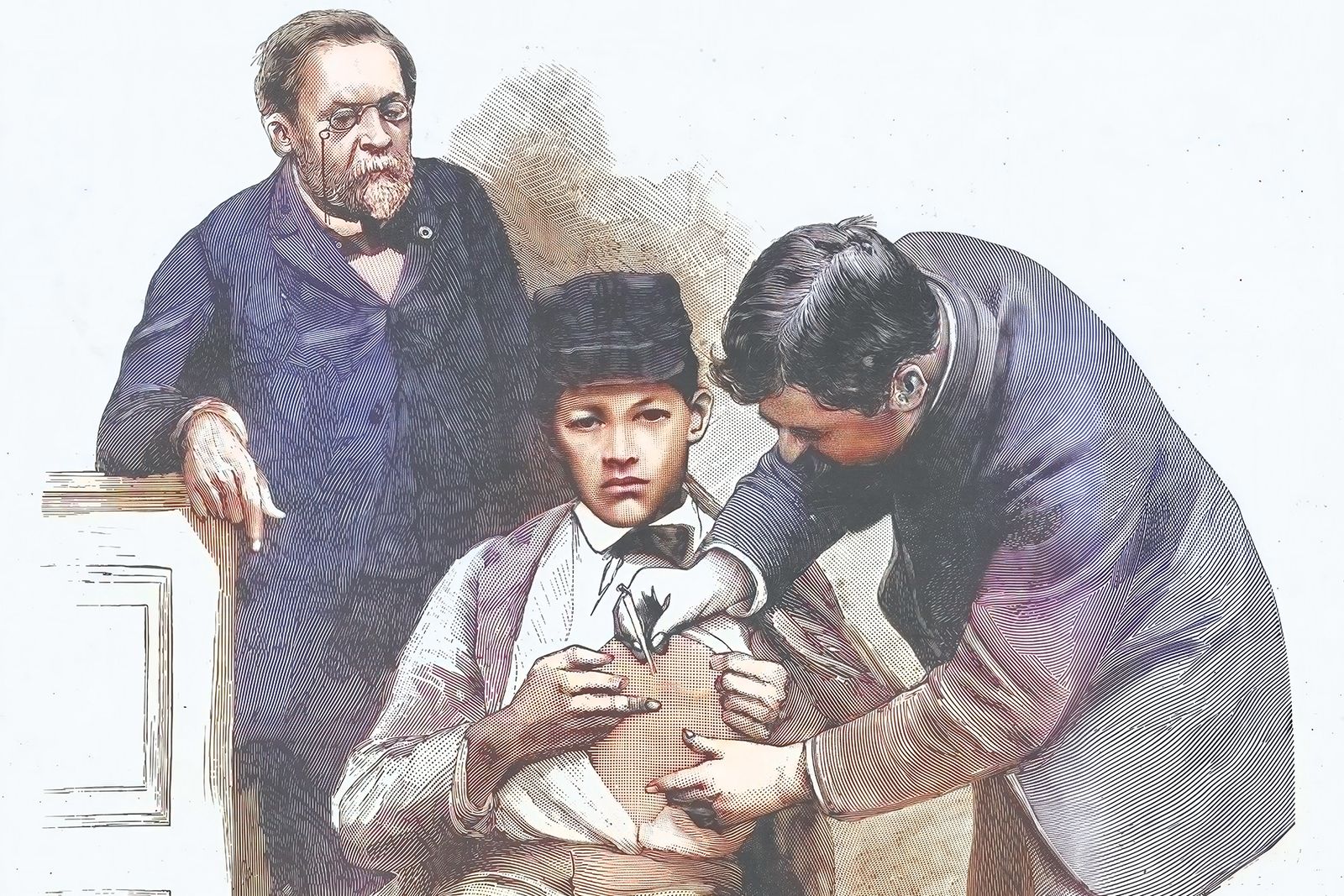
A case of rabies was often fatal in the era before Louis Pasteur developed a vaccine. For the young patients to see the French doctor, though, required a new kind of collective effort An 1885 illustration depicts Jean-Baptiste Jupille (center), age 15, one of the first patients treated for rabies by Louis Pasteur, left. Harper’s Weekly / Public Domain On December 2, 1885, a crazed dog dashed through the streets of Newark, foaming at the mouth and snapping at anything that crossed its path. It attacked several other dogs near the Market Street train station before fleeing toward two crowds of schoolchildren. The dog flew at the children, biting six. For millennia, the bite of a rabid dog had often been a death sentence. But luckily for the kids, a treatment had just been developed thousands of miles away, across the Atlantic. The victims’ unlikely journey would help mark the end of rabies as an untreatable killer—and represented a turning point in how medical breakthroughs could capture and benefit from concerted public attention. Eventually, one man killed the animal, and the bitten children were taken to nearby doctors. Five-year-old Eddie Ryan, partially spared by a patch of thick felt on his coat, still suffered a deep bite on his right elbow. Ten-year-old Austin Fitzgerald got the worst of it, including a bleeding gluteal gash. Other victims included Patrick Reynolds and a teenage messenger boy, William Lane. The doctors tried cauterizing some of the children’s wounds, but other than that, the only option was to wait and see whether rabies symptoms appeared, which could take weeks or even months. The next day, another local doctor, William O’Gorman, wrote of an intriguing possibility in an open letter in the Newark Evening News: “Were it my misfortune to be bitten by a rabid dog, I would board the first Atlantic steamer, go straight to Paris and, full of hope, place myself immediately in the hands of Pasteur.” French chemist Louis Pasteur was already an accomplished scientist. He’d revolutionized beer- and winemaking by discovering how to destroy pathogens via heat, a process that turned his name into a verb—pasteurize. Then, less than two months before the Newark incident, Pasteur announced that he’d successfully saved at least one young French boy from rabies through his invention of a novel vaccine. Pasteur gingerly collects a sample of foaming saliva from the mouth of a rabid dog, in an undated period drawing by Czech artist Alphonse Mucha. Science Photo Library This wasn’t the first vaccine—Englishman Edward Jenner had successfully demonstrated the smallpox vaccine in 1796, and Pasteur and his team had created a vaccine for anthrax in animals just a few years earlier. But Pasteur’s new vaccine was notable because, thanks to rabies’ long incubation period, it could be administered after a bite occurred. Yet the news had received only passing mention in U.S. newspapers, if they carried it at all. Fatefully, though, O’Gorman had heard of Pasteur’s latest breakthrough. Toward the end of his open letter, he included a plea: “If the parents be poor I appeal to the medical profession and to the humane of all classes to help send these poor children where there is almost a certainty of prevention and cure.” O’Gorman even sent a cable to Pasteur himself, asking whether he’d treat the children. Pasteur telegrammed a response to O’Gorman the very next day, encouraging him to send the children immediately. A few days later, on December 9, four of the children—Fitzgerald, Ryan, Lane and Reynolds—boarded the steamship Canada, beginning the 12-day journey to France. (The two other kids who’d been attacked stayed behind in the U.S. Both survived.) Within hours of O’Gorman’s letter, donations had started to appear. This was the age of penny-press newspapers, which often ran sensationalized stories in a fierce fight for readership. And this story had everything an audience-hungry editor could want: wanton violence; innocent victims (schoolchildren, no less!); a desperate voyage; the promise of salvation. It also benefited from rabies’ reputation as a “nightmare disease,” says Diane Wendt, curator of the history of medicine at the Smithsonian’s National Museum of American History. While it was relatively rare compared with measles or diphtheria, the fact that it spread via the bite of a wild beast, and that the afflicted could die so dramatically, “touched something that was so elemental in people.” Technically, it was possible some or even all of the boys were uninfected—perhaps the cauteries had worked, or perhaps the dog had been merely vicious, not rabid—but with the dog dead and no reliable test yet invented, there wasn’t a way to know for sure. The New York Herald took up the fundraising cause with particular vigor, printing the names of benefactors, even down to children who donated 10 cents. Altogether, the public raised some $1,000 (the equivalent of more than $34,000 today). Newark merchants donated winter clothes, and the French steamship line Compagnie Générale Transatlantique offered the children steeply discounted tickets (the trip would have cost around $2,000 at the time for all of them) and agreed to house the boys in a small apartment onboard. The company converted one of the ship’s dining rooms into a playroom. Two adults accompanied the boys. One was Frank S. Billings, a Berlin-trained veterinary scientist, who came along to learn more about vaccination. The other was Eddie Ryan’s mother, possibly because she spoke French. It was an ambitious journey, as she was eight months pregnant—and toting along Eddie’s 2-year-old brother, unbitten but too young to leave at home. The ship left the New York City docks in a thick fog. At sea, the children were reportedly well behaved, save for Reynolds, who appeared to be full of “animal spirits” and played pranks on the servants and sailors, according to the New York Times. Some onboard feared it might be a sign of rabies. One can imagine Ryan’s mother putting her hand on her boy’s forehead as he woke up each morning. If it was rabies, the symptoms that followed—seizures, delirium, paralysis and hydrophobia, or fear of water—would be far less gentle. Eventually the infected boy could slip into a coma and die. By 1885, Pasteur was in his early 60s with short, dark hair and a gray beard. He often wore formal clothing and was partially paralyzed on his left side from a stroke years earlier. In the months since his announcement about the rabies vaccine, Pasteur had been busy. His lab, located in a stately building near the Paris Panthéon, had already seen well over 100 visitors from as far away as Russia. By the time Billings arrived at his doorstep on the evening of December 21, Pasteur had closed the lab for the day. Outside the lab, Billings was flanked by foreign correspondents for newspapers including the New York Herald and New York Times, who’d been awaiting the boys’ arrival. Billings explained to Pasteur that the boys had just arrived at a nearby hotel and entreated the chemist to reopen his doors. In public, Pasteur’s demeanor was often gruff and aloof, but he had a known soft spot for children. He agreed to Billings’ request and called back his colleague Jacques-Joseph Grancher, who’d gone home for the day; as a chemist but not a medical doctor, Pasteur relied on Grancher to administer all injections. The shots were made from the spinal cords of rabbits that had been injected with the virus. Pasteur had observed that air-drying the tissue first seemed to weaken the virus within. (Pasteur air-dried the rabbits’ spinal cords right in his lab.) The result was a vaccine just strong enough to trigger the host’s immune system—but without causing the disease. Fun facts: More to know about Louis Pasteur Louis Pasteur decisively championed the germ theory of disease in the 1850s and ’60s Some of his major breakthroughs came from studying beet juice and sheep’s blood. In his work innovating vaccines, Pasteur built on pioneering efforts by the English doctor Edward Jenner. In the U.S., pasteurized milk was controversial when it was first reintroduced, in part because American officials argued that the process removed important nutrients—and flavor. The boys, clockwise from top left: Austin Fitzgerald, William Lane, Patrick Reynolds and Eddie Ryan. Above left: a clipping from the New York Herald, 1886. Newspapers.com; Pasteur Institute According to a dispatch published in the Herald, once the boys arrived, Pasteur quickly assuaged their fears, saying, “Let’s start with the biggest and bravest.” All four children rushed forward and took their shots in the belly without too much fuss, save for Ryan, who briefly panicked upon seeing the needle. After his first jab, Reynolds was even cheeky enough to exclaim: “Golly! Is that all we came so far for?” before running off. Injections done, Pasteur told them to get some rest and to report back in the morning. For the next 11 days, the boys visited Pasteur’s lab twice a day for injections. In the meantime, they explored the city. Crowds followed the boys through the streets. Lane, the oldest, reportedly asked for copies of any newspaper that mentioned him. Reynolds continually tried to escape his guardians and delighted in blowing on tin trumpets he’d bought after wheedling a franc from a reporter. At one point, according to the Times, Billings resorted to hiring “a stout German woman” to help wrangle the boys. Grancher administered the last shots on January 1, 1886. Pasteur seemed confident in the treatment and said he’d remember the little boys fondly—“all four of whom are such interesting natures,” he put it, according to the Times. The party departed the next day, laden with gifts from well-wishers—including from Billings himself, who bought the boys clothes for the coming year. Reynolds received a flannel shirt covered with, of all things, blue dog heads. The ship steamed back into the New York docks 12 days later, on January 14. By then, it was more than six weeks since the attack back in Newark. A joyful crowd on the docks greeted the group—including Ryan’s new brother, to whom his mother had given birth on the way back. The boys were technically still within the incubation window, but Billings told the press he was confident any danger had passed.In the meantime, American physicians had begun lobbying Pasteur to reveal his methods. Within a few years, independent Pasteur clinics would open in New York, Baltimore and Chicago—as well as in Russia, Mexico and Brazil—offering vaccines for any dog-bite victims who could travel to them. “It was a lot easier than going to Paris,” says Jessica Wang, an expert in the history of American science and medicine at the University of British Columbia. The boys continued to enjoy notoriety for a time. A New York City dime museum offered their parents $15 a week for the boys to appear as a temporary exhibit. Three of the families agreed (the offer was the equivalent of a week’s wages, worth more than $500 today). Reynolds in particular was reportedly delighted with the gig. Thousands of visitors reportedly came to see them. The boys’ tale would fade into obscurity, but the episode marks an important turning point in the media’s coverage of science, says Bert Hansen, an emeritus historian of science and medicine at Baruch College in New York. At the time, medical science was often seen as quackish, and advancements were not of special interest to the American public. But attaching human drama to the story changed that. “The patients are key to its ability to become a bigger story,” Hansen says. Through the Newark boys, the public began to learn more about Pasteur, his vaccine and what was possible in modern medicine. Wendt notes that newspapers sustained this interest in stories about future breakthroughs. “It made medicine become a story worth following,” Wendt says. Over time, audiences began to expect new developments. “I think that [was] a fairly new idea for most people, that somehow science is going to push medicine forward.” Also out of Louis’ lab Billions of milk cartons bear his name, but the scientist’s contributions reach far beyond the dairy aisle By Rachel Nuwer National Archives, Bridgeman Images, Dartmouth, Pasteur Institute; Illustration by Emily Lankiewicz 1. To prove that life could not spring up spontaneously, Louis Pasteur boiled beef broth in flasks with long, curved necks that let air in but trapped dust. Left undisturbed, the broth remained clear and sterile. But when Pasteur broke off the necks, giving access to unseen organisms, the broth grew cloudy with microbial growth. Pasteur revealed “an invisible biological world that profoundly influences nearly every aspect of our lives,” says Rodney Rohde, an expert in medical laboratory science at Texas State University.2. When a mysterious 1865 blight devastated French silkworm populations, tanking the industry that depended on them, Pasteur came to the rescue. The chemist soon identified two distinct maladies sickening the insects. Next, he helped establish methods to weed out infected worms and stem the diseases’ spread—an early example of how basic laboratory science can translate directly into real-world economic gains, says Rohde. 3. In the 1870s, anthrax was sweeping through Europe’s herds of sheep and cattle, killing large numbers of animals and sometimes spreading to humans. Ever ahead of his time, Pasteur recognized that protecting livestock from anthrax would also protect human health, agricultural livelihoods and the broader European community. After several major challenges and intense rivalries with other scientists, he produced an anthrax vaccine and proved its effectiveness in a widely publicized 1881 experiment with sheep. 4. In 1879, Pasteur happened to notice that the bacteria responsible for chicken cholera weakened over time. Recognizing the implications of this chance discovery, Pasteur inoculated chickens with the weakened microbes. When later exposed to the fully virulent bugs, many of the birds proved immune. The new vaccine paved the way for further advances in vaccination, and for Pasteur, it ignited an enduring passion for studying immunity. You Might Also Like Get the latest stories in your inbox every weekday. More about: children Dogs Famous Scientists France Health Media Medicine New Jersey Scientific Innovation Scientists Ships Vaccines
When a Dog Attacked a Group of Young Boys in 1885, It Sent Them on a Trans-Atlantic Adventure That Changed Medicine
Full Article
Original Source
Read the full article at Smithsonianmag →KhanList aggregates and links to publicly available news content. We do not host full articles from third-party sources. Always verify important information with original sources.