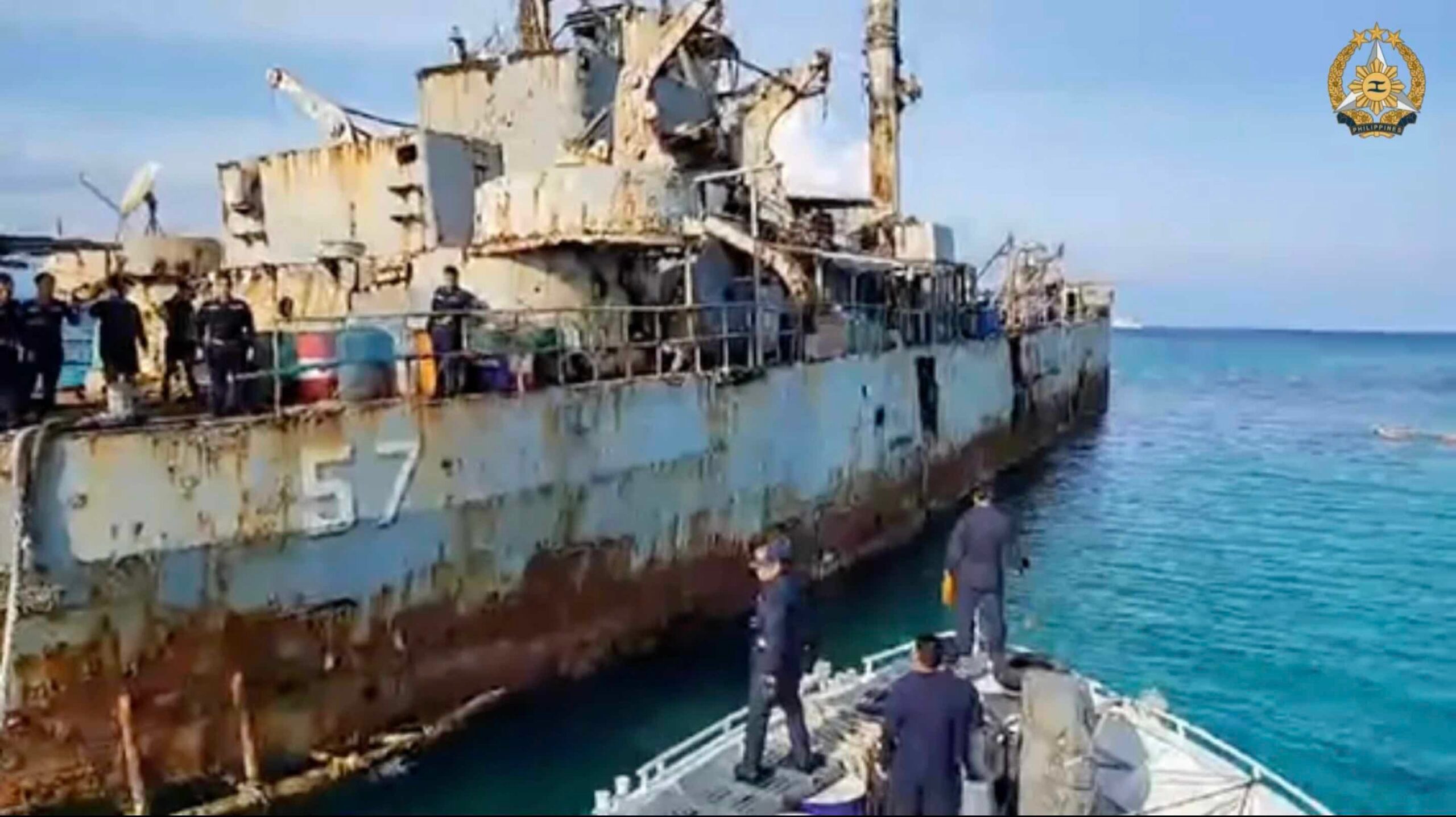
Not even a day had passed back in 2024 between the Philippines announcing an “understanding on the provisional arrangement” covering military resupply missions to Ayungin (Second Thomas) Shoal, and the Department of Foreign Affairs (DFA) decrying their Beijing counterpart’s “inaccurate” statement about the same deal. Two years later, both disagreement and confusion persist — but this time, it’s crossed over to agencies and personalities within the Philippine government. The “provisional arrangement” — alternatively called a provisional agreement or understanding — is a 2024 deal between the Philippines and China covering rotation and resupply mission (RORE) to Ayungin Shoal, where the rusting BRP Sierra Madre has served as a Philippine outpost since 1999. It’s a flashpoint for tensions between the two countries. Since Ayungin is a low-tide elevation that’s within the Philippine exclusive economic zone (EEZ), Filipinos should have sovereign rights or the exclusive right to exploit resources in those waters. But China claims almost all of the South China Sea, and considers Ayungin Shoal a part of its territory. He said, she said, Marcos said Defense Secretary Gilberto Teodoro Jr. has claimed that he either does not know of the agreement or considers it non-existent, given the apparent gaps between how Manila and Beijing understand this deal. The DFA has defended its efficacy by pointing out that prior to the July 2026 clash, 15 RORE missions had taken place incident-free. President Ferdinand Marcos Jr. himself has doubled down on the existence, utility, and defensibility of the arrangement. “These arrangements that we make are to prevent any kind of miscalculation, mistake that might lead to even greater tension and hopefully not conflict. And that’s what we are trying to avoid. And that’s why we make these arrangements. And it is especially important because we have to resupply our people who are still on the Sierra Madre,” he said in a briefing with foreign correspondents on August 14. The exact text of the deal is confidential. But in the two years since it was made, details have been revealed, piecemeal, by officials themselves in the Philippines. The Chinese government has also made claims regarding its details — most of which the Philippines has denied. What is the deal, exactly? The DFA’s announcement of the agreement on July 21, 2024 simply said: “The Philippines and the People’s Republic of China have reached an understanding on the provisional arrangement for the resupply of daily necessities and rotation missions to the BRP Sierra Madre in Ayungin Shoal.” The deal was the direct effect of a June 17, 2024 confrontation between the two countries in the shoal. Elite soldiers had, for the first time in a while, used fast boats to bring supplies and troops to the Sierra Madre. The China Coast Guard (CCG) went inside the shoal and confronted Filipino soldiers up close — their bigger boats rammed the Rigid-Hulled Inflatable Boat (RHIBs) of the Philippine Navy. The melee right at the base of the Sierra Madre, a warship that’s still under commission, was caught on tape and later distributed by Manila for all the world to see. A Filipino severed his thumb because of the CCG’s ramming, RHIBs and other equipment were damaged, and military firearms were seized by the Chinese. It’s the most violent confrontation between the Philippines and China in the West Philippine Sea to date. Back then, the DFA did not release details of the said arrangement, but said “both sides continue to recognize the need to de-escalate the situation in the South China Sea and manage differences through dialogue and consultation and agree that the agreement will not prejudice each other’s positions in the South China Sea.” By each other’s position, that would be — that Ayungin Shoal is part of the Philippines’ EEZ for Manila, and that the same shoal is part of Chinese territory, as far as Beijing is concerned. In so many words, the two countries agreed to disagree, as they always have. Who negotiated the deal? Foreign Secretary Ma. Theresa Lazaro, who was then an undersecretary, led negotiations for the deal. Enrique Manalo, now the Philippines’ permanent representative to the United Nations in New York, was then the foreign secretary. Then, as is now, only a handful of people, even in the DFA and in the rest of government, know the full details of the agreement. Sources familiar with discussions said that even in 2024, top officials — Manalo, Teodoro, and then-national security adviser Eduardo Año were aware of the deal, at least before it was finalized between Lazaro and her counterpart, vice foreign minister Chen Xiaodong. By late July 2024, Teodoro said that while he had not yet been briefed on the arrangement, he was “certain that the DFA is conscious of those parameters that it cannot exceed and I have no reason to doubt that such parameters were not heeded in coming into this arrangement or agreement with China.” What was agreed on? An Associated Press report from 2024 and subsequent sources have confirmed that Beijing tried to negotiate “advance notice and the right to inspect the ships.” Manila did not agree to these conditions. Instead, an “exchange of information” between Manila and Beijing takes place ahead of these regular missions, said Manalo in late July 2024. Marcos has since expanded on how this “exchange” works — the Philippines issues a NOTAM or A Notice to Mariners (also called an NtM or NOTMAR) to announce the upcoming mission. Beijing gets a copy of this too. Sources privy to RORE missions to Ayungin have said the path that the Navy uses to bring supplies — typically, a small boat so it can still sail inside the shallower “lagoon” of the shoal — is predetermined. Operators don’t know the exact text of the deal, according to sources Rappler has spoken to — but they obviously know the parameters through which the missions are carried out. Top officials — Teodoro and Año then — are briefed when these missions are about to be carried out. The exact date of when these missions are to take place, what’s in the boats, or who are deployed, are typically the call of the Palawan-based Western Command, which has jurisdiction over the BRP Sierra Madre. There’s another apparent term in the deal that hasn’t gotten as much public attention — an end to embedded media during these RORE missions. Under the government’s transparency push beginning in 2023, a small contingent of journalists — from the state-owned network, private Philippine media companies, Filipino journalists working for foreign media networks, or foreign journalists who parachute to the Philippines — are usually part of these missions, through the Philippine Coast Guard (PCG). Journalists have not joined RORE missions to Ayungin Shoal since, although embeds still happen for missions to other parts of the West Philippine Sea, be it aboard the ships of the PCG, Bureau of Fisheries of Aquatic Resources, or Philippine Navy. Why is it in the news again (and again)? For most of the past two years, the provisional agreement has stayed mostly under the radar. The DFA has, on occasion, released statements announcing successful RORE missions although the department eventually stopped making these announcements. The agreement made headlines at the end of July 2026 after a confrontation between the CCG and Philippine soldiers in Ayungin. Again, the CCG entered the shoal’s lagoon and sailed close to the BRP Sierra Madre. China’s ambassador to Manila Jing Quan, told reporters the CCG had to inspect the BRP Sierra Madre over supposed suspicions that construction materials had been brought in, in supposed violation of the agreement. Again, this claim is not new — in July 2024, China had also claimed that the arrangement meant no construction materials were allowed in RORE missions. Days after, both the DFA and Lazaro herself denied Jing’s claim — as it had in July 2024. What other deals have been made over Ayungin? If Beijing’s terms — no construction materials and therefore no repairs to the Sierra Madre — seem familiar, it’s because the Philippines had agreed to them before. Under former president Rodrigo Duterte, through what has been called a “gentleman’s agreement,” Manila nodded to no construction taking place in the rusting BRP Sierra Madre. China’s hope, after all, is that the elements simply work their way and erode the Sierra Madre into oblivion. Yet the Philippines managed, slowly but surely, to still fortify the BRP Sierra Madre. While the military is scant about the exact upgrades it’s made to the warship, various sources have said that its foundations have been reinforced and other improvements — primarily to make the ship more habitable — have been implemented through the years. Is the deal still on? As of posting, yes. And Marcos seems keen on keeping it. After disclosing the issuance of NOTAMs as part of the understanding or agreement, Marcos said: “And that is the extent of it. And that does not somehow make more vulnerable or give up any of our sovereign rights, any of our territorial claims and our well-recognized territory, especially under the UNCLOS and all other Arbitral Award.” The President seemed keen on downplaying the deal, too. “I hesitate to use the word arrangement because we’re not going into any arrangement with everyone. We’re just conducting ourselves according to the standard practice of the vessels sailing in the West Philippine Sea and, for that matter, in other seas. So there is no special arrangement that somehow the implication is that we have to ask for permission or that we have to give up some of our rights,” he added. Operators in Palawan, even off record, acknowledge the utility of the agreement — although in the same breath, they speak about the discomfort they feel over its existence in the first place. – Rappler.com
What’s the Philippines-China Ayungin arrangement all about?
Full Article
Original Source
Read the full article at Rappler →KhanList aggregates and links to publicly available news content. We do not host full articles from third-party sources. Always verify important information with original sources.