
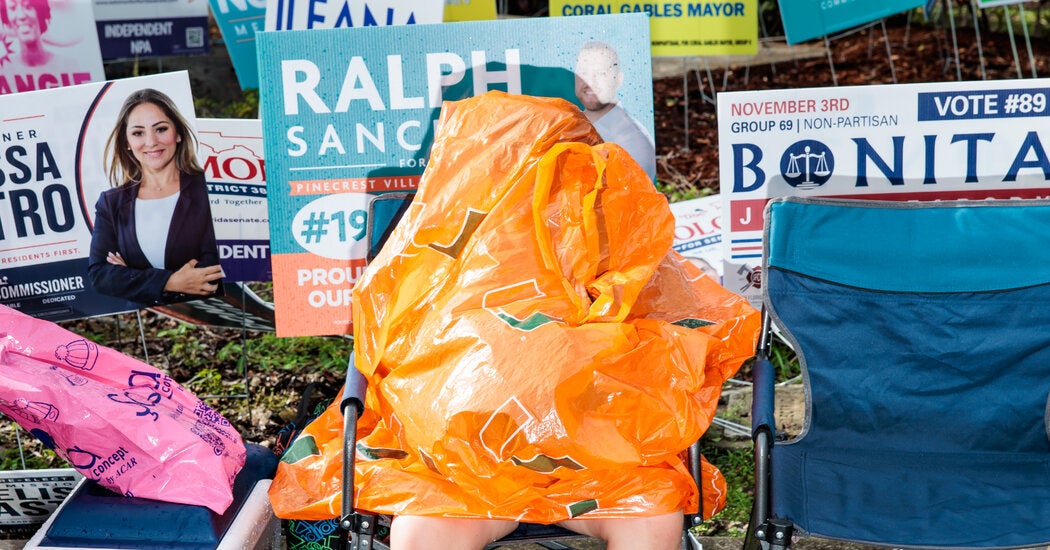
Credit...Damon Winter/The New York TimesCredit...Damon Winter/The New York TimesDemocrats around the country are now asking the question weird-crime aficionados and real estate analysts have been asking for years: What is happening in Florida?The anti-Trump stampede that trampled Republicans in blood-red bastions like Kansas, South Carolina and Texas on Nov. 3 somehow missed President Trump’s adopted state, where Republicans held on to a U.S. Senate seat, the governor’s mansion and every other statewide office. The Democratic candidate for governor, David Jolly, came just over one heartbreaking percentage point of breaking the G.O.P.’s 27-yearlock on Tallahassee.ImageDavid JollyCredit...Damon Winter/The New York TimesNow the finger-pointing has begun, with Florida Democrats blaming suboptimal candidates, dubious strategies and especially the national donors who in recent years have stopped investing in this former super-swing state. Florida was once the ultimate expression of America’s 50-50 politics, with eight races for governor, Senate and the presidency decided by roughly a point or less between 2000 and 2018, and frustrated Democrats believe their latest razor-thin losses prove that it can be again.But that deep-purple Florida is gone, and it isn’t coming back anytime soon. The simple reason Democrats lost here last week is that an awful lot of Republicans have moved to Florida since the Covid pandemic, and those newcomers really like the way Republicans are running it. Gov. Ron DeSantis has remained quite popular despite Mr. Trump’s struggles, and his vision of a “Free State of Florida” — where taxes are low, vaccines should be optional and masks are for woke losers — has become a magnet for some of the nation’s most reliable G.O.P. voters.In 2000, when Al Gore lost the presidency to George W. Bush by a mere 537 votes in Florida, registered Democrats outnumbered Republicans here by nearly 400,000 voters, a four-point gap. But Republicans took a narrow registration lead after the pandemic in 2021, and conservative baby boomers have continued to flock here ever since. There are now 1.5 million more Republicans than Democrats, a gigantic 11-point gap, and they vote.ImageCommunities like Lakeland, Cape Coral, Sarasota and, here, the Villages are drawing conservative retirees to Florida.Credit...Damon Winter/The New York TimesThere’s no reason to think the trend will reverse, because the majority of Florida’s growth is happening in sprawling Republican boom towns like Lakeland, Cape Coral, Sarasota and the Villages, not already crowded Democratic urban centers like Miami and Fort Lauderdale. Of the 40 fastest-growing counties in Florida, in 2024 zero chose the Democratic nominee Kamala Harris over Mr. Trump. Only four voted for Mr. Jolly against Mr. Donalds this year. Mr. Donalds won the new Florida and Mr. Jolly won the old Florida.It’s true that Mr. Jolly might have managed to win if Mr. Donalds hadn’t raised six times what he did, or if the Republican state party wasn’t so much better funded and better organized than its Democratic counterpart. But that’s to be expected in a red state that keeps getting redder.Winning begets winning, and corporations and donors have poured money into the G.O.P. throughout the 27 years it’s controlled state government. Losing begets losing, and national Democrats have understandably shifted their resources to less expensive and, it turns out, more winnable states, driving even more losses and depressing morale among party volunteers.It’s also true that Florida Democrats might have had a less disappointing night with better candidates and better strategies. Their Senate candidate, the left-wing firebrand Angie Nixon, ran a dynamic campaign that (along with President Trump) helped drive solid Democratic turnout, but her membership in the Democratic Socialists of America and harsh criticism of Israel was a bad fit for a conservative state with so many socialist-hating Cuban Americans and pro-Israel Jews.Image Angie Nixon ran a dynamic campaign for Senate but ultimately lost to the Republican Ashley Moody.Credit...Damon Winter/The New York TimesMr. Jolly, a mild-mannered former G.O.P. congressman, had a better chance to persuade skeptical voters he was a different kind of Democrat. But he ran on a conventional Democratic agenda, ignoring those who urged him to distance himself from his party’s brand. And Trump voters clearly saw him as a fairly generic Democrat. He performed only slightly better than Ms. Nixon did in her race despite her radical politics. In Martin County, an upscale enclave full of the kind of moderate Republicans he used to be, he didn’t even do as well as Ms. Harris.Mr. Jolly also missed something important about the way Florida has changed. He complained more about Mr. DeSantis and his culture wars against rainbow-themed crosswalks and D.E.I. than he did about Mr. Trump. When I asked him about high gas prices last spring, he said he didn’t talk about it much because it wasn’t a Florida issue, and he didn’t want to focus on Mr. Trump in a state that backed the president three times.But polls suggest Florida voters now disapprove of Mr. Trump by about 10 points, while approving of Mr. DeSantis by a similar margin. Mr. Donalds is a Trump ally who never received Mr. DeSantis’s support in the G.O.P. primary, but the most prominent pro-Donalds ads highlighted his DeSantis endorsement in the general election, warning that Mr. Jolly would undo the governor’s work.ImageEarly voting in Coral Gables.Credit...Damon Winter/The New York TimesImageIn Hialeah, a heavily Cuban American city.Credit...Damon Winter/The New York TimesThe uncomfortable truth is that a majority of voters here appreciate the DeSantis brand of state government that doesn’t force you to conserve water or build your house outside a hurricane zone or pay a lot of taxes to support people who aren’t you. On Election Day, Floridians overwhelmingly approved a referendum to slash property taxes even though local governments warned that it will gut services; the boomers moving here were fine with that. Most of them don’t want funding to go to electric-car charging stations or racial sensitivity training or Medicaid health services for the working poor.I wish that weren’t true. Republican rule has left Florida on an unsustainable and unaffordable path of environmental destruction, traffic congestion and political corruption. It’s been a festival of short-term gratification over long-term investment, and there are already signs that the bill is coming due. The growth machine is slowing. The insurance market is in crisis.Companies are struggling to find skilled workers and workers are struggling to find affordable housing. The next big hurricane could create an economic cataclysm. And a lot of the DeSantis vision is just wrong: Vaccines work, climate change is real and weed would be legal in a truly free state.ImageDebris in Punta Rassa after Hurricane Ian in 2022.Credit...Damon Winter/The New York TimesImageFort Myers after Hurricane Ian.Credit...Damon Winter/The New York TimesBut it’s easy to see why some Republicans now see Mr. DeSantis as a 2028 presidential nominee after they got drubbed just about everywhere except his state. He’s thrilled conservatives by severely restricting abortion, executing record numbers of inmates and cramming immigrants into a detention center in the Everglades. He didn’t impose tariffs, suppress the Epstein files or start the war in Iran; that was all the guy at Mar-a-Lago.Maybe someday, there will be a revolt against the excesses of entrenched one-party rule in Florida, just as there was last week in Texas. Maybe loads of new cash would help Democrats turn it back into a swing state. But when they’re already winning races in typically less expensive red states like Ohio, Iowa and even Mississippi, they shouldn’t make Florida their top cash priority anytime soon.The fact that it’s now an outlier rather than a bellwether state is actually good news for Democrats. The election showed that as goes Florida, so goes Florida. The Republican migration that’s made it redder has made the rest of America a little less red, and the popularity of Mr. DeSantis here no longer necessarily translates into popularity with mainstream America.ImageCredit...Damon Winter/The New York TimesThe really good news about Florida for Democrats is that they won’t need it to win back the White House in 2028. They have easier targets.Michael Grunwald is a contributing Opinion writer and the author, most recently, of “We Are Eating the Earth: The Race to Fix Our Food System and Save Our Climate.”The Times is committed to publishing a diversity of letters to the editor. We’d like to hear what you think about this or any of our articles. Here are some tips. And here’s our email: letters@nytimes.com.Follow the New York Times Opinion section on Facebook, Instagram, TikTok, Bluesky, WhatsApp and Threads.Related ContentAdvertisementSKIP ADVERTISEMENT
What’s the Matter With Florida?
Full Article
Original Source
Read the full article at Nytimes →KhanList aggregates and links to publicly available news content. We do not host full articles from third-party sources. Always verify important information with original sources.