
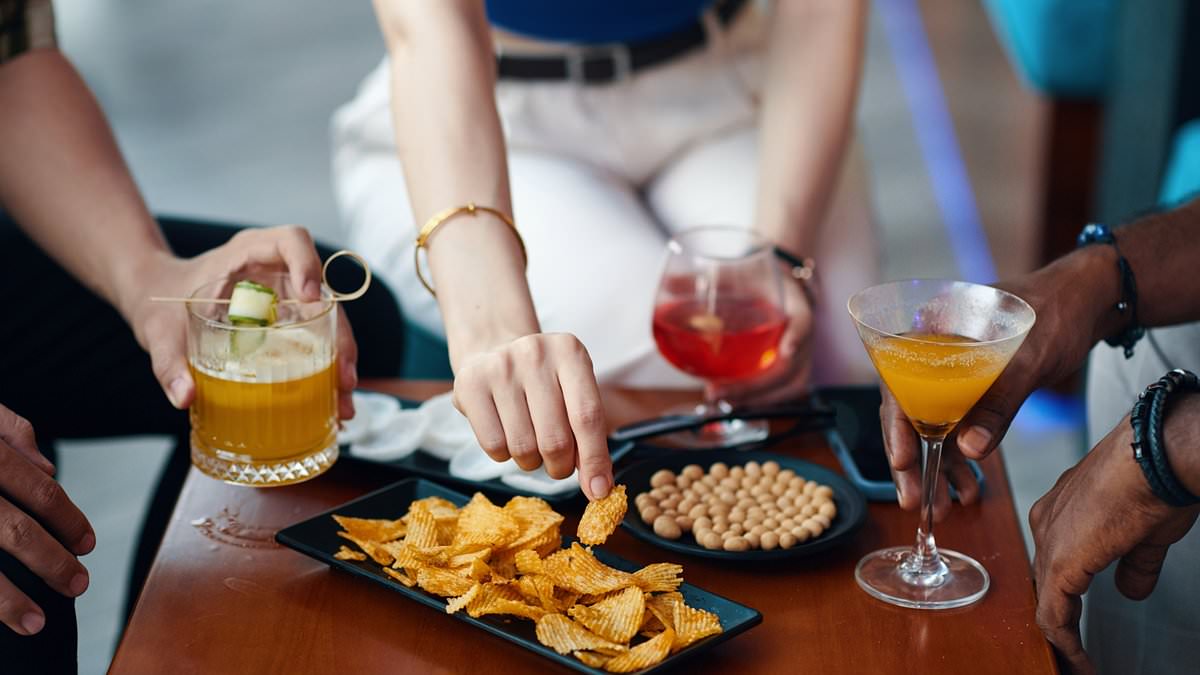
It's approaching Christmas party season - the month-long period when barely a week goes by without an evening spent at a pub or wine bar. Inevitably, the evening meal is replaced with a couple of packets of crisps and perhaps some pork scratchings.But, aside from the pints you might drink alongside them, what impact is your pub snack habit having on your health? And could some actually be surprisingly good for us?According to Rob Hobson, registered nutritionist and author of The Low Appetite Cookbook, some don't deserve their bad reputation. 'There's actually quite a difference between them nutritionally, depending on which you choose,' he says. 'Some, such as peanuts and olives, provide useful nutrients alongside their calories, while others offer little beyond fat, salt and energy.'It's especially important to consider the calories, fat and salt in your pub snack of choice, he adds, as alcohol stimulates appetite, making you eat more. Here, Hobson identifies some of the healthiest - and least nutritious - pub nibbles found at bars and boozers across the UK. Crisps aren't an ideal snack, nutritionists say, but they're healthier than many other optionsCrisps A packet of crisps might be the quintessential pub snack, but nutritionally, they have little going for them.While potatoes naturally contain nutrients such as potassium and vitamin C, the process of turning them into crisps substantially increases their fat and calorie content, while some vitamins are lost along the way.A standard 25g packet contains around 125 to 135 calories and about a gram of saturated fat, depending on the brand, but provides relatively little protein or fibre, meaning they're unlikely to keep hunger at bay for long.One interesting plus is that most popular crisps are, nowadays, very slow in salt - containing around 0.3g (about five per cent of your daily limit). Hobson says: ‘If you're genuinely hungry, something containing more protein or fibre is likely to be more satisfying.’And when it comes to choosing a flavour, he recommends keeping things simple.‘I would also go for a plain salted crisp than anything highly flavoured that is likely to contain more preservatives and artificial flavourings,’ he adds.Verdict: 3/5 Scampi FriesIt might sound like the cutest fish in the sea, but scampi actually refers to the peeled tail meat of the langoustine, a cold-water crustacean related to lobsters.Scampi Fries were launched in the 1980s and, according to their manufacturer, Smiths, they are the top-selling packaged pub snack in the UK today.The golden, salty pillows actually contain zero shellfish and are in fact made from a cereal-based mixture that is fried and flavoured to resemble the popular seafood dish. The vegetarian snack offers plenty of fat and salt, but very little in the way of protein, fibre or other useful nutrients.A standard 27g bag contains around 0.8g of salt – more than 13 per cent of the recommended 6g daily and nearly three times as much as a typical packet of crisps.‘That's quite a lot of salt for such a small snack,’ says Hobson. They are also higher in calories than crisps - a total of 148 - with around 50 per cent more saturated fat - and there's a quarter of a teaspoon of sugar added for flavouring.Verdict: 1/5Peanuts A handful of peanuts is actually one of the healthiest snacks you can enjoy alongside a pint, says our expert.A 30g handful provides around 7 to 8g of protein - about a sixth of your daily needs - and about a banana's worth of fibre, alongside magnesium, which supports muscle and nerve function. You’re also getting vitamin E, an antioxidant that helps protect cells from damage, and niacin, a B vitamin essential for energy metabolism. A scotch egg provides 10g of high-quality protein, vitamin B12 and choline, vital for brain health‘Peanuts would be near the top of my list because they offer a really good combination of protein, fibre and healthy fats,’ says Hobson.Most of their fat is unsaturated, which is better for cardiovascular health than the saturated fat found in many pastry-based snacks. Research has also linked regular nut consumption with a reduced risk of heart disease.However, portion size is crucial. Peanuts are calorie-dense, with a 30g handful containing roughly 170 to 180 calories.And while ideally, you'd eat unsalted varieties, recipe reformulations mean many salted types aren't as high in salt as you'd think. For instance, 30g of Sainsbury's salted peanuts contains 0.2g - less than a packet of crisps. But, warns Hobson: 'They are very easy to over-eat and often bags in the pub come in large sizes. Try and stick to a standard serving of 30g.’Verdict: 4/5Pork pieServed as an individual pie or in giant wedges with a dollop of spicy piccalilli, pork pies are a staple of British pub grub – but they’re one of the most calorific options.Made from crumbly pastry, savoury pork filling and cushioned with a layer of meat-infused gelatine, a pork pie can pack more than 325 calories.‘A whole pork pie alongside several drinks can be closer to a small meal in energy terms,' says Hobson. Twiglets are among the healthiest pub snacks you can eat, with high protein and fibre That’s not to say that there are no nutrients in a pork pie; the meat provides protein, vitamin B12, iron and zinc. But it also contains between a quarter and a third of your daily saturated fat intake, depending on if you're male or female, thanks to the pastry made with lard.There's also 50 per cent more salt than in a packet of Scampi Fries.Verdict: 2/5 Scotch eggWith its combination of egg, sausage meat and breadcrumbs, a scotch egg might seem like a nutritional disaster – but it actually has more going for it than you might think.The egg provides 10g of high-quality protein, vitamin B12 and choline (both vital for brain health), while the sausage meat delivers additional protein, iron and zinc.But as you might expect, wrapping it in a thick layer of breadcrumbs and deep-frying substantially increases the fat and calorie content.A large, supermarket-bought scotch egg can contain nearly 300 calories and 5.5g of saturated fat, while an artisan or homemade option served at pubs can contain more than three times that amount. It also has the highest salt content of all the snacks analysed - contributing a third of your daily intake. There are also serious concerns about the meat content. Sausage meat, like the type in a scotch egg, is considered processed red meat - the type linked to an increased risk of bowel cancer. Cancer Research UK estimates that eating 50g of processed meat daily (roughly one large sausage) increases the risk of developing the disease by around 18 per cent.Verdict: 2/5Sausage rollIt’s a British favourite, but also one of the more indulgent snacks on offer at the pub, says Hobson.‘The pastry can contribute a substantial amount of saturated fat, while the sausage filling adds salt and processed meat - the type that's linked to bowel cancer,’ he says.‘There is some protein, iron and vitamin B12 from the meat, but the overall nutritional balance isn't particularly great.’Indeed a standard sausage roll is the most calorific snack, containing around 340 calories. It also tops the chart in terms of saturated fat, with nearly half of a woman's daily limit and a third of a man's. Pork scratchings are high in protein, packing in nearly half of the rcommended daily intakeHowever, there is slightly less salt here than you'll find in a scotch egg. Hobson says: ‘It's not something I'd choose regularly.'Verdict: 1/5 Pork scratchingsMade from pig skin that's been fried or roasted until crispy, pork scratchings have a surprisingly high protein content - around 24g for a typical 40g bag.However, Hobson reminds us that not all protein is created equal.Much of the protein in pork scratchings comes from collagen, a structural protein found in animal skin and connective tissue.‘Pork scratchings are interesting because they're often marketed as a high-protein snack, and they genuinely can contain quite a lot of protein,’ he says.‘But unlike the protein found in eggs, dairy or meat, collagen is not a complete protein, meaning it doesn't provide all nine essential amino acids the body needs.'Collagen is particularly low in leucine, an amino acid that plays an important role in stimulating muscle growth and repair, making it a less effective choice for building muscle than other protein-rich foods.Pork scratchings are also the second fattiest snack analysed - with 8g per packet - and has among the highest total salt. Calories-wise, one pack is roughly the same as a scotch egg.Verdict: 1/5OlivesMost of the relatively high fat content in olives comes from monounsaturated fats, particularly oleic acid – the same heart-friendly fat found in olive oil.Unlike the saturated fats found in many other savoury snacks, unsaturated fats can help support cardiovascular health, particularly when eaten in place of saturated fats.‘These are definitely one of my preferred pub snacks,’ says Hobson. Olives also contain small amounts of Vitamin E, which helps protect cells from oxidative damage, alongside polyphenols – plant compounds with antioxidant properties.However, there are two nutritional drawbacks. First, their salt content.Because olives are typically preserved in brine, even a relatively small portion contains up to a sixth of your daily limit - although this is still considerably less than Scampi Fries as well as sausage rolls, pork pies and a scotch egg. Secondly, there's little protein, fibre or calories here which, is fine if they're eaten alongside a meal, but not if you're counting on them for satisfying a hearty appetite. Verdict: 3/5 PopcornPopcorn is actually one of the healthiest options when it comes to satisfying a craving for something salty and crunchy, our expert says.‘Popcorn can be a surprisingly nutritious snack because it's made from wholegrain maize so it contains fibre,’ says Hobson.Fibre prevents constipation and keeps us feeling fuller for longer - but only a fraction of British adults eat the NHS’ daily recommendation of 30g a day. A 25g portion of lightly salted popcorn provides more than a 10th of the daily needs, and about the same as a large banana.However, while standard versions are very low in saturated fat, salt (less than a packet of crisps) and contain around 100 calories, varieties with added butter, oil or sugary flavourings can be considerably more calorific. Hobson recommends sticking to plain or lightly seasoned popcorn. Verdict: 4/5Twiglets With their distinctive knobbly appearance and strong, Marmite-like flavour, Twiglets might not look like the healthiest option behind the bar – but they're actually a strong choice of packaged pub snack.The secret lies in their main ingredient: wholewheat flour, which means they contain considerably more fibre than many traditional savoury snacks, as well as a boost of protein.A 25g serving provides around 2.8g of fibre – almost a tenth of the NHS-recommended daily intake of 30g for adults, and nearly 4g of protein. There's also just over 100 calories and only 0.3g of saturated fat.‘They're baked rather than fried which explains why they're low in saturated fat,’ says Hobson. The only downside is the 0.8g of salt - more than twice that of a packet of crisps and about the same as Scampi Fries. Nevertheless, Hobson says that compared with many other crunchy pub snacks, ‘Twiglets have a few genuine nutritional advantages.’Verdict: 4/5
What's the healthiest pub snack? From Scampi Fries to scotch egg, diet expert reveals the surprising perks of the nation's favourite nibbles
Full Article
Original Source
Read the full article at Dailymail →KhanList aggregates and links to publicly available news content. We do not host full articles from third-party sources. Always verify important information with original sources.