
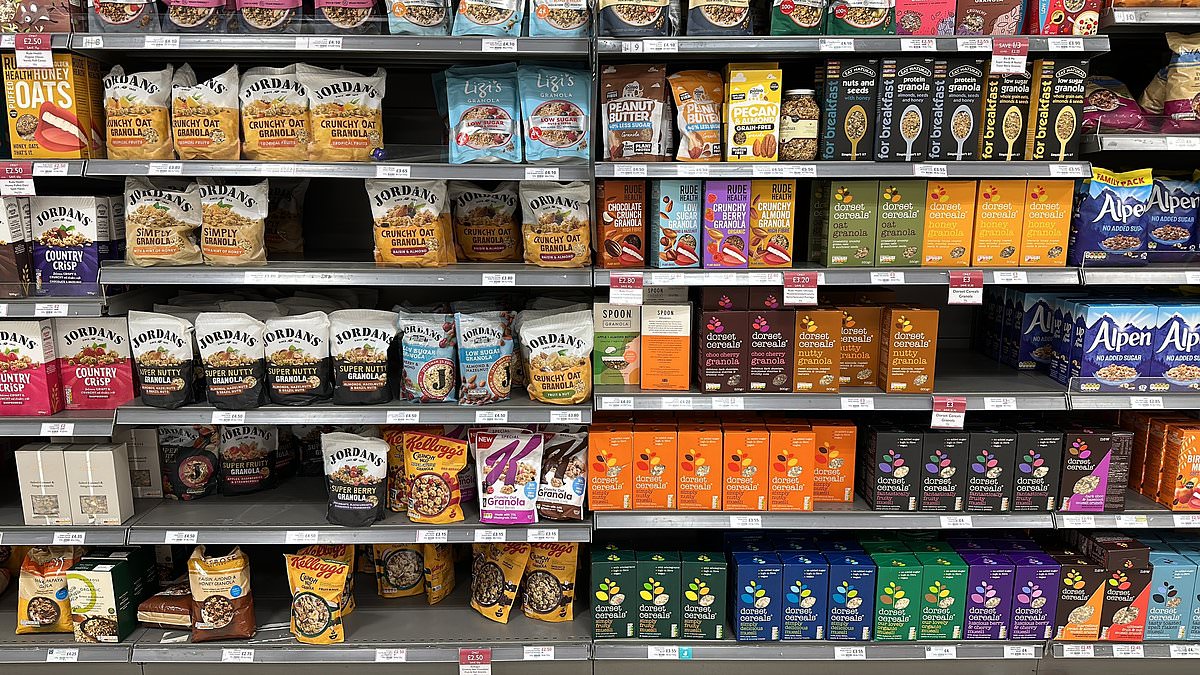
They may have better name recognition, but research has shown expensive breakfast cereals are often less healthy than supermarkets' own-brand labels.Consumer champion Which? assessed 73 different cereals marketed as 'healthy choices', including bran flakes, porridge oats, granola and muesli.Own-brand products, they found, were not just cheaper than branded cereals, but often matched - or even outperformed - brand leaders in terms of fibre content.Some own-brand wheat biscuits, for example, were around half the price of Weetabix Original packs - but had more fibre than their name-brand competitor.Sainsbury's wheat biscuits had 10.5g fibre per 100g compared to 10g per 100g for Weetabix, at a cost of 34p per 100g as opposed to the branded product price of 81p.Other supermarket own-brands such as Aldi, Asda, Tesco and Morrisons had the exact same recipe and fibre levels as Weetabix despite being less than half the price.Many branded cereals also contained higher sugar content than their unbranded alternatives. Said Which? nutritionist Charlotte Phillips: 'When buying staple wholegrain cereals, paying extra for a familiar household brand rarely buys you extra fibre.'Checking the per 100g column on store-brand packs ensures you get maximum fibre for the lowest shelf price.' Supermarket own-label cereals consistently beat big brand equivalents for fibre content despite often costing a fraction of the price, research by Which? foundNichola Ludlam-Raine, a dietician and author of How Not To Eat Ultra-Processed, called the Which? research a 'useful reminder that a higher price or a familiar brand doesn't automatically mean more fibre'.'In many categories, supermarket own-label cereals matched or beat branded options for fibre, often at a lower cost,' she added.Why do we need fibre? Fibre is a key nutrient needed to keep the digestive system running smoothly, as well as to keep bowel cancer and cardiovascular disease at bay. But just five per cent of British adults reach the recommended amount of 30g of fibre a day, consuming just over half that amount on average.Breakfast is a brilliant meal to prioritise fibre intake, says Ms Ludlam-Raine, due to the high-fibre content in many wholegrains, such as bran and porridge oats.'Bran-based cereals, wholegrain wheat biscuits, shredded wheat and porridge can all be practical ways to add fibre at breakfast,' she says.'But while fibre is important, it isn't the only thing to consider. Check the whole nutrition picture, including sugar and salt, and remember that the figures quoted per 100g may differ from what you get in your usual bowl, depending on portion size.'Adding fruit, nuts or seeds can also boost the fibre in a breakfast you already enjoy!'So, which supermarket cereals contain the most fibre? Bran sticksTop performers: Asda High Bran and Kellogg's All-Bran Fibre PlusFibre: 26g per 100gSugar: 13g and 15g per 100g Kellogg's All-Bran Fibre Plus had the joint-highest fibre content of similar products but was higher in sugar and more expensive than Asda's versionThere was a tie for the highest fibre content among bran sticks, with Asda High Bran and Kellogg's All-Bran Fibre Plus both promising 26g per 100g.According to Which? nutritionists, the products both had high wheat bran bases - 78 per cent for Kellogg's and 70 per cent for Asda. Asda's own-brand, however, had a lower sugar content and was nearly 25 per cent cheaper.Bran flakesTop performer: M&S Bran FlakesFibre: 18g per 100gSugar: 9.3g per 100g M&S Bran Flakes had 18g of fibre per 100g, the most of any similar productBran flake cereals often are blended with added wheat bran, hiking their fibre content above standard wholegrain cereals.But they're still outperformed by bran sticks because whole wheat flour and sugar are also mixed into the pure bran content.Coming out on top in this category was M&S's own-brand Bran Flakes, which had an impressive 18g of fibre per 100g.Among the highest scorers were Aldi's version – 17.5g – and Kellogg's Bran Flakes – 17g. Both still contained more sugar than M&S's version, however.Which? experts found shoppers could be 'essentially paying 18 times more for less fibre' in this category.The most expensive bran flakes analysed, Daylesford Organic Wholewheat Bran Flakes, cost a whopping £3 per 100g and had just 16g of fibre per 100g.M&S's product, while just 17p per 100g, did have a slightly higher sugar content, however. Shredded WheatTop performer: Nestle's Shredded Wheat BitesizeFibre: 14.2g per 100gSugar: 0.7g per 100g Nestle's Shredded Wheat Bitesize had a higher fibre content than its competitors but far cheaper alternatives delivered only slightly lower levelsShredded wheat was one of the few categories where a branded product came out on top, according to the Which? analysis. While Nestle's Shredded Wheat Bitesize contained the most fibre of all the shredded wheat products, Aldi's version cost around 40 per cent less and still delivered just 2g less in fibre.The two products were identical in sugar content.Wheat BiscuitsTop performer: Sainsbury's Wheat BiscuitsFibre: 10.5g per 100gSugar: 4.2g per 100gSainsbury's Wheat Biscuits beat off their big brand competitors in the fibre race as its 10.5g per 100g rating pipped Weetabix Original's 10g.The supermarket's version was also less than half the price.PorridgeTop performer: Waitrose Duchy Organic Jumbo Whole Rolled OatsFibre: 9.9g per 100gSugar: 0.9g per 100gPorridge oats are a brilliant source of fibre - naturally containing both soluble and insoluble forms of the nutrient. Both are brilliant for the body; while soluble fibre can help improve digestion and lower blood sugar, insoluble fibre softens stool, helping to support bowel regularity. Despite this, however, porridge oats still contain less fibre than cereals made from whole wheat bran. According to Which?'s survey, Waitrose Duchy Organic Jumbo Whole Rolled Oats came out on top when compared with other porridge oats. This is because the product uses whole, uncut jumbo oats—oat groats that are steamed and rolled into thicker flakes.Said Which?: 'Their larger particle size means they are less finely processed than quick or instant oats, cook more slowly, and retain the grain’s natural bran, germ and endosperm.'That supports a chewier texture and a more gradual release of energy, although their fibre content is broadly similar to standard rolled oats.'GranolaTop performer: Morrisons Simply GranolaFibre: 7.2g per 100gSugar: 13.8g per 100gThough made from oats, granola tends to contain less fibre, and more sugar, than other cereals on this list. According to Which? Morrisons Simply Granola, which contains 7.2g of fibre per 100g, beat its competitors because it was the only granola that included not only sunflower seeds but fibre-rich almonds.The supermarket's granola was almost half the price of the Jordans branded equivalent. Kellogg's Special K was a poor performer in fibre terms, delivering just 6g of fibre per 100gSpecial flakesTop performer: M&S Made Without Wheat Special FlakesFibre: 9.2g per 100gSugar: 9.8g per 100gThe research found the lowest-fibre cereal option overall was special flakes - including Kellogg's Special K - which had 15g of sugar per 100g and just 6g of fibre.M&S Made Without Wheat Special Flakes had the highest fibre content, with 9.2g per 100g, and had nearly triple the level of the store's standard special flake product. The highest-fibre options for cereals1. Bran sticks: Asda High Bran, 26g of fibre per 100g, 37p per 100g2. Bran flakes: M&S Bran Flakes, 18g, 17p3. Wheat biscuits: Sainsbury's Wheat Biscuits, 10.5g, 34p4. Porridge: Waitrose Duchy Organic Jumbo Whole Rolled Oats, 9.9g, 29p5. Muesli: Rude Health Instant Bircher Muesli, 12g, 93p6. Granola: Morrisons Simply Granola, 7.2g, 27p
What's the healthiest own-brand cereal? As Which? survey reveals expensive branded cereals have more sugar and less fibre than unbranded alternatives, our experts reveal the best supermarket swaps
Full Article
Original Source
Read the full article at Dailymail →KhanList aggregates and links to publicly available news content. We do not host full articles from third-party sources. Always verify important information with original sources.