
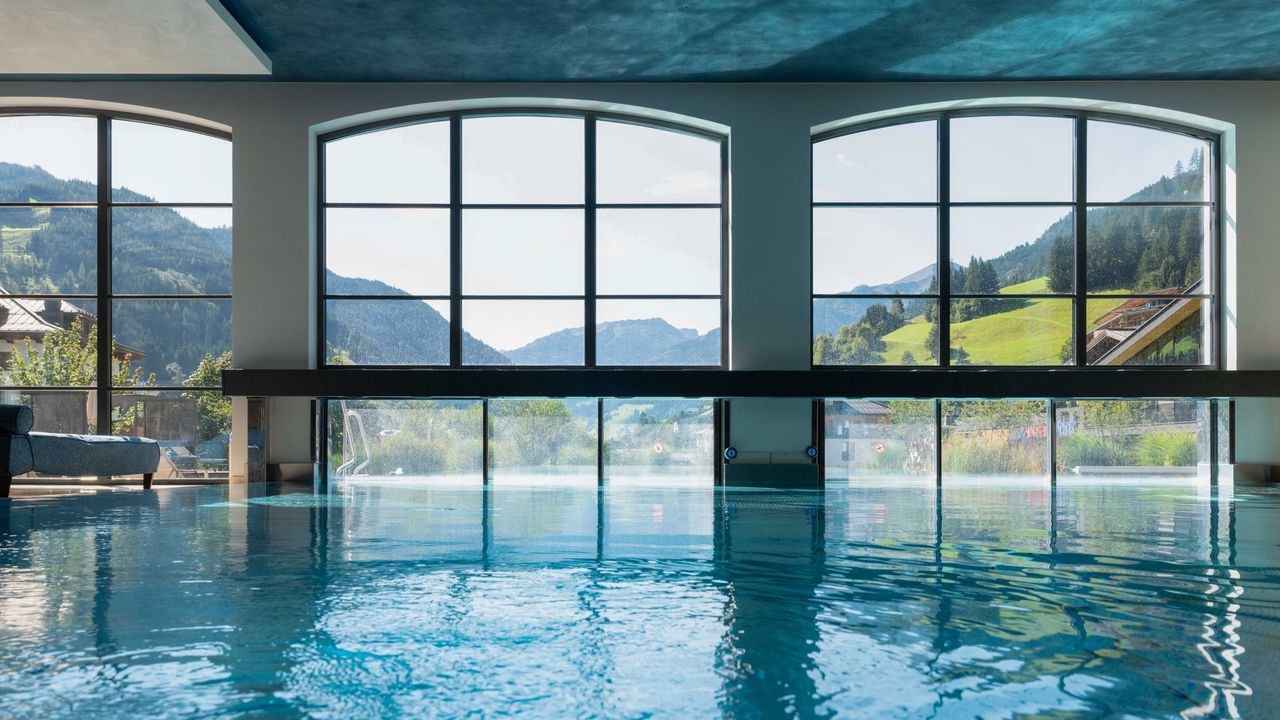
When I was told the general rule of thumb at Hotel Nesslerhof, an alpine wellness resort nestled in Austria’s Großarl Valley, was that it’s weird if you’re not naked, I listened.In Austria, being naked isn’t just a physical state. It’s an emotional state, too. Austrians strip themselves down, both figuratively and literally, to achieve a mindset they call “Lebensgefühl,” a deep mind-body awareness and lifestyle that is difficult to define, let alone translate.Großarl Valley, also known as the “Valley of Alpine Pastures" in the Salzburger Land region of Austria. Originally a German concept, the idea stems from “Lebensphilosophie,” a 19th-century intellectual movement popularized by big name thinkers like Friedrich Nietzsche, Georg Simmel, and Wilhelm Dilthey. Translating to “philosophy of life,” the framework is centered around the idea that life can only be understood from within oneself, as opposed to through applying external dogmas like logic and science. Life, according to this framework, is a joyful, vibrant, and embodied experience—a philosophy now widely integrated and cherished by Germany’s neighbor, Austria.Language, of course, falls short when attempting to describe what Lebensgefühl means in practice; this complete awareness of being is a physicality, an emotion, a lifestyle, and a philosophy all rolled into one. It can’t be described, only felt (ah!). It’s the pleasure of simply existing. Leben (life), Gefühl (feeling). It’s an experience I wanted to understand firsthand. So when I found myself in Munich, less than a two-hour train ride from Hotel Nesslerhof, with a lifelong friend oblivious to my schemes, I decided it was time to get to the bottom of it.The root of Lebensgefühl is being entirely present in a moment: a conscious effort to slow down, gauge your own energy in the here and now, and choose the way you want to live your life accordingly. While the Austrian National Tourist Board uses the concept of Lebensgefühl as a marketing language, the feeling itself is real–and you can cultivate it anywhere. Admittedly, though—hand of accountability raised—it’s a whole lot easier when you’re surrounded by the postcard-perfect Austrian Alps.Reaching this state of awareness requires an analog attention span and total presence. This is exactly what is demanded of you at Hotel Nesslerhof, which has dubbed itself the “natural happiness hotel.” The sprawling, sun-warmed property is an emerald-colored garden punctured by buttery blonde oak 1643 Austrian longhouse architecture. Here, the world is calm. Quiet.I arrive burned out, my attention scattered across screens and obligations. Stepping into a place fully immersed in nature with nothing expected of me, is jarring. It's been a while since I've consumed life this way. We’re conditioned to scroll, desire, save, project, and imagine, rather than to simply be—even to just be for a little bit.Finding the answer started with carving out time and space, and letting go of everything I thought presence was supposed to look like. Next thing, I was naked in Austria with 40 strangers wondering the same thing.Natural swimming pond for post-sauna plunges in the Zwanzigsechzehn sauna area for guests aged 16 and older. Courtesy NesslerhofThe saunasThe hotel’s dedicated wellness area features five co-ed clothing-optional saunas (plus an additional private sauna in select suites), a salt steam bath, infrared loungers, and expansive natural swimming pools. To practice, or fully embody, Lebensgefühl successfully, you must be aware of your environment. At Nesslerhof, the alpine nature allows your body to break away from any externally imposed schedules and return back to your natural circadian rhythm, where an omniscient digital third person doesn't determine your flow; you do.A Swiss pine sauna in the Zwanzigsechzehn sauna area for guests aged 16 and older. As a lifelong advocate for a good time, I mustered some gumption to join one of the daily themed sauna “infusions.” During these sessions, a sauna master leads thematic experiences using natural, regional botanicals like thyme, sage, Swiss stone pine, and eucalyptus. It’s held in the adults-only sauna event room, a space large enough to accommodate nearly 50 people.I walk in—towel on—and it occurs to me I’m the one making it weird here. There’s a lot I can swallow in life, but one thing I certainly will not do is be the person making things weird in a room. So, I lose the towel, join the crowd, and, in a state of mild panic, take a seat on the floor. Now, retrospectively speaking, I couldn’t grasp how all my choices in life had led me to this single, very conscious state of nudity in front of 40 Austrian strangers. There I was—sitting on the floor, completely floored. Which actually made things weirder, because I was later told you aren’t supposed to sit on the floor.Enter the sauna master. Also nude. A sauna master is like a spiritual guide to a proper schvitz, and the infusions at Nesslerhof are next level material. At pivotal moments, I’m watching him execute rainbow ice acrobatics, teasing large, colorful chunks of ice around the room in a giant spoon before launching them onto the glowing-hot stones. Steam is sizzling everywhere as thick aromatics sweep across the room.Hotel Nesslerhof's outdoor saltwater pool (with indoor access) surrounded by the Großarl Valley. And it’s hot. To make matters worse for myself—still on the floor—we’re given a natural body scrub to apply. So, whatever, sure: I start scrubbing amidst the rainbow ice, dense botanical air, and naked strangers unabashedly sprawled across the room in their entirety. I begin to gain consciousness of the palpable sense of self-assurance emanating from everyone as they laughed and chatted heart-to-heart. They were all having…fun. Slowly, decidedly, I reach a state of compos mentis: the only thing mortifying about this experience is my belief that this is a mortifying experience. This is not an intimidating reality. In fact, it’s pretty funny—and wildly inclusive, despite the fact that no one here speaks English but me. For the first time since arriving here, I feel entirely in the moment, free from any pressure to make it something else. I’m there, existing. I watch as my friend walks by the glass door and we lock eyes—him sending a distress call, and me, now a part of the sauna hijinks, completely in on the bit. Yeah, we’re all naked. So what?Over the next three days, I continue this conversation with myself about the humility of physical form, alternating between stone pine saunas and crystal-clear mountain ponds. One amber afternoon, as I float between lily pads dotted by flowers and busy dragonflies, I stare at the burgeoning purple-pink Austrian Alps blanketing me, and I remember what it’s like to feel small again. Perception, both of ourselves and from others, has never really been that serious, has it? This is the body that’s given me life, the body that makes everything I do possible. Suddenly, I’m aware of every inch, from my fingertips to my toes. And I’m aware of my awareness. Lebensgefühl, for sure.Mid-mind-body connection, a group of Austrian regulars hand-signals for me to come over for a beer. “For the electrolytes” is their roundabout scientific mojo after two to three courses of saunas and plunges. I catch what feels like an illegal glimpse of myself in the reflection of a sauna door and laugh. Gratitude emerges.Hotel Nesslerhof's 800 m² natural swimming pond surrounded by a sunbathing lawn. Courtesy NesslerhofThe foodGratitude for your body means food is more than just fuel, it’s an offering. The art of a meal has been a ritualistic practice since we were homo erectus: slowing down to practicing eating as an experience, not a function. And an eating environment can communicate a lot: savor this, stay with me, I’m here.At Nesslerhof, eating was a slow and meditative practice, always beginning with a dedicated space: a seat at their table that was mine for my entire visit, an altar of sorts. Libations aplenty. In Austria, the Vorspeisensuppe—the traditional first-course soup—is served before almost every meal as a ceremonial anchor of hospitality and warmth. It’s often a non-negotiable, and acts as a symbolic moment to ground yourself before eating, or, as I’m practicing as an honorary Austrian here, to ground myself in a state of Lebensgefühl. For breakfast, lunch, dinner, and even the occasional snack, the soup is served first, and my brain instantly locks into being entirely in the moment. How could I not—I’m sipping on fresh ginger, carrot, and seasonal herb soups pulled directly from the mountains of Großarl—the lush valley an hour outside of Salzburg where the property sits.Daily breakfast spread by the “Gästeflüsterer” team, including a wide selection of regional specialties. Austrian Zwiebelrostbraten (pan-seared beef roast with crispy fried onions) served with seasonal Alpine accompaniments from the Großarl Valley. When you are sick, what do you feed yourself to get better? How do people care for you using food? A lot of roads lead back to soup. It’s nourishing, easy for a strained body to digest, and a slow, intentional practice. It’s an antidote to hurriedness, a gateway to culinary Lebensgefühl.Outside of the soup, a daily breakfast and lunch menu of fresh regional dishes, served on a strict schedule in the main parlor, makes indecision obsolete. In the evening, a five-course dinner at Atelier N, the hotel’s dedicated dining space, feels like stepping into an Austrian grandmother’s kitchen and hitting all the classics: Perftillbauer lamb, roast venison, fried veal Butterschnitzel, and pan-fried fish fillets. Everything is local, organic, and rooted in a genuine "nose-to-tail" principle—completely free of pretentious trends. And everyone here is known by their first name. The baker, Toni, brings fresh bread and pastries every morning. Elisabeth crafts the butter, curd cheese, yogurt, and whey—a real lactose lady. Anni and Sepp Inhög’s bees live on the sunniest side of the valley, which means their honey is something else entirely. Fresh local salmon trout, rainbow trout, brook trout, Arctic char, and local game are sourced directly from the nearby Hohe Tauern National Park. It’s a literal "alp-to-table" dining experience.Kreuzkogel mountain in the Großarl Valley, accessed by the Kieserlbahn cable car. The peopleThe writer stopping for wild blueberries on a hike in the Austrian Alps. Hotel Nesslerhof's hospitality was the last dance to Lebensgefühl. Longing for an escape–more often than not–coincides with a longing to feel in touch with yourself again. A weltanschauung, or worldview, can easily become skewed by the monotony of everyday life, which is why it takes displacement to course-correct. Human connection—which in this case took the form of the warm hospitality of Nesslerhof's staff—can serve as the intermediary. An agent [what do you that can create safe third spaces, and abstractly direct you to where your values lie.On a hike just outside Nesslerhof’s front door in Hohe Tauern National Park, I meet one of Hotel Nesslerhof’s owners, Tina Neudegger. She built the property from the ground up with her husband, Hermann, and their three daughters. That’s over 40 years of family tradition and expertise coursing through this space. Tina is a consumingly luminous person, a natural caregiver. What she fosters at the property extends beyond hospitality–it’s a sense of security. It’s a maternal, comforting awareness that I am entirely taken care of, that my environment is safe, and that I don’t need to be on the defense. At Nesslerhof, I receive the same attention she gives her daughters and her husband, who treat the hotel like their home because, well, it is their home.Employing my primate purpose, step by step with Tina as I teeter along an intimidating alpine cliffside, and attempting to eat a handful of fresh berries I covertly hoarded from a wily bush because I couldn't stop myself, I tune into her flow. We talk about how life can be a comedy of errors, and how we as humans cling to a gravitas that seems funny from a higher perspective. “Life’s simple. You can do anything once, right? So do it,” is Tina’s cheeky motto, something that makes all the seriousness in the world abruptly fade. I’m arrested by the smell of cows and am drawn back to the present. Weirdly, I like it.The writer above Großarl Valley with Austrian libation. The August 2026 total solar eclipse dips behind the Austrian Alps. Later, Tina drives me up the mountain to watch the solar eclipse from Wolke7, her family’s ski lodge, which is normally reached by the Kieserlbahn cable car adjacent to the hotel. We’re on a 40-minute, long, winding road up the Austrian Alps that feels alarmingly close to vertical. I’m bearing intense witness to the fact that there’s no guardrail, but I'm at ease knowing I can free my gaze because of Tina's confidence. We continue on a path that’s already there, a path that's always been there, a path that will always be there. Something about that feels nice. At the summit, I meet the family she’s created in Großarl: her eclectic collection of friends who uphold this alpine town's legacy. They look at her with complete adoration as they pass me homemade Kaiserschmarrn and a Radler. We watch the eclipse slowly fade behind the Austrian Alps—the totality of it lasting just over two minutes.But as I stand there, witnessing the world in its most sublime form, surrounded by Tina’s friends, who are vivid, complex, and completely magnanimous, the awe I feel expands from my chest, and those two minutes feel endless. I dub Tina the Mayor of Großarl, and as I overlook her valley, 6,500 meters above sea level, I see the whole picture again. At its deepest level, Lebensgefühl–your Lebensphilosophie–is painfully simple. What made you feel alive today? Build the environment for it. Pause and marvel. Continue forward.
What’s My Lebensphilosophie? I Went to the Austrian Alps to Find Out
Full Article
Original Source
Read the full article at Cntraveler →KhanList aggregates and links to publicly available news content. We do not host full articles from third-party sources. Always verify important information with original sources.