
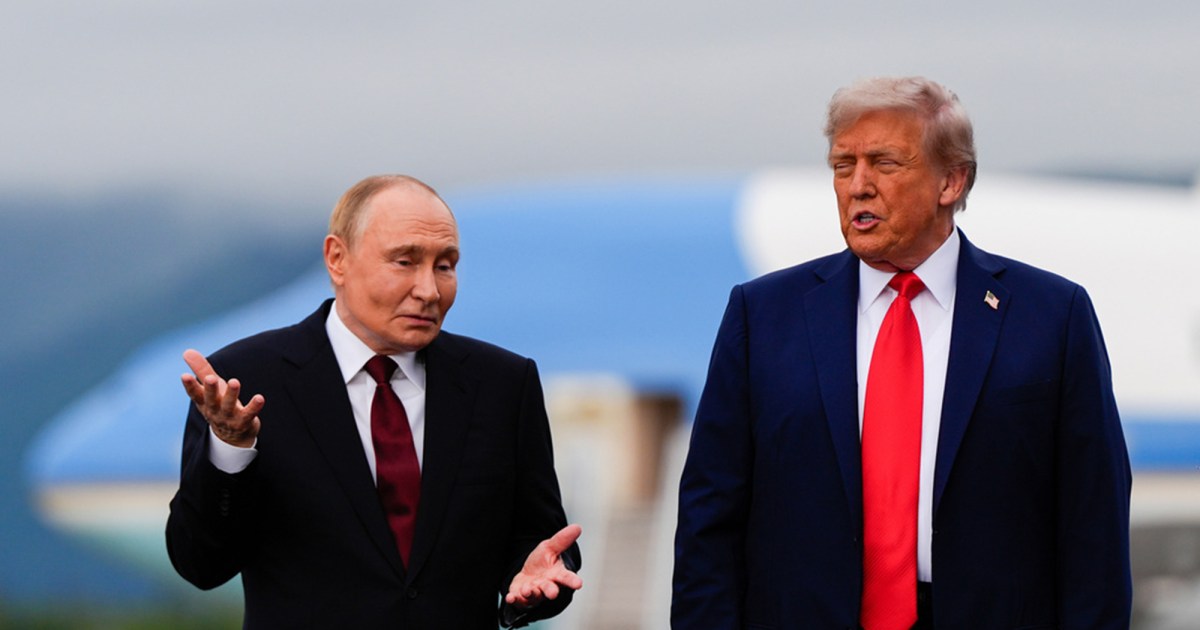
President Donald Trump and Russian President Vladimir Putin at Joint Base Elmendorf-Richardson, Alaska, in August 2025. Julia Demaree Nikhinson/AP Get your news from a source that’s not owned and controlled by oligarchs. Sign up for the free Mother Jones Daily. A version of the below article first appeared in David Corn’s newsletter, Our Land. The newsletter comes out twice a week (most of the time) and provides behind-the-scenes stories and articles about politics, media, and culture. Subscribing costs just $5 a month—but you can sign up for a free 30-day trial. As an adult, I have had two recurring dreams for decades. The first is that I must return to college to complete my studies and earn a diploma. (I left school a semester shy of graduating but ended up taking courses elsewhere, transferring the credits, and snagging that sheepskin.) The second is that I appear on an episode of Saturday Night Live and—most important—attend the afterparty. There’s not much I can do to address the anxiety of unfinished business underlying the college dream. As for the second, I say it’s never too late. And the closest I’ve come to realizing that dream occurred earlier this week when I was a guest on The Daily Show. Jon Stewart invited me on to discuss my new book, How Russia Won: Donald Trump, Vladimir Putin, and the Fight for America, and the latest news about Trump, Putin, and the war in Ukraine. I’ve never had such an entertaining and amusing chat about a profound threat to American democracy and global order. Stewart was a generous host, allowing me plenty of time and opportunity to respond to his smart questions and sharing the laughs. The crowd was supportive. At one point, Stewart posed an intriguing query. After I noted that Trump was now consummating his “man crush” on Putin, he asked whether it was possible Trump was pursuing the theory that it would be good for the United States, in terms of stability and prosperity, if the world were divided into spheres of influence dominated, respectively, by Russia, China, and the United States. I countered that Stewart was giving Trump too much credit. He replied that there’s “a first time for everything.” The audience laughed. He added, “He was very good on The Apprentice.” Stewart then remarked that he believes a line from Peaky Blinders explains Trump’s view of the world: “Big fucks small.” That became a tagline for the rest of the interview. You can watch it here: Stewart displayed a firm grasp of the big story of Trump’s yearslong infatuation with Putin and what it might mean for the rest of us. But even as Trump’s recent full-throttle embrace of Putin and his abandonment of Ukrainian President Volodymyr Zelenskyy have become headline news these past two weeks, much media coverage still lacks the full context of what’s occurring—that this is the triumph of Putin’s decadelong shadow war against the United States (which I detail in the book).A few hours before The Daily Show taping, I appeared on Nicolle Wallace’s MS Now show to discuss Trump’s capitulation to Putin, and she asked me, “Why do you think people can’t get their brain” around the complete tale of Putin’s assault on the United States and Trump’s complicity? I answered: “The fact of Russia intervening in our democracy—which [Putin] did in 2016, 2020, 2024, and he’s doing right now…may be too tough a truth for people to get ahold of.” I explained that Trump has succeeded in the messaging war: I will give him credit: This whole messaging, that this is all BS, it’s all a hoax, a witch hunt. If the Democrats are not pushing this issue—and they stopped after the Mueller report—he’s had a wide-open field for seven years now to try to discredit this story. Some reporters, politicians, and others think it’s the past. If you write a book like I did, then you’re obsessed with it, you’re looking backwards. Those are the kinds of criticism I get from the MAGA right. But I did the book because I think it’s a major part of the Trump story that hasn’t been fully presented as a coherent narrative. In the following days, I realized that even though Trump’s recent accommodation to Putin—the diesel deal, his absurd defense of Russia’s actions in Ukraine, his shocking denunciation and abandonment of Zelenskyy and Ukraine—was drawing much media notice, the overall story of Trump and Russia was still not being conveyed. As Wallace might say, brains still were not wrapping around it. Two striking examples of this were major analyses of the recent developments by a pair of top New York Times reporters. David Sanger, the White House and national security correspondent (with whom I went to high school in White Plains, New York), wrote a smart piece, noting: “Trump’s intensifying effort in the past few weeks to rehabilitate Russia and usher President Vladimir V. Putin back into diplomatic society is remarkable for its speed, its characterization of Mr. Zelensky as the primary obstacle to peace, and its brazen denial that Russia is continuing the war that Mr. Trump says he is trying to end.” There’s no sense of history or of the overarching narrative in those New York Times analyses. They sharply capture the moment. But they do not place it in full context. Correspondent Valerie Hopkins sagely noted: “Mr. Trump has set aside years of U.S. foreign policy by openly embracing Mr. Putin and easing the economic pressure on the Kremlin. At the same time, Mr. Trump has vilified President Volodymyr Zelensky of Ukraine, the putative American ally trying to defend his nation against a Russian invasion.” She pointed out, “Putin has never been so close to his goal of normalizing relations with Washington without having to make any compromises on Ukraine.” These were solid and perceptive takes. But neither mentioned that Russia attacked the 2016 election to help Trump win the White House. Or that Trump aided and abetted that attack by accepting and echoing Putin’s false denials. Or that in subsequent elections, Putin, as part of his ongoing twilight war against the United States and the West, continued to mount disinformation and influence operations for Trump’s benefit. Or that Trump has never acknowledged this gray-zone warfare and has thus been complicit in this assault waged by a foreign adversary on the US. Or that Trump, during his second stint in the White House, has run his own disinformation operation that releases formerly classified information that he and his minions falsely claim shows that there was no Russian assault in 2016. Or that Putin is currently meddling in the midterm elections by having his disinformation operators spread fake videos pushing scurrilous allegations against Democratic candidates. (See here and here.) What’s now happening is both the culmination of Putin’s long-term operation to weaken the United States and the West, and the fulfillment of Trump’s yearslong craving to forge a bond with Putin—a yearning Putin has exploited. There’s no sense of history or of the overarching narrative in those New York Times analyses. They sharply capture the moment. But they do not place it in full context. What’s now happening is both the culmination of Putin’s long-term operation to weaken the United States and the West, which is part of his grand scheme to restore the Russian/Soviet empire, and the fulfillment of Trump’s yearslong craving to forge a bond with Putin—a yearning Putin has exploited. The Russian tyrant has been scheming for over a decade to accomplish this. And for that same stretch, Trump has betrayed the nation by repeatedly covering for Putin and declaring all talk of Russia’s hybrid warfare against the US is a Deep State conspiracy. The Russians get this. “Well done, Trump,” one of Putin’s pundits proclaimed on state-controlled television. “Today, he’s on our side!” And in her article, Hopkins quotes pro-Putin journalist Marina Akhmedova: “In my personal view, victory has already been achieved.” The title of my book seems a reasonable appraisal these days. But that’s because it’s attached to a thorough telling of what has led to Trump’s surrender to Putin. Even though there’s much shock and anger over Trump’s appeasement of and submission to the dictator he once asked to be his “new best friend,” perhaps a bigger outrage is that for 10 years, Putin’s operation and Trump’s collaboration occurred in plain sight and the media and political world for most of this time have neglected or ignored this story. And that’s still happening today.
What’s MIA in the Trump–Putin Story
Full Article
Original Source
Read the full article at Motherjones →KhanList aggregates and links to publicly available news content. We do not host full articles from third-party sources. Always verify important information with original sources.