
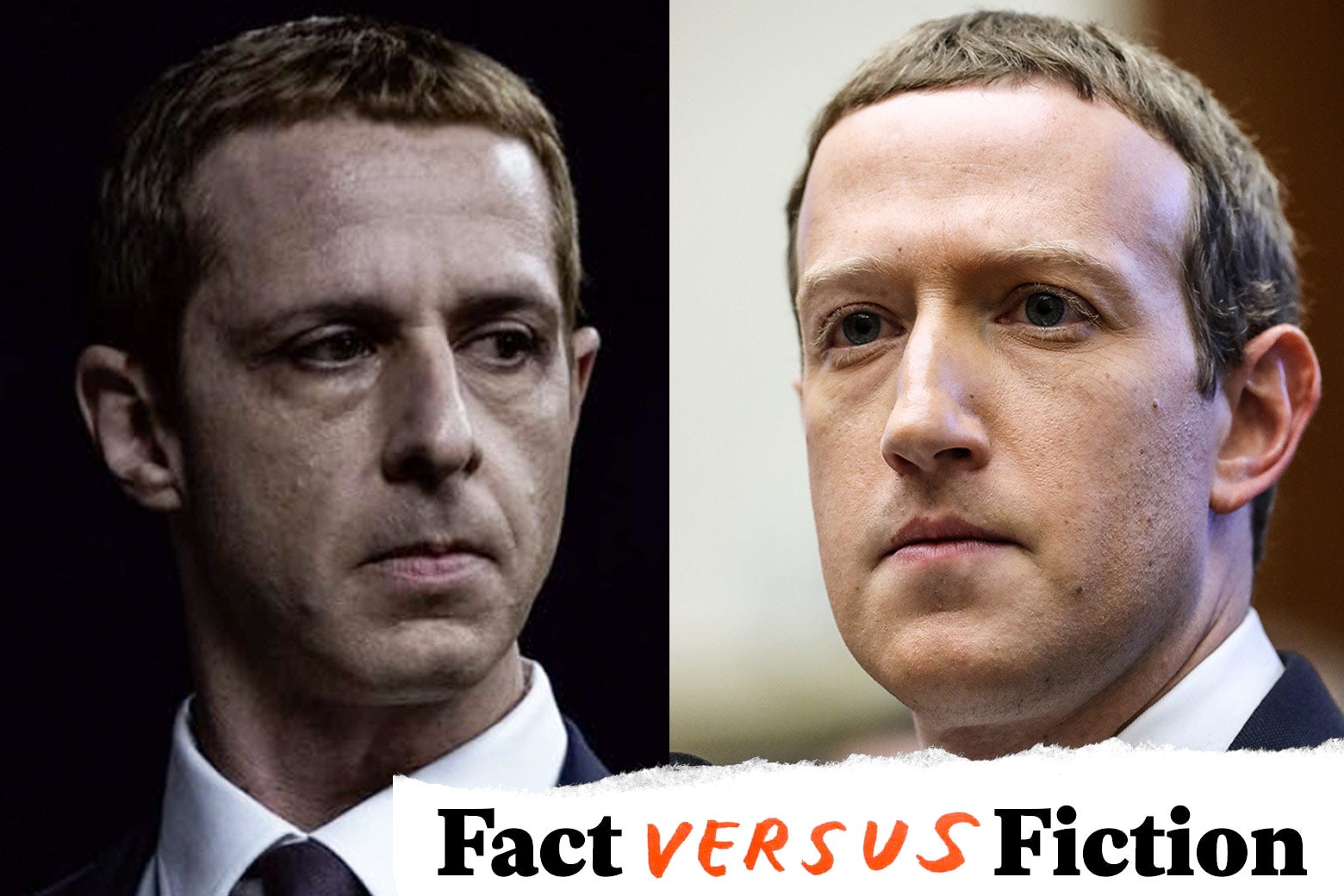
Movies The new film follows the journalist and whistleblower who revealed Facebook’s misdeeds to the world. But was the latter really inspired to leak by something she overheard in a restaurant? Photos by Sony and Chip Somodevilla/Getty Images Sign up for the Slatest to get the most insightful analysis, criticism, and advice out there, delivered to your inbox daily. The Social Network (2010) was sort of Facebook’s origin story, with founder Mark Zuckerberg initially presented as a largely sympathetic character—a socially awkward weakling getting metaphorical sand kicked in his face by the smug, rich, muscle-bound Winklevoss twins. But by the end of the film, we see the glimmerings of the mature Zuckerberg—ruthless, focused, and ready to throw his co-founder and only friend under the bus in pursuit of power. Now, 16 years later, Aaron Sorkin has written a sequel to his earlier script, where Zukerberg (trading Jesse Eisenberg for Jeremy Strong) is revealed in his final form as a contemporary Citizen Kane, the very model of a modern media mogul, determined to maintain his company’s stock value whatever the cost to society, democracy, or individual lives. As with Citizen Kane, in The Social Reckoning the ostensible major character remains unknowable, with a journalist—in in this case the Wall Street Journal’s Jeff Horwitz (Jeremy Allen White)—acting as our guide into his highly guarded world. The actual protagonist is Frances Haugen (Mikey Madison), an introverted data scientist who journeys from being a true believer in Facebook’s potential to permit the voices of ordinary people to be heard and to promote social connection into a disillusioned but empowered whistleblower. She is motivated by the company’s cynical indifference to the proven harms caused by its prioritizing profit over all else. The Social Reckoning’s other cinematic touchstone is, of course, All the President’s Men, complete with dogged investigative reporter, reluctant source, purloined documents, and a powerful and paranoid target. The film is thus firmly in the old-fashioned “legacy media journalists taking on vested interests as guardians of democracy” camp, as opposed to the currently fashionable “legacy media journalists as integrity-free sellouts complicit with the vested interests they’re supposed to be scrutinizing.” A film that champions truth and serving the public over propaganda sets a high bar for itself, particularly when it’s a work of fiction that might tweak the facts to make the drama more compelling. With this in mind, we look at what’s information and what’s disinformation in The Social Reckoning. Jeff Horwitz and Jeremy Allen White. Photos by Sony and Dia Dipasupil/Getty Images Was Jeff Horwitz Really a Tech Naīf? From the moment Jeff shows up at his new job at the Wall Street Journal’s San Francisco bureau in 2019, it is clear he’s not a techie. His new colleagues are astonished to learn he doesn’t use GPS and still relies on maps. Nor is he on Facebook. When Frances becomes his source, she is constantly astonished by how analog he is and how much she has to explain to him. When Aaron Sorkin started talking to the reporter about making a film based on his and Haugen’s books, the writer/director said he’d be taking some liberties with the Horwitz character. “He told me that he thought he’d need to change some chronology and details to make the story he had in mind work,” Horwitz recalled. “He also told me that he wanted to take some liberties with ‘Movie Jeff,’ who was sort of going to be a fictionalized, investigative reporter composite.” While we can’t know exactly how tech-savvy Horwitz really was, chances are that while he may have been no match for Facebook engineers when it came to understanding how to design algorithms or track user engagement, he was not quite as hopeless as the film suggests. Before joining the Wall Street Journal, Horwitz was a financial and investigative reporter for the Associated Press’s D.C. bureau, where he broke stories such as Donald Trump’s former campaign chairman Paul Manafort’s secret efforts to advance Russian interests, and he previously had worked at American Banker, where he exposed how banks profited from the sale of overpriced insurance. The point is: It takes a certain amount of IT familiarity to be able to pursue complicated digital paper trails. Horwitz also told Reuters that “source cultivation takes a long time in real life. I’ve found that the best sources are almost always ones that are off-the-radar, and that you have to demonstrate that you already know a great deal about a subject before they’ll talk to you,” which would seem to suggest he was not a complete tech ignoramus when Haugen first contacted him or else she wouldn’t have continued with the connection. Mikey Madison and Frances Haugen. Photos by Sony and Matt McClain/Pool/Getty Images Was Haugen Nerdy and Shy? In the film, Jeff initially reaches out to members of Facebook’s Civic Integrity team, which was tasked with looking at how information about elections was treated on the platform, as well as at how the platform could be used to disseminate political disinformation. In search of a story, he contacts several members of the team via LinkedIn, but the only one who responds is a nervous Frances, who, after much persuasion and reassurance, meets him in a park location chosen for giving her a view of anyone approaching them. She is very worried that someone will see her with Jeff (whom Facebook employees have already been warned off contacting), and she will be sued for violating her nondisclosure agreement. At work, Frances is condescended to by her fellow Civic Integrity team members and, although highly capable at her job, is reluctant to assert herself or speak up. She keeps to herself and remains somewhat isolated. Meanwhile, her personal life appears to be nonexistent and when she finally ventures on to a dating app, she can’t leave the date it’s arranged with a finance bro fast enough. As she gets drawn into providing more material, she continues to meet Jeff in the park and then in the apartment he’s renting, where she dresses like she’s on a date so she has plausible deniability in case she runs into anyone from work. In reality, Horwitz did reach out to a number of members of the Civic Integrity team before the 2020 election, but Haugen didn’t contact him until after the election on the day the team was dissolved. She did initially meet him on a hiking trail in an Oakland park, but aside from that, the movie’s account of how she became involved is very different from the reality. For one thing, Haugen was not a shrinking violet who had to be coaxed to come forward. On the contrary, Horwitz recalled, she was “a sophisticated source, and one of the first things she made clear to me was that, if she was going to be a whistleblower, she needed to be confident she would have impact.” A number of Facebook employees had previously left the company over concerns that it was knowingly prioritizing engagement over policing misinformation and users’ safety, but they were dismissed as disgruntled ex-employees. In the film, she express concern about her revelations having an impact and resulting in change, but it comes much later in the process, not right at the beginning. By the time Haugen met with Horwitz, she was already working in a new Facebook division that was looking into whether governments were misusing the platform to do things like entrap political dissidents. Several of the new team members had backgrounds in national security, so while in the film it is Horwitz who insists on giving Haugen a burner phone with which to contact him, in reality she emphasized security concerns from the start, and they agreed to communicate securely at that first meeting, with subsequent meetings not at the park or in his apartment but in Horwitz’s backyard. Haugen was not a socially awkward introvert but a Harvard MBA who had competed on and coached national-level debate teams while still in high school and had already worked at Google, Yelp, and Pinterest. In her 20s, she regularly attended Burning Man and, far from being unfamiliar with dating apps, worked at Hinge. What’s more, she had been married briefly to a Google colleague. Nor was she, as the movie suggests, inclined to hide her light under a bushel but was confident enough to assert in a 2021 conversation with Vogue, “There are probably 200 people in the industry who understand how algorithmic consumer products work as well as I do.” And far from being a guileless tech worker brought out of her shell by experienced media professionals, Haugen carefully selected Horwitz. “I auditioned Jeff for a while,” she told the New York Times, “and one of the reasons I went with him is that he was less sensationalistic than other choices I could have made.” Was Haugen Motivated by Seeing a Friend Radicalized by Facebook? The film starts off with a sequence that seems to have been filmed on a bodycam, where a woman waiting for a tow truck is haranguing a police officer who wants her to take a breath test. In true Karen tradition, she asks to speak to his superior before making racially disparaging remarks. When Frances sees this viral footage on the internet, she is horrified. The woman in the video is a former friend of hers, who, she tells Jeff, used to be all peace and love and very involved with progressive causes but who was in the 90th percentile of FB users and, Frances believes, was pushed to the extreme by consuming content from alt-right groups provided by the algorithm. She tells Jeff she is motivated by wanting to help Facebook fulfil its potential as a force for bringing people together, not putting them at one another’s throats. Haugen did indeed have a friend who she felt was radicalized by spending a lot of time on Facebook, telling 60 Minutes in October 2021, as Horwitz’s exposé appeared in the Wall Street Journal, that she agreed to take a job at the company “only if she could work against misinformation because she had lost a friend to online conspiracy theories.” But this was not Haugen’s only, or even primary, motivation. Her main concern was with the effect of Facebook on societies in the “global south,” where she felt the company was not taking responsibility for allowing material that incited intercommunal violence. “She told me she believed Facebook was corrosive to civil society—it sort of tore down trust, and she was deeply scared that its future growth was going to come from recruiting users in some of the world’s poorest places, places without internet,” Horwitz told Reuters. Indeed, one of the reasons she decided to trust him with her leaked documents was his work writing about Facebook’s role in spreading violent Hindu ultranationalism in India. Similarly, her mother, Alice Haugen, an Episcopal minister, recalled that “one of the things that had her concerned was Ethiopia,” a country in a protracted civil war, because Haugen didn’t think Facebook had enough Amharic speakers to moderate the site effectively. Did Haugen Become Aware of Instagram’s Effect on Young Girls by Overhearing One in a Restaurant? In the movie, Haugen is having dinner in a restaurant by herself when she overhears a conversation where a young teenage girl is telling her parents how miserable she is because she’s being bullied and body-shamed on Instagram. This inspires her to look into whether Facebook/Instagram content is affecting young girls’ mental health. She gets nowhere until a co-worker, who until now has shown no interest in helping Frances, passes her a dongle with files showing 32 percent of girls get worse mental health from spending time on Instagram. In reality, it was not an overheard conversation that got Haugen investigating the platform’s effect on girls’ body image and self-esteem but a request from Horwitz to look into it. Nor did a colleague helpfully give her a thumb drive with the relevant studies already downloaded onto it. She had to search for them. The information discovered, however, is correct. Did Frances Move to Puerto Rico to Escape COVID? Taking note of the spread of COVID in spring 2020 and having already determined to leave Facebook, Haugen decides to move to Puerto Rico and continue going through Facebook files from there. She is also motivated to move because her celiac disease makes her hands and feet very sensitive to cold. She spends her time dining alone, drinking daiquiris, and photographing images of Facebook documents. Haugen did move to Puerto Rico before lockdown as COVID took hold and did spend her time taking screenshots of thousands of Facebook documents. However, she also spent her time surfing and getting to know her new boyfriend. Puerto Rico had another attraction for her: It was home to a large community of blockchain investors, who had moved to the island to create what they called “Puertopia,” a crypto hub with no federal income tax or capital gains taxes. Haugen was an early investor in a crypto startup and her profits helped her pay for the lawyer, a Harvard Law School professor, who advised her during the publication of the hacked material and her subsequent testimony before Congress. Facebook How Accurate Is Mark Zuckerberg Movies
What’s Fact and What’s Fiction in The Social Reckoning
Full Article
Original Source
Read the full article at Slate →KhanList aggregates and links to publicly available news content. We do not host full articles from third-party sources. Always verify important information with original sources.