
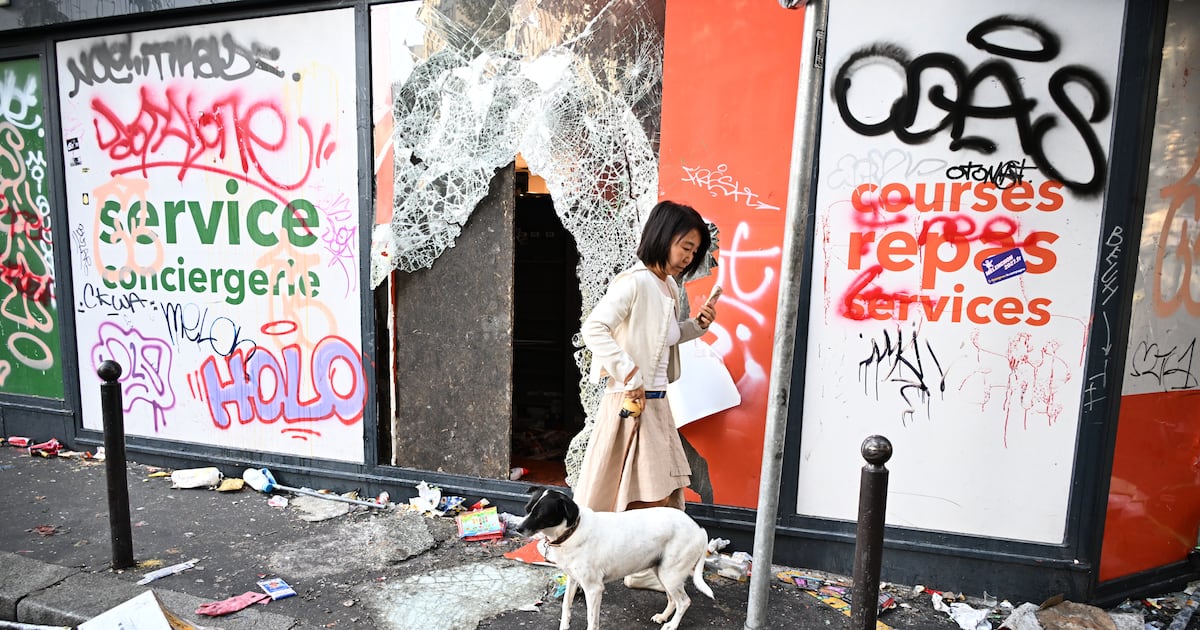
Who, exactly, is protesting in France?On Saturday two protest movements came together. Secondary school students and their supporters organised a march through Paris, as they have several times a week for the last few weeks.They were joined by demonstrators who had already called for protests in cities across France on October 17th many weeks ago about the high cost of living and fuel prices.The second group are hoping to revive the Yellow Vest, or Gilet Jaune, movement that paralysed France at times between 2018 and 2020. Their online calls for protests invited disparate groups, from farmers to trade unionists to climate activists, to take part.How did the demonstrations turn violent? In Paris, clashes between police and protesters began in the early afternoon around Place de la République, the meeting point for the demonstration. A march of tens of thousands of people then proceeded around Paris largely peacefully, with students chanting and marching with placards, sometimes accompanied by parents or grandparents.READ MOREAt the same time, smaller crowds began attacking shops and buildings and burning cars in a wildcat manner in various points around central Paris. They also built piles of rubbish and electric rental bicycles along the roads and set them alight, causing a potent dark smoke and the batteries to explode.Place de la République was a focal point. Bus stops were smashed, a newspaper kiosk was burned and shops and buildings attacked indiscriminately. The symbolic central monument representing Marianne, an allegory of the French republic, was badly vandalised with graffiti.Violent clashes took place across France as as tens of thousands of people angered by rising costs and declining services took to the streets. Video: Reuters Were protests and violence confined to Paris?No. Protests had been called for most large towns and cities in France. People thought to be protesters burned down the historic city hall in the small and picturesque city of Limoges. In Marseilles, demonstrators managed to break open the door of the city hall and ran through the building, trashing some furniture and art. In Lyons, a tourist information centre on the central square where crowds amassed was sacked and burned. Shops were looted in Marseilles, Nice and Lille.Who caused the damage?Some of the initial vandalism was clearly by protesters. They scrawled left-wing political messages on the Marianne monument on Place de la République and inside the Marseilles town hall.However, it isn’t clear that the later, wider looting and destruction was political.The Paris prosecutor Laure Beccuau, who is responsible for criminal prosecutions, told French media she “absolutely cannot confirm” that those responsible for violence in Paris were “politically aligned with the far left”.Those arrested are mostly people with no public profile who “remain silent and do not make any political demands”, she told broadcaster TF1.The instigators appear to have be largely young men, mostly dressed in black, many in hoodies and often with their faces covered.Once the shutters and doors to shops were forced open, video footage indicates that some people who appeared to be random passersby opportunistically took part: young women with shopping bags, a middle-aged lady in a headscarf, a child running off with a pair of runners.Adults make up 70 per cent of the 2,331 people arrested in France since Saturday in connection to the unrest, according to the minister of justice.Rioting took place across France over the weekend. Photograph: AP What happens next?Protests are set to continue. The Yellow Vest organisers, who have declined to disavow the violence, have called for an “act-two” protest on Saturday, October 24th, to demand the resignation of president Emmanuel Macron.Unions had already called for a mass demonstration against the proposed budget on November 5th.School students had until now been protesting on Tuesdays, Thursdays and Saturdays; however, the half-term break has begun. Their next large protest may end up being November 5th, when they return to school.The most immediate concern is whether wildcat rioting and looting could continue this week.There was sporadic looting in central Paris and Marseilles on Sunday night. Authorities have banned all public gatherings in Marseilles from noon until 8pm on Monday. Macron is reported to have considered imposing a curfew, before deciding against it in case it antagonised protesters further.What are the political implications?France is in full campaign mode in advance of presidential elections in April 2027 and the unrest is widely being seen as a turning point, though the implications are not yet entirely clear.The front-runner in polls, far-right Marine Le Pen, has used the violence to present herself as a law-and-order candidate. She has been blaming the left wing for causing the unrest, and accuses the current government of incompetence for losing control.She issued a presidential-style address to the nation from behind a desk on Sunday night, promising to pass new laws and restore order.Politicians from across the political spectrum are using the violence as an opportunity to attack Jean-Luc Mélenchon, the hard-left candidate and runner-up to Le Pen in polls. He has been marching with the students and on Saturday blamed the police for causing the violence, only belatedly condemning the rioting.Interior minister Laurent Nuñez has admitted that police resources were misallocated on Saturday and has said he offered his resignation, but that Macron refused it.Could Macron resign?The public anger and disorder are a discordant end to Macron’s final term in office, and the president looked uncertain as he delivered an address to the nation on Sunday night. He is due to leave France for a three-day visit to the Middle East.With his term due to end soon anyway, an early resignation seems unlikely.French president Emmanuel Macron looked uncertain as he delivered an address to the nation on Sunday night. Photograph: Benoît Tessier/ Pool/AFP via Getty Images French stocks sank on international markets when trading opened on Monday, and the cost that Paris must pay to borrow money will be closely watched.The French government faces the difficult task of passing a budget through a hung parliament under the watchful eye of market hawks concerned about excessive national debt, while public sentiment is fiercely opposed to cuts in spending.The government collapsed when trying to pass a budget last year, so watch this space.[ ‘A bombshell’: French teachers spot something on payslips that reveals scale of funding crisisOpens in new window ]Is there a link to unrest in other countries?A protest against the cost of living in Milan devolved into rioting on Saturday. There were protests against the housing crisis and cost of living in Portugal, which follows mass demonstrations about the housing crisis in Spain.Although there are common themes, the movements in each country are not directly linked. Viral clips on social media could play a role in spreading unrest, but this is unclear.A French firefighter responds as a street barricade burns amid clashes between riot police and demonstrators in Paris on Sunday. Photograph: Mohammed Badra/EPA Within France itself the complaints of protesters are highly disparate. Some young people have very concrete concerns about education policy, but also much broader worries about what future they will have linked to climate change, the effect of artificial intelligence on the labour market and inflation in housing costs.
What’s behind the violence shaking France, and what comes next?
Full Article
Original Source
Read the full article at Irishtimes →KhanList aggregates and links to publicly available news content. We do not host full articles from third-party sources. Always verify important information with original sources.