
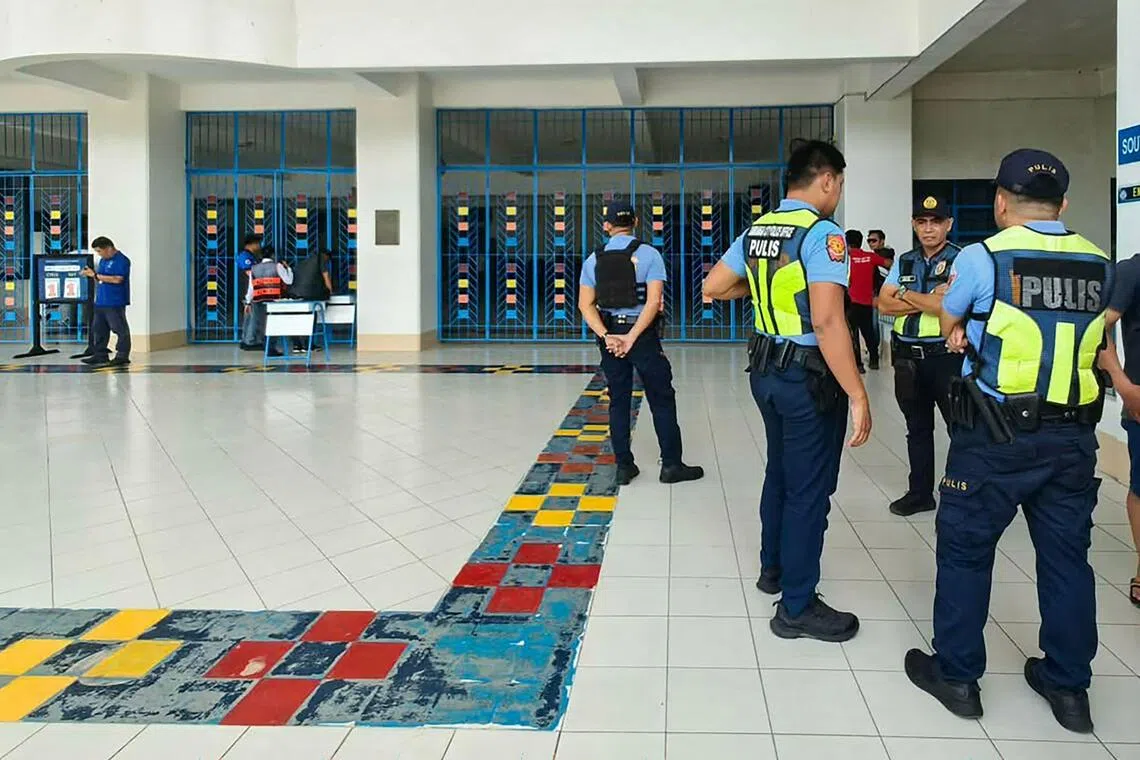
MANILA – Two school shootings in eight weeks have forced the Philippines to confront a form of violence it once regarded largely as an American problem.School shootings have historically been rare in the country, even though gun violence is not uncommon and the Philippines has one of the highest gun ownership rates in South-east Asia.Yet, the attacks in Tacloban in July and in Zamboanga in August have been followed by bomb threats, a stabbing and firearms being recovered on other campuses. The alarm prompted the Department of Education to plan nationwide active shooter drills on Aug 25, only to cancel them following warnings from psychologists that they could further traumatise children.Psychologists, sociologists and lawmakers point to a perfect storm: the normalisation of violence, Filipino adolescents’ deep immersion in the digital world and too few adults equipped to spot those becoming isolated or distressed. Online extremist networks have learnt how to exploit these gaps.Senator Risa Hontiveros led hearings into the two school shootings and nihilistic violent extremism (NVE). She said the country needed to reckon with what she termed the legacy of violence left behind by the bloody drug war waged by former president Rodrigo Duterte.“What effect could the past years of normalising violence from the highest pulpit in the country, through language, through the so-called war on drugs, through reportedly tens of thousands of killings on the ground and the widespread impunity… what effect could it have had on our culture as Filipinos?” Hontiveros told The Straits Times.“Instead of stopping the culture of violence, it seeped deeper and has now even entered our schools”.Duterte is now facing trial at the International Criminal Court in The Hague over alleged crimes against humanity for thousands of killings in his anti-drug campaign from 2016 to 2022.Sociologist Filomin Gutierrez of the University of the Philippines Diliman said the drug war may have provided a wider cultural backdrop of “violence as a solution to problems”, normalising killing, death and guns as a means of resolving issues.However, both Gutierrez and psychologist Peejay Bengwasan, who works with children in conflict with the law, cautioned against drawing a direct causal link between the drug war and the shootings.“It’s not a direct causal factor of any kind of aggressive behaviour,” said Bengwasan, a board member of the Psychological Association of the Philippines.But he added that exposure to a political climate that seems to glorify violence “increases your chances to become more aggressive or to see aggressive acts or tendencies as more normalised”.He said a child repeatedly exposed to violence could begin thinking that it is “a normal thing” that they can try or do.Perils of the internetThis cultural backdrop is now being exploited through its intersection with another vulnerability: the increasingly digital lives of Filipino adolescents.Recent government data showed that 60 per cent of Filipino children aged 10 to 17 not only have internet access but are also active users. The suspects in the Tacloban shooting were aged 14 and 15, while the suspect in the Zamboanga shooting was 14 years old.Bengwasan noted that Filipino teenagers today have been immersed in social media since childhood, unlike older generations who encountered it after years of predominantly face-to-face interactions.“For Filipino adolescents, the chances that they meet random people online are heightened,” he said.Social media exposes them to people whose backgrounds, values and principles can be different from their usual social circles, at an age when they remain particularly susceptible to outside influence.The Senate hearings showed how systematically NVE networks can exploit vulnerability. Cybersecurity expert Angel Redoble told senators that recruiters seek lonely or socially isolated children on ordinary platforms like online games, before moving them into private servers or encrypted messaging apps, where trust-building can escalate into isolation, coercion and blackmail. Algorithms make the hunt easier.The process can culminate in what Redoble called “status through brutality”, where increasingly extreme acts earn standing within the group, and violence eventually spills into the real world.The police told senators on Aug 20 that they had handled 74 NVE cases and rescued 42 minors, 30 of them aged 15 or younger.The authorities are also investigating a possible copycat phenomenon after posts glorifying the Tacloban shooters appeared online within hours of the attack, while footage of the Zamboanga shooting has continued to be reposted.Shifting social dynamicsBut the internet does not create every vulnerability that recruiters exploit.Gutierrez sees a paradox in a society that prides itself on close families and strong community ties. She said Filipino social bonds may not necessarily be weakening but “transforming”.“While many of us are well-bonded, the few who could not bond – viewed as ‘weak’, ‘strange’, ‘delinquent’, ‘problematic’ – suffer in isolation, and pathways for them to be integrated are sealed,” she said.“This makes alternative groups or subcultures that provide them acceptance attractive.”Bengwasan said this isolation can be compounded by the potentially traumatic experiences Filipino children are exposed to, from natural disasters such as typhoons, floods and earthquakes to violence in society.Children respond to distress differently, he said. Some turn inward, manifesting it as anxiety or depression, while others may express their difficulties through more aggressive behaviour.School itself is a significant social world for adolescents, where they discover whether they are “popular”, “accepted”, “seen or invisible” to their peers and teachers, Gutierrez said.Studies of rampage shooters suggest some perpetrators seek to overturn perceived exclusion through spectacular public violence: to destroy the identity others have imposed on them and, in Gutierrez’s words, “write their own biography”.That complicates proposals to simply block violent games or restrict social media use among minors.Gutierrez noted that scientists have not definitively established that violent video games directly cause real-life violent behaviour.“If we try to blame a particular source, for example, social media alone, or violent video games alone, we may be missing the overall picture,” she said, warning against the “moral panic” of finding a convenient object to blame.Bengwasan said psychologists likewise oppose an automatic blanket ban on social media or online games for minors.“Just because we eliminate a potential source of violence... if there’s still this society that very much normalised or promoted the violence, then children will get it from there,” he said.Erecting a first line of defenceThe cancellation of the active shooter drills leaves schools with a more immediate question: What can they do now to prevent another attack?Bengwasan supported scrapping drills, warning that simulating a shooting could heighten children’s anxiety and undermine their perception of school as a safe space.Meanwhile, Hontiveros, the senator, said the authorities could instead consider measures such as exercises that prepare school personnel without exposing children to realistic simulations.She also said teachers need to be trained to recognise warning signs, especially since the Philippines has more than 45,000 schools but fewer than 1,000 registered guidance counsellors.“The Department of Education really needs to be supported,” said Hontiveros. “After parents, they have the next eyes on the children every day.”Since hiring thousands of guidance counsellors can take some time, Hontiveros said psychometricians – those who specialise in developing and administering psychological tests – may undergo additional training simultaneously, so they can respond to children’s needs better. Peer-counselling groups could also help identify struggling students and refer them to mental health professionals.Hontiveros, a single mother of three, also urged parents to stay closely involved in their children’s lives and look out for signs that they may be struggling.“We have parental intuition. If we spot a potential issue, we can ask them, ‘Is there anything or anyone bothering you?’ Because you never know. The simple act of checking in on our children may mean the difference between life and death,” she said.The uncomfortable reality in the aftermath of the two Philippine school shootings is that extremist recruiters have become skilled at identifying children who feel alone.The challenge for Filipino families and schools is to reach them first.
What’s behind the school violence haunting the Philippines – and what can be done?
Full Article
Original Source
Read the full article at Straitstimes →KhanList aggregates and links to publicly available news content. We do not host full articles from third-party sources. Always verify important information with original sources.