
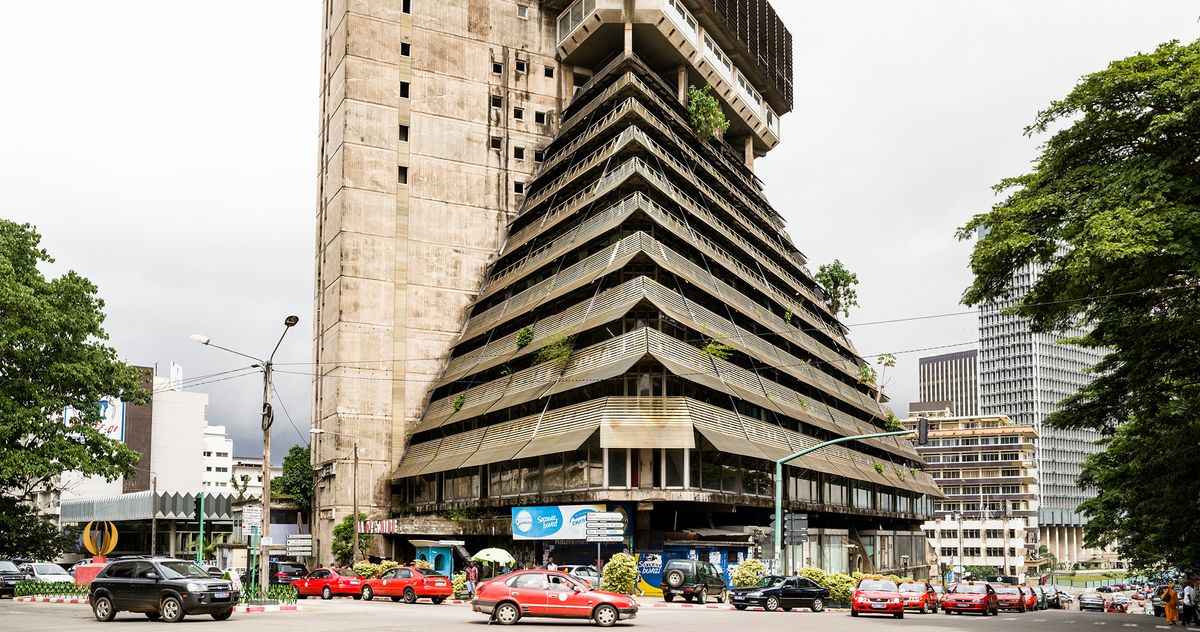
Intelligencer The Cut Vulture The Strategist Curbed Grub Street Subscribe What’s African About Modern African Buildings? An ambitious show at MoMA argues that architecture after independence could be a tool for freedom. By , New York Magazine’s architecture and classical-music critic since 2007 and was the recipient of the Pulitzer Prize for Criticism in 2002. Rinaldo Olivieri’s sort-of high-rise La Pyramide was a landmark of economic optimism in downtown Abidjan, Côte d’Ivoire, when it opened in 1973. It’s now vacant and falling apart. Photo: François-Xavier Gbré Rinaldo Olivieri’s sort-of high-rise La Pyramide was a landmark of economic optimism in downtown Abidjan, Côte d’Ivoire, when it opened in 1973. It’s now vacant and falling apart. Photo: François-Xavier Gbré Rinaldo Olivieri’s sort-of high-rise La Pyramide was a landmark of economic optimism in downtown Abidjan, Côte d’Ivoire, when it opened in 1973. It’s now vacant and falling apart. Photo: François-Xavier Gbré MoMA’s “Architects of Liberation: Modernism in Western Africa” feels at first like a slightly esoteric architecture show. A formidable assembly of drawings, photos, and models takes viewers on a packed tour of landmarks that tourists skip: bridges, university campuses, conference centers, and office towers from the 1950s, ’60s, and ’70s. Soon, though, you get the sense that you’ve wandered into a deceptively quiet argument among strangers. Polite, slightly puzzling debates over the merits of using concrete in Africa muffle the period’s scalding passions and incandescent dreams. Design debates stand in for the underlying conundrum of the time: How does a new land decide what to be once it’s no longer a colony? Decades of manifestos, exile, subversive actions, and scattered violence led to the formation of the seven countries covered here: Senegal, Côte d’Ivoire, Ghana, Togo, Benin, Nigeria, and Cameroon, almost all of which gained independence in 1960. The fervor of those times also yielded an elegantly futuristic National Theatre in Lagos that bore an ironic resemblance to Queen Elizabeth’s crown, a metal-clad pyramid in Abidjan, and a tapestrylike sprawl of interlocking triangles at a trade center in Dakar. It can be hard, in the confines of MoMA’s galleries, to connect these buildings with the symbolic load they carried — the upwellings of pride and fierce ideological battles that produced them or the bitterness that followed their construction. But linger a while and you begin to see that those were years when everyone understood that architecture wasn’t just about cost or form or function; instead, it gave material expression to beliefs about the kind of ideas that people kill and die for: democracy, race, old resentments, future prosperity. Conceived and organized by the museum’s chief curator of architecture and design, Martino Stierli, this is the third in a nearly decade-long series of responses to a mainstream narrative he finds deeply flawed. That is, that “modernism was invented in Western Europe and spread across the ‘free world’ before trickling down into the rest of the world,” as Stierli has put it. In that conventional view, the International Style (a term MoMA introduced in 1932) proliferated as an instrument of the Cold War, adjusting to local preferences but always faithful to its Franco-German origins. Instead, Stierli believes, modernism was a powerful political weapon, so versatile and mutable that it could be turned against its creators. He’s interested in how countries and people who tried to stay neutral in the great global polarization understood what modern meant. In 2018, he mounted “Concrete Utopia,” a stunning show of the way brutalism mutated in Yugoslavia. Three years later, he dove into the topic of post-colonial architecture in India, Pakistan, and Bangladesh with “The Project of Independence.” Now he turns to the nonaligned nations of Western Africa, who used architects to help them navigate a channel between superpowers. When Côte d’Ivoire’s first president, Félix Houphouët-Boigny, conceived a new capital in Yamoussoukro, the Burkina Faso–born, French-trained architect Jean Léon designed a girls’ high-school auditorium there — a bug-eyed concrete UFO on stilts from 1962. The Hôtel de la Paix in Lomé, by the French architect Daniel Chenut, was one of the jewels of Togolese tourism until it was abandoned two decades ago. It’s now threatened with demolition. The Nigerian artist Demas Nwoko wasn’t trained as an architect but he did design buildings, including this expressive Dominican Chapel and Ibadan, completed in 1975. The clustered forms of the Banque Ouest Africaine de Développement, or BOAD, in Lomé, Togo, designed by Guy Durand, Yves Ménard, and Messan Raphaël Ekoué-Hagbonon and completed in 1980, evoke traditional Togolese construction translated into industrial materials. Photographs by François-Xavier Gbré Or rather, many channels. Each new building found its place in a treacherous and complicated network of political pathways, serving countries that were variously capitalist and socialist, English-speaking and French, centralized and fragmented, impoverished and resource-rich. A motley range of leaders tried to bind together disparate populations and somehow reconcile local ethnic identities with the nation-state and Pan-African ideals. How’s an architect supposed to address these overlapping and contradictory rubrics, much less resolve them? How do you design a convention center that incorporates the malleable cultural concept of African self-determination and political critique that Senegal’s first president, Léopold Sédar Senghor, promoted as négritude? Ironically, the aesthetic language of the old colonial overlords helped negotiate between conflicting sensitivities and aspirations. The results could be counterintuitive. Take the 1967 Africa Pavilion in Accra, designed for the Ghana International Trade Fair by a trio of Polish architects, Victor Adegbite, Jacek Chyrosz, and Stanisław Rymaszewski. Like the New York State Pavilion, built just three years earlier for the World’s Fair in Queens, it sheltered crowds beneath an immense levitating disc, broadcasting an idea of unity as embodied in concrete, glass, and steel. Those visitors might have been forgiven for wondering what a building that looked like the Starship Enterprise had to do with national self-determination. At MoMA, the scant wall texts struggle to explain, but a catalogue entry by the art historian Ikem Stanley Okoye makes it clear that the Africa Pavilion bore an invisible political overlay — or several. In plan, the circular head, long walkway, and transverse arms “can evoke the iconic Akan figure, the akua’ba — a traditional doll-like sculptural symbol of re/production.” And if that “can” reads like a hedge, it may be because the raised disc was also “likely inspired by the royal umbrellas, symbols of status, wielded by all rulers of the principal precolonial kingdoms.” Although, come to think of it, Ghana’s president, Kwame Nkrumah, may actually have been “resisting specific ethnic references” and instead making “a visual argument for a unified post-ethnic national identity.” It seems that the pavilion’s references were highly specific and safely generic at the same time. Built in 1976 for the Second World Black and African Festival of Arts and Culture in Lagos, Nigeria and designed by the Bulgarian firm (Technoexportstroy), the monumental National Theater flaunted a crown with an oddly colonial resemblance to the Queen of England’s headgear. Photo: The Marilyn Nance Archive The new countries of Western Africa went on a university-building spree, including this technical school at the Institut National Polytechnique in Yamoussoukro, Côte d’Ivoire, designed by a team led by the French architect Henry Pottier. (Mosaic by Gérard Brand, 2025.) Photo: François-Xavier Gbré Just what is African about African modernism? The show dances around that question, occasionally tossing out a scrap of an answer and vigorously defining what it isn’t. Modernist architecture was not, Stierli insists in a catalogue essay, “a foreign-born concept to be adopted, but rather a malleable set of progressive ideas that African architects put to use in the search for a genuinely African contemporary architecture.” That distinction is key, because it takes a stand on a 60-year-old controversy over whether the new nations were trapped in a mentality that perpetuated colonial hierarchies and systems. Many of the buildings featured here were designed by European or European-trained architects, constructed with imported materials and financed from abroad to plug into Western systems of capital and trade. Still, to Stierli, they don’t represent “a continuation of colonialism, but rather a tool of emancipation.” The French architect Fernand Bonamy designed this brutalist beach house with teeth for Senegal’s first president, the poet Léopold Sédar Senghor. (Senghor House, Dakar, Senegal, 1978.) Photo: François-Xavier Gbré To reinforce that point, he ringingly rejects the movement called Tropical Modernism, which was developed in the last days of the British Empire by the almost stereotypically well-meaning but drastically blinkered English couple (and Le Corbusier acolytes), Jane Drew and Maxwell Fry. With a sense of superiority worthy of a Monty Python skit, they claimed to have conjured up a whole transnational tradition from scratch. “There seemed to be no indigenous architecture,” they declared, willfully ignoring the region’s rich culture of building, “we therefore tried to invent an architecture which specifically met the needs of the West Africans and dealt with climate and the diseases it brought with it.” Fry and Drew did make important contributions, working out passive techniques for setting hot and humid air in motion. Such tools for combating oppressive heat look prescient now, but Stierli isn’t impressed; Tropical Modernism was sensitive to the region’s climate but not to its culture. That kind of architecture for Africa just wasn’t African enough. So what is? One of the spectacular — and quasi tragic — centerpieces of the exhibition is the Italian architect Rinaldo Olivieri’s La Pyramide, an oddball high-rise standout in the heart of Abidjan, purportedly inspired by the Sudano-Sahelian region’s conical earthen mosques. Rising above an underground parking garage, a supermarket, nightclub, shops, and a dramatic three-story atrium, it narrows to a point before widening into a crown, the whole thing pushed up against a brawny concrete core. The shrinking triangular plan is inefficient and despite the aluminum sunshades that wrap the façade, the job of keeping the office floors comfortable for its workers went to a distinctly foreign technology: air-conditioning. In preparation for the show, MoMA sent the photographer François-Xavier Gbré on a multination tour to film and shoot new images of the show’s principal buildings, and his footage of La Pyramide is especially poignant. The tower stands, a handsome ruin and a relic of a more optimistic age. “Architects of Liberation” stops in 1980, so it omits contemporary studios like the Dakar-based firm Worofila, which focuses on locally sourced materials and earthen construction, or the Pritzker Architecture Prize winner Francis Keré, who merges Indigenous traditions with the practices of the industrial West. Its relatively narrow focus on the first postcolonial decades might have dramatized the period’s ideological debates or at least clarified the stakes. Instead, the show stuns viewers with a document dump of scholarship: nearly 450 items that make the arguments harder to follow. I turned to the catalogue for more nuance about the interplay of national aspirations and international style, and while I emerged better informed, the essays did test my tolerance for academic prose. More casual viewers may look at the luxurious high-rise Hotel Ivoire in Abidjan or the concrete mushrooms spouting from the Banque Ouest Africaine de Développement, or BOAD, in Lomé, Togo, and come sheepishly asking, “What’s so revolutionary about that?” What’s African About Modern African Buildings? Your product is saved! You’ll receive emails when your saved products go on sale. Manage preferences. Every product is independently selected by editors. Things you buy through our links may earn Vox Media a commission. Where Is a Celebrity to Live in This Town? In Defense of Murray Hill Where Did the Italians of Carroll Gardens Go? The Shmancification of the U.S. Open Who Was the Man in 2B? Where Is a Celebrity to Live in This Town? In Defense of Murray Hill Where Did the Italians of Carroll Gardens Go? The Shmancification of the U.S. Open A Downtown Brooklyn Bike Lane Has Come Back to Life Where Is a Celebrity to Live in This Town? In Defense of Murray Hill Where Did the Italians of Carroll Gardens Go? The Shmancification of the U.S. Open Who Was the Man in 2B? Where Is a Celebrity to Live in This Town? In Defense of Murray Hill Where Did the Italians of Carroll Gardens Go? The Shmancification of the U.S. Open A Downtown Brooklyn Bike Lane Has Come Back to Life
What’s African About Modern African Buildings?
Full Article
Original Source
Read the full article at Curbed →KhanList aggregates and links to publicly available news content. We do not host full articles from third-party sources. Always verify important information with original sources.