
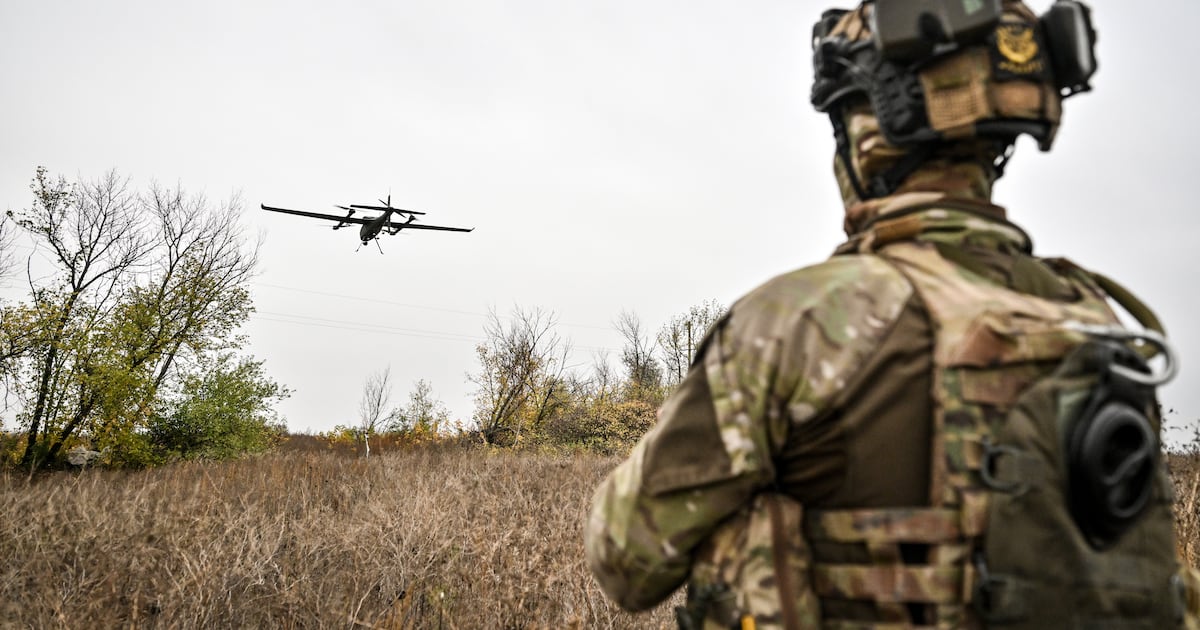
In his dugout near the front line, a Ukrainian soldier with the call sign Seal sits surrounded by the essentials of a drone pilot’s life.Energy drinks, coffee and protein bars are in easy reach, as are small tools, rolls of tape and two drone batteries clad in blue plastic. In front of him glow the screens through which he views the battlefield, the drone controller rests easily in his hands and a tortoiseshell cat named Murka is napping on his lap. Everything else he needs – his bunk bed and sleeping bag, store of food and water, camping stove and automatic rifle – are just a few steps away.READ MOREIt is a scene repeated, underground and painstakingly camouflaged, across a vast swathe of eastern Ukraine, where the front line snakes for some 1,200km from Sumy region on the Russian border to the coast of the Black Sea.Ukrainian operators in the Zaporizhzhia region track the route of a drone earlier this month. Photograph: Dmytro Smolienko/ Ukrinform/Future Publishing via Getty Images Tinned food and rocket-propelled grenades sit side by side in the dugout of a Ukrainian military drone crew. Photograph: 'Seal' These bunkers vary in size and technical sophistication, and in their proximity to Russian positions, but the men and women who inhabit them and the air and land drones they operate – whether for surveillance or attack, delivering supplies or evacuating casualties – underpin Ukraine’s success in holding back a vastly larger enemy.Dugouts combine the cutting edge and the spartan. They access satellite internet service and Ukraine’s innovative Delta system of live battlefield management. But they are still holes in the earth where soldiers must meet challenges that are timeless: endure privations, control fear, savour victories and small pleasures, survive.As autumn turns to winter, the day now begins at 6am for Seal (39) and the other soldier in the dugout, who uses the call sign KVN. It is from the Club of the Funny and Smart, a long-running television comedy competition in which one Volodymyr Zelenskiy, now Ukraine’s president, first came to public attention.They brush their teeth and make coffee, and prepare drones for the first flight.“Daytime is getting shorter and we don’t have night-vision cameras at the moment, so we don’t work at night,” says Seal, who is a member of the Ronins drone unit of 65th Separate Mechanised Brigade. “So we’re probably working from 7am until 6pm. Now we get maybe seven hours’ sleep. In summertime we were only getting three or four, because daylight lasted longer and flying conditions were better. That meant more Russian flights incoming, and so more flights for us. It was pretty tough. But now we’re getting enough sleep.”Seal and KVN (24) use first-person-view (FPV) drones to intercept larger Russian attack drones that target Ukrainian troops and armour around the front line in the southeastern Zaporizhzhia region. Their most common target is the Molniya (Lightning), a drone resembling a small plane that can carry a 10kg antitank mine.At the entrance to his dugout, a Ukrainian soldier prepares to launch a first-person-view drone to intercept a Russian attack drone. Photograph: Seal Their screens in the dugout show a video feed from their FPV drone and, ideally, an intercepted feed from the drone they are attacking. When the FPV is alongside its target, they press a button on the hand-held controller and detonate their drone.The FPVs have a relatively short range and battery life, so must be flown from correspondingly close to the front line. Seal says Russians are positioned only 7-8km from his bunker, and send out small teams from there to probe for gaps in Ukrainian defences.“They’re pretty near, and sometimes their infiltration groups come closer – maybe only 4km or 5km away. You can’t relax in that situation.“The scariest moments are when some good Samaritan calls and says: ‘Put on your armoured vest and helmet and get your gun close.’ ‘There is some information,’ he says. ‘I can’t tell you everything but be prepared’ – and that’s it. Be prepared for what? You don’t know … That’s the worst,” Seal says.“Or when KABs [air-launched bombs weighing up to 3 tonnes] or huge-calibre artillery is incoming, and landing closer and closer, and you realise it’s just logs and soil above your head and it would be impossible to dig your way out.”The dugout consists of a main room that is about 2m high and 2m by 4m wide, with a small hallway and storage space for drones, supplies and other gear. The floors and doors are made of wood, logs form the walls and ceiling, and metal foil and plastic sheets provide insulation. Seal describes it as “pretty comfortable” – warm and dry, with a diesel heater for winter.“We bring about 15kg of food to the position – soda, energy drinks, ramen noodles, instant mashed potatoes. Mostly dried food. Sausages. Candy. Coffee and condensed milk to put in it,” he says.They also order supplies from base – basics such as bread, pasta, eggs, vegetables, cheese and tinned food – and can buy extras with their own money.Ukrainian drone pilots with the call signs Seal (left) and KVN in their dugout in southeastern Ukraine. Photograph courtesy of Seal But getting food, water, fuel and ammunition to forward positions is difficult, when FPV drones roam a 30km-deep “kill zone” that straddles the front line.Deliveries are moved forward first by car, then ground drone and then attached to a heavy-lift aerial drone that can fly a 20kg payload to the bunkerThey use bottled water and wet wipes to wash, and a hole dug in a nearby trench as their toilet.“If you want to go at night, you take your gun, because you never know who could crawl into the trench,” Seal says. “You’ve got to be ready to defend your poop station.”[ Lara Marlowe: Robots have brought a ‘horrifying intimacy’ to warfareOpens in new window ]Murka (“Purrer”) defends the dugout’s food stores from mice and makes life more pleasant for each two-soldier team that spends a fortnight or so there before returning to base to rest.Many Ukrainian front-line units take in dogs and cats to keep them company and hunt rodents that are attracted to their supplies. Murka ("Purrer") lives at this drone position on the Zaporizhzhia front. Photograph: Seal She helps them relax at night, when they also go online and check the news.Seal says their Starlink connection was stable this week, while Ukrainian units using its military-grade Starshield version suffered problems amid a new push from US president Donald Trump for Kyiv to make concessions to Russian leader Vladmir Putin.“Of course we follow the news,” says Seal. “But we have a routine and stability here. We don’t get more scared or worried, and we know we will stay here and destroy the invaders and their forces, whatever Trump and Putin agree on.”[ A drone-maker in Lviv: Stopping Russians from killing Ukrainians is ‘an act of love’Opens in new window ]Seal had no romantic ideas about army life, and previously told The Irish Times about how he was mobilised, then fled his assigned unit and crossed Ukraine to join his preferred brigade in Zaporizhzhia, where he describes conditions and morale as good.“The main satisfaction from this work is saving lives. The Molniyas are basically flying bombs, so by destroying them we help protect our soldiers,” he says.[ Russia’s new jet-powered drones are fuelling anxiety in UkraineOpens in new window ]“Money also makes our mood better. When you go to a forward position you receive 100,000 hryvnia (€1,980) for the month, and you get substantial bonuses for hitting targets … That’s compared to basic pay of about 30,000 hryvnia.”He describes the world outside the bunker as both “beautiful and devastated”.“It is burned-down fields and treelines between them, abandoned and destroyed homes and villages, roads covered with destroyed cars … But there are also very beautiful moments, when you fly in the morning above the water,” he says. “Lots of animals live in this nightmare too … Peacocks and many other birds, foxes, rabbits. A falcon was living in a high tree next to our position.”A Ukrainian serviceman rides on a pickup vehicle under the antidrone net in Prosyana village in Dnipropetrovsk region earlier this month. Photograph: Darya Nazarova/STR Zaporizhzhia/AFP via Getty Images A bird's nest on the edge of fields in the Zaporizhzhia region of southeastern Ukraine. Soldiers on the front line live in close contact with nature, which clings on despite the destruction caused by nearly five years of full-scale war. Photograph: Seal Now he and KVN are nearing the end of another stint in the dugout, and preparing for the nerve-racking journey out through the kill zone, which begins with a 20km trek and then a car ride under threat of attack by Russian FPVs.“Everything must go smoothly so you get back,” he says. “You are planning to rest, but to get there, to get your rest, you have to take this final leap of faith.”[ Killer drones and frontline robots: Ukraine’s new weapons industryOpens in new window ]
‘Whatever Trump and Putin agree, we’ll fight the invaders’: Inside the dugouts powering Ukraine’s drone war
Full Article
Original Source
Read the full article at Irishtimes →KhanList aggregates and links to publicly available news content. We do not host full articles from third-party sources. Always verify important information with original sources.