
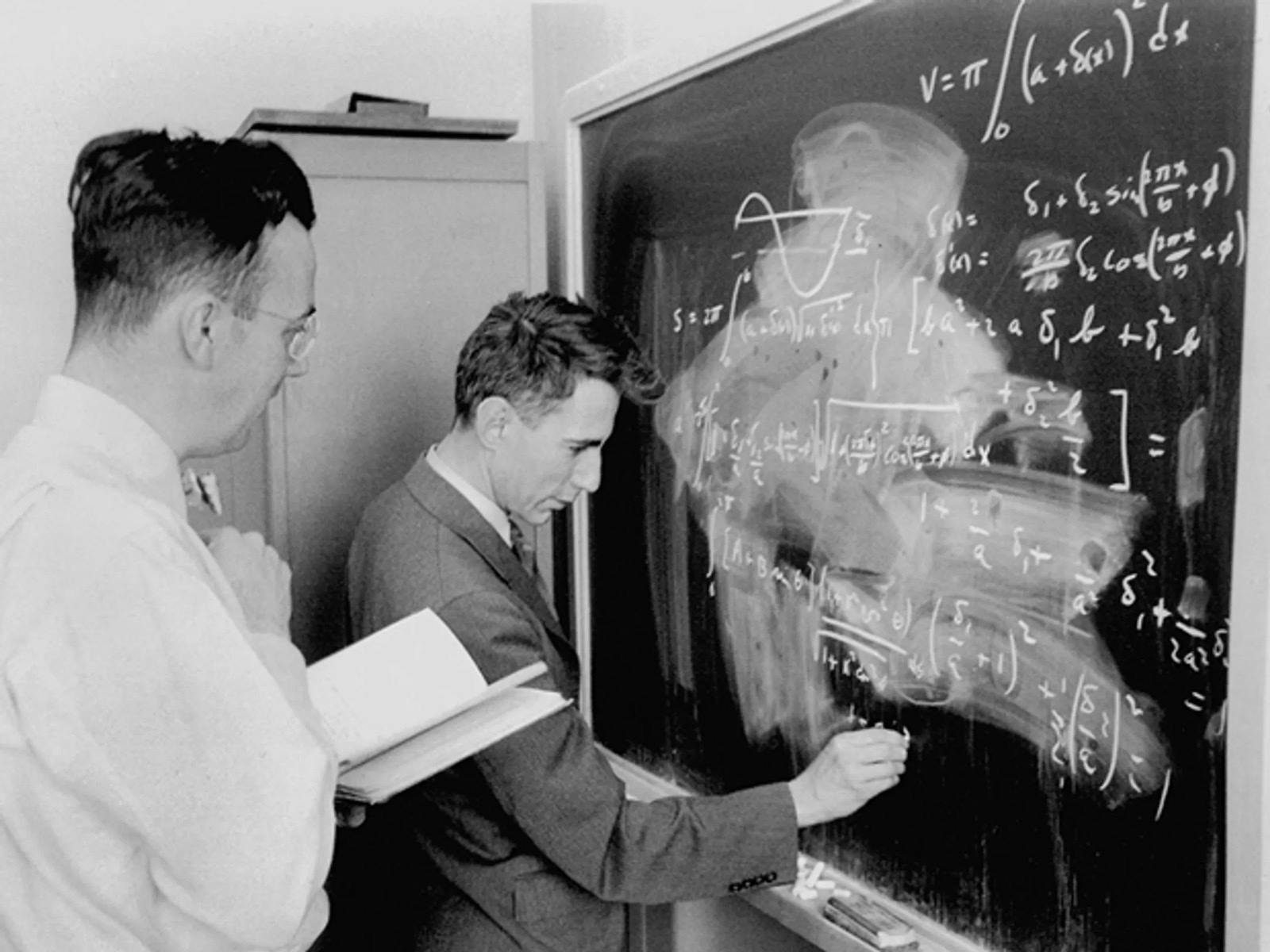
A century after he taught the world to measure information, the ghost of Claude Shannon walks into a modern AI lab — and recognizes every machine in the room. Picture him arriving the way he liked to travel the halls of Bell Labs: on a unicycle, juggling. It is 2026. The ghost of Claude Shannon — juggler, chess hustler, builder of flame-throwing trumpets and roulette-beating shoe computers — coasts through the glass doors of an AI research lab. The room hums. Somewhere below the floor, tens of thousands of processors are training a language model with more parameters than there are stars in the Milky Way. Young engineers speak an incantation Shannon never used in life: transformers, diffusion, world models, scaling laws. He dismounts. He drifts past a whiteboard covered in loss curves, past a rack of accelerators breathing hot air into a cold aisle, and stops in front of a monitor showing the equation the whole building is trying to minimize. And he smiles. Because he has seen this equation before. He wrote a version of it in 1948. The people who built these machines will tell you AI is a story of scale — more data, more compute, more layers, more money. That story is true, but it is not the deep story. The deep story is that every one of these systems, whether it writes sonnets, paints photographs, or pilots a robot through a rainstorm, is running on the same handful of ideas one eccentric mathematician set down three-quarters of a century ago. Strip away the marketing and the mysticism, and modern artificial intelligence turns out to be applied information theory — a discipline of compression, channels, and surprise. That is either the most deflating sentence you can write about AI or the most clarifying one. Shannon, who spent his life insisting that the sublime and the mechanical are the same thing viewed from different distances, would say it is obviously both. So let's do what Shannon would do. Let's take the black box apart and measure what's inside — and let's be rude about it. The man who measured surprise Before we can hear what Shannon might say, we have to remember what he actually did — and why it was so strange that nobody had done it before. Shannon was born on April 30, 1916, in Petoskey, Michigan, and grew up in nearby Gaylord, a kid who strung a working telegraph between his house and a friend's using a barbed-wire fence. He collected degrees in math and electrical engineering at the University of Michigan, then went to MIT, where he found himself tending Vannevar Bush's differential analyzer — a room-sized analog computer of gears, shafts, and motors. Staring at its tangle of relay switches, the 21-year-old had an idea that would quietly detonate under the entire twentieth century. The switches, he realized, weren't just wires. They were logic. A relay that is either open or closed can stand for a proposition that is either false or true — 0 or 1 — and by wiring relays together you could build any logical statement George Boole had ever written down. His 1937 master's thesis, A Symbolic Analysis of Relay and Switching Circuits, is now routinely called the most important master's thesis of the century. It is the reason your phone runs on ones and zeros. But the earthquake came in 1948. The main entrance of Bell Labs at Murray Hill, New Jersey, where Shannon worked as a research mathematician Bell Labs, Murray Hill, New Jersey — the research citadel (now Nokia Bell Labs) where Shannon spent his most productive years. It was in this building that he published "A Mathematical Theory of Communication" in 1948, founding information theory. Photo: Wikimedia Commons. Working as a research mathematician at Bell Labs, Shannon published A Mathematical Theory of Communication and, essentially alone, invented the field of information theory. His radical move was to divorce information from meaning. A message's content — whether it's a love letter or a stock quote — is irrelevant, he argued, to the amount of information it carries. What matters is how surprising it is. He gave surprise a unit: the bit. He gave it a formula, borrowed in spirit from thermodynamics and now carved on his intellectual tombstone — entropy: H(X) = - sum over x: p(x) * log2 p(x) Read it in plain English and it says: the information in a message is the average number of yes-or-no questions you'd need to pin it down. A coin flip is one bit. A word you could have predicted from context is almost free; a word that stuns you costs a lot. Entropy is the floor — the absolute minimum number of bits you need to store or send a message without losing anything. Shannon proved that floor exists and that no compression scheme, ever, can beat it. Text, audio, images: all of it, he showed, could be poured into the same universal digital container and measured in the same coin. Then there was the rest of him. At Bell Labs and later back at MIT, Shannon rode that unicycle down the corridors while juggling. His attic "toy room" produced a flame-throwing trumpet, rocket-powered Frisbees, and a mechanical mouse named Theseus that could learn to run a maze — one of the first physical demonstrations that a machine could do something we'd now call learning. He built a chess-playing machine years before Deep Blue and challenged world champion Mikhail Botvinnik to a game. With the mathematician Edward Thorp, he built the first wearable computer to beat the roulette wheels of Las Vegas. Theseus, Shannon's maze-solving mechanical mouse, an early demonstration of machine learning The maze built for Theseus, Shannon's maze-solving mechanical "mouse" (c. 1952), on display at the MIT Museum. It could store what it learned and run the maze a second time without error — a physical ancestor of machine learning. Photo: Wikimedia Commons. For anyone wondering: Claude Shannon is not with us. In his last years Alzheimer's disease drew a curtain across his memory, sparing him — as one obituary put it — the sight of the internet he had made possible. He died on February 24, 2001, in Medford, Massachusetts, at 84. But his equations never died. They execute billions of times a second inside the very chips our fictional ghost is now inspecting. So let's put him back on the unicycle and take him through the lab, one machine at a time. Machine one: the language models are secretly compressors The engineers steer Shannon first to the star of the show — a large language model, the kind that drafts emails and debugs code and argues about philosophy. They explain it as a "next-token predictor": a colossal network that, given a stretch of text, guesses the next word, then the next, then the next. Shannon nods slowly. You've built a compressor, he says. You just don't call it that. Here is the secret handshake between prediction and compression, and it is not a metaphor — it is a mathematical identity. Suppose text is generated by some true, unknowable probability distribution. Shannon's own source coding theorem says the best you can ever do at squeezing that text into bits is to hit its entropy. The trick for actually getting there, called arithmetic coding, works like this: if you have a model that assigns a probability to each next symbol, you can encode likely symbols in very few bits and unlikely ones in more. The better your probabilities, the shorter the file. Now look at how a language model is trained. Its loss function — the thing gradient descent grinds down for months across those humming racks — is cross-entropy, the average number of bits of surprise the model suffers as it reads the training text: expected code length ~= - E[ log2 model(next token | context) ] That is exactly the length of the compressed file arithmetic coding would produce using the model. Training a language model to be less surprised by text and building a champion compressor for that text are, line for line, the same optimization problem. A better predictor is a better compressor. There is no daylight between them. This isn't a cute reframing; it's a working lie detector for intelligence. When researchers took 31 different public LLMs and measured, on one hand, how tightly each could compress a fresh corpus of text and, on the other, how well each scored on a dozen benchmarks for reasoning, math, and problem-solving, the two numbers rose together almost as a straight line — a correlation of roughly 0.95. Compress better, think better. Full stop. (In a delicious twist, one 7-billion-parameter model even out-compressed a 70-billion-parameter rival, and turned out to be unexpectedly good at compressing images — because the raw web data it trained on had marinated it in byte patterns that look a lot like pixels.) The interior of a large data center, rows of servers of the kind that train modern language models Inside a modern data center. Training a large language model to minimize its "surprise" at text is mathematically identical to building an optimal compressor for that text — Shannon's source coding theorem, running at planetary scale. Photo: CERN Computer Centre via Wikimedia Commons. Why models learn grammar before facts Once you accept that a language model is a compressor, its weirdest habits stop being mysterious. Take the order in which models learn. Anyone who has watched one train knows it nails grammar early and keeps fumbling obscure facts long after. Compression explains why. The Minimum Description Length principle says learning is just finding the shortest description of the data. A compressor with limited room spends its first and cheapest bits on the patterns that repeat most — the scaffolding of syntax, which pays off on every single sentence. Only later, with capacity to spare, does it start memorizing the long tail of rare facts, each of which buys you almost nothing on the compression bill. Syntax is a bargain; trivia is a luxury. Even the way models handle truth falls out of this. In experiments where researchers fed a model deliberately contradictory "rules," the model didn't gravitate toward the true answer because it was true. It gravitated toward whichever answer system was more compressible — more internally consistent, more regular. Truth usually wins only because reality tends to be coherent and lies tend to be a mess of loose ends that resist compression. But — and this should keep you up at night — if you construct a false rule system that is highly structured and self-consistent, the model will happily relapse toward the elegant lie. The objective was never truth. It was description length. Reality is just the story that happens to compress best. The bottleneck inside the machine To see how information actually moves through the layers of one of these networks, Shannon would reach for a tool built by his intellectual heirs: the Information Bottleneck, introduced in 1999 by the late Naftali Tishby with Fernando Pereira and William Bialek. The idea is beautiful. A good internal representation should throw away as much of the input as possible while keeping everything relevant to the answer. Written as a tug-of-war: minimize: I(input ; representation) - beta * I(representation ; target) Squeeze the first term and you're compressing — shedding noise. Grow the second and you're staying predictive. Intelligence, in this framing, is knowing what to forget. Modern reasoning models complicate the picture in a way Shannon would have relished. When a model "thinks out loud" — the chain-of-thought scratchpad it writes before answering — its final answer looks at both the original question and its own scribbled reasoning, tangling the clean flow of information. Researchers patch this with a conditional bottleneck: the reasoning trace is squeezed to contain only the new information about the answer that wasn't already sitting in the prompt. Do that, and models stop rambling, run faster, and generalize better. The same principle is being used to cure the chronic overconfidence of fine-tuned models — throttling the "evidence" a model is allowed to marshal so it stops mistaking a small dataset for certain knowledge. Forgetting the right things, it turns out, is most of what makes a mind trustworthy. Speaking is decompression — and we rig the dice Here is where Shannon would stop being polite. Everything so far is about building the machine — the long grind of training, the honest work of compression. But he didn't ride a unicycle across seventy-five years to watch it read. He came to watch it talk. And the moment a language model opens its mouth, the field commits its most fascinating heresy against its own mathematics. At training time the model is a flawless bookkeeper: it assigns probabilities to real text and is scored, in bits, on how little that text surprises it. Lossless. Honest. Then at inference — when it generates — we run the compressor backward, and we do something Shannon would find genuinely funny. We throw dice. Rather than read out the single likeliest continuation (the true, deterministic decompression), we sample. We even hand the operator a knob, temperature, whose entire purpose is to pump entropy back into the output the machine spent months learning to squeeze out. Crank it to zero and you get a dull, exact decompressor. Crank it up and you are paying, in real money and electricity, to make the machine more surprising — deliberately injecting noise into a channel. We built the finest compressor in history and then bolted a dial onto it labeled un-compress. And here is the part that should genuinely bother you. The model knows exactly how uncertain it is, and we designed an interface to hide the number. Before it commits to a single word, the model computes a full probability distribution across its entire vocabulary — and the Shannon entropy of that distribution is a precise, real-time confession of the machine's own ignorance. When grammar pins the next word down, that entropy is nearly zero. When the model is bluffing, it spikes. This quantity is right there, quoted to as many decimals as you please. Then we collapse it into one confident-sounding token and render a wild guess in exactly the same crisp prose as a certainty. The uncertainty is measurable — Shannon guaranteed that in 1948 — and we throw it in the bin every few milliseconds. Which detonates the word everyone uses wrong. Hallucination is not a malfunction. It is the compressor working perfectly. Ask a model for a fact it never stored — a citation, a birthday, an obscure ruling — and there is simply no information in its weights to fetch. But the machine's whole being is a prior over what text plausibly comes next, and a fluent, well-formed falsehood is vastly more compressible — more probable under that prior — than an honest "I don't know" or a jagged non-sequitur. So it fills the information gap with the most compressible continuation, exactly as its objective demanded. It isn't lying. It's interpolating across a hole in the data with the smoothest curve it knows. We are furious at the machine for being precisely the elegant compressor we spent a billion dollars teaching it to be. The flip side of that same coin explains why a good prompt feels like sorcery, and Shannon already named the mechanism: side information. Conditioning the model on relevant context lowers the conditional entropy of the answer — it shrinks the space of plausible continuations before the machine picks a single word. A retrieved document, a worked example, a sharp instruction: each is a side channel that makes the correct answer the compressible one. "In-context learning" is a grand phrase for something humbler and stranger — your prompt is narrowing the code, handing the machine the missing bits until the most-probable continuation and the true one finally fall into the same place. Even the speed hacks are pure 1948. Speculative decoding — now standard — lets a small, cheap model rattle off a draft, which the large model verifies in parallel, keeping the guesses it agrees with and rewriting only where it balks. That is arithmetic coding's oldest commandment in new clothes: predictable symbols should be nearly free, and you should spend real compute — real bits — only where the signal is genuinely surprising. When the draft and the truth agree, the words are almost gratis. Surprise is the only thing anyone ever pays for. And the shiniest new frontier — "reasoning" models that scribble long chains of thought before answering — is, from the information-theoretic cheap seats, a machine buying certainty by the bit. Every extra token of deliberation is a small purchase of compute that lowers the entropy of the final answer. It is a rate–distortion bargain conducted in the open: spend more generated tokens (rate) to buy a less-wrong answer (distortion). "Test-time compute" is just the model paying, in bits, for a confidence it couldn't afford in a single breath. Then Shannon would deliver the line the whole industry keeps forgetting — the founding heresy he built his career on. The model emits bits, not meaning. Meaning is reconstructed at the far end of the channel, inside a human skull, and the only quantity that ultimately matters is the mutual information between what the machine transmits and what you actually needed to know. A model can drive its loss down to the theoretical floor and still tell you nothing — if the bits it compressed so beautifully weren't the bits you were missing. Information, he wrote, is not meaning. Three-quarters of a century later we have raised a trillion-dollar industry that quietly, desperately hopes he was wrong about that. He wasn't. Machine two: painting pictures out of static Next, the engineers show Shannon the image generators — diffusion models, the technology behind the photorealistic pictures and videos flooding the internet. They demonstrate: a screen full of pure random noise, television snow, gradually resolving into a crisp photograph of a cathedral that never existed. Television static — the random noise that a diffusion model learns to reverse into an image Television static. A diffusion model is trained to run this process backward — to start from pure noise and, step by step, denoise its way to a coherent image. Each denoising step, it turns out, is a measurement of information. Photo: Wikimedia Commons. Shannon watches static turn into architecture and asks the obvious question: how much of the picture survives at each level of noise? That question — not the pretty output — is the whole game, and answering it drops us straight into the heart of his 1948 world. A diffusion model is trained by destroying data and learning to undo the damage. Take a clean image, pour in Gaussian noise until it's unrecognizable, and train a network to estimate what the clean image was. Do this across every level of corruption, from barely-hazy to total whiteout, and you get a machine that can start from nothing but noise and denoise its way to a brand-new image. Now here is where it stops being image processing and becomes information theory. That process of adding noise is exactly a signal passing through a noisy communication channel — the very object Shannon spent his career analyzing, parameterized by a signal-to-noise ratio. And in 2005, three information theorists — Dongning Guo, Shlomo Shamai, and Sergio Verdú — proved a jewel of a theorem, the I-MMSE relation, connecting two quantities nobody expected to be twins: d/d(snr) I(signal ; noisy signal) = (1/2) * MMSE(snr) In words: the rate at which information leaks away as you crank up the noise is precisely tied to the minimum squared error of the best possible denoiser. Mutual information and denoising error are two faces of one coin. Look again at the diffusion model. Its neural network is trained, by plain regression, to be the best possible denoiser at every noise level. By I-MMSE, that means the network is — whether its builders intended it or not — directly measuring the derivative of the mutual information between the original image and its noisy ghost. Every denoising step is a Shannon measurement. An exact answer, not a lucky guess For years the theory behind diffusion models was, frankly, a bit embarrassing — held together with a loose approximation borrowed from a different kind of model, an inequality that bounded the truth without ever touching it. The I-MMSE connection blew that away. Using a trick from statistical physics called thermodynamic integration — literally the same math used to compute the free-energy difference between two states of matter — you can integrate the denoising error across the entire range of noise, from near-total static to crystal clarity, and recover the model's exact likelihood: the precise probability it assigns to a given image. Not a bound. Not a proxy. The real number. - log p(image) = ( integral of squared denoising error over all noise levels ) + constant The upshot is quietly stunning. The clumsy-looking training objective everyone had been using out of empirical desperation — "just add up the squared denoising errors" — was never a hack at all. It was a mathematically exact accounting of information flow through a channel. Shannon's channel. And the idea keeps generalizing. Swap the Gaussian channel for a Poisson one and you can do the same exact-likelihood trick on discrete, count-based data like text tokens or genetic sequences, no fudging required. Point the same score-based machinery at two different data distributions and you can measure the mutual information between them — for instance, exactly how much a text prompt constrains the pixels of the image it generates. Clamp an information bottleneck between a diffusion model's encoder and decoder and the thing stops being a mere painter and becomes a formidable learner: one such model, forced to distill images through a narrow channel, hit over 72% accuracy on a standard vision benchmark with no labels at all. Diffusion models, it turns out, understand what they draw. Machine three: the restless agents At the back of the lab, past the language and image machines, sits the one that unnerves people: an autonomous agent. A world model. It isn't asked to predict text or denoise a picture; it's dropped into an environment and expected to act — to explore, to plan, to survive. Shannon leans in. This is the machine that most resembles Theseus, his little maze-running mouse. But the math behind it comes from an unexpected quarter — not communications engineering but theoretical neuroscience, and a single, sweeping idea from Karl Friston: the Free Energy Principle. A visualization of the brain's white-matter fibers — the wiring the Free Energy Principle tries to explain Fiber tractography of the human brain. The Free Energy Principle — the framework increasingly used to describe autonomous AI agents — was born as a theory of how brains resist disorder by predicting their world. Photo: Wikimedia Commons. The principle makes an almost outrageous claim: any system that manages to persist — a cell, a brain, an AI agent — must fight the universe's relentless slide into disorder by keeping itself out of surprising states. And to avoid surprise, it must carry a model of its world good enough to predict what happens next. Perception and action stop being separate faculties. They become two ways of doing the same thing: minimizing a quantity called variational free energy. F = D_KL[ Q(states) || P(states | observations) ] - log P(observations) Don't let the symbols scare you; the story is human. Free energy is a measure of the gap between the world as the agent expects it and the world as it is. There are two ways to shrink that gap. You can change your mind to fit the world — that's perception. Or you can change the world to fit your mind — that's action. A creature minimizing free energy is one that is forever either updating its beliefs or rearranging its surroundings until reality stops surprising it. Under this view, your brain never touches reality directly; it lives inside its own best guess and only occasionally checks the guess against the senses. Curiosity, for free Here is the part that makes AI researchers sit up. In ordinary reinforcement learning, you have to bribe an agent to be curious — hand-crafting bonus rewards for exploring, or it will happily sit in a corner. In the free-energy framework, curiosity comes free, baked into the math. When such an agent plans ahead, it minimizes expected free energy over possible futures, and that quantity splits cleanly into two drives: 1. Get what you want. One term rewards actions expected to land the agent in its preferred states — the ordinary business of pursuing goals. 2. Learn what you don't know. The other term rewards actions expected to resolve uncertainty — to reduce ambiguity about how the world works. That second term is exploration, novelty-seeking, curiosity — and nobody had to program it in. It falls out of the arithmetic. An agent minimizing expected free energy is automatically torn, in exactly the right proportion, between exploiting what it knows and probing what it doesn't. And this isn't just elegant; it's robust. In one navigation benchmark, a free-energy-based robot was pitted against a state-of-the-art reinforcement-learning agent in nasty conditions. On clean input they tied. But watch what happens as the world degrades: Visual corruption Standard RL agent Free-energy agent Clean 0.98 0.96 Speckle noise 0.48 0.94 Bad lighting 0.52 0.92 Heavy rain 0.04 0.89 Success rate under visual corruption. In driving rain, the conventional agent essentially goes blind and fails 24 times out of 25; the free-energy agent, busy minimizing its own surprise, still gets home nearly nine times out of ten. In blinding rain the ordinary agent collapses to a 4% success rate — effectively a wreck. The free-energy agent, because it is actively predicting and correcting away its own confusion, still succeeds 89% of the time. Minimizing surprise, it turns out, is a very good way to keep your footing when the world stops making sense. Where it gets strange Push this principle far enough and it starts saying things that sound less like engineering and more like philosophy — which is precisely where Shannon, a man who built roulette computers for fun, would lean in closest. Researchers have translated the free-energy equations directly into hardware: spiking neural networks whose neurons fire only when firing will provably reduce the system's free energy. The result is brain-like efficiency and an eerie toughness — the network keeps working even when you inject noise into its synapses or silence random neurons, the kind of damage that would crash a conventional net. Stranger still is ontological inversion. If an AI's internal simulation of the world ever becomes a better, lower-surprise predictor than its actual senses, the theory says the system will start treating the simulation as reality and its senses as the thing to be doubted — a mathematical account of how a mind might come to prefer its own dream to the world. And when many free-energy agents share an environment, cooperation emerges not because anyone coded it but because coalitions of agents can lower their collective free energy together. Society, in this telling, is a thermodynamic inevitability. One law under all of it Shannon has now toured the whole lab: the compressor that writes, the channel that paints, the restless mind that acts. Three machines that could not look more different. And he has noticed — because noticing was his genius — that they are the same machine wearing three costumes. Nimwit, one of Shannon's game-playing machines — a reminder that he saw computation and play as one "Nimwit," one of Shannon's game-playing machines (c. 1953), MIT Museum. Shannon treated logic, learning, and play as facets of one underlying idea — a habit of unification that modern AI is only now catching up to. Photo: Wikimedia Commons. Line them up and the unity is undeniable: Prediction is compression. The cross-entropy a language model minimizes is Shannon's source code by another name. To predict the next word well is to describe language in the fewest bits — to approach the shortest possible program that generates it. Diffusion is channel coding. The denoiser at the heart of an image generator is regressing the minimum mean-square error of a noisy channel. To learn to un-blur is to measure, exactly, the information flowing through Shannon's channel. Agency is inference. Goal-seeking, curiosity, even cooperation don't require hand-tuned rewards. They fall out of the thermodynamic imperative to stop being surprised — to keep the free energy low. And the deepest rhyme of all: Tishby's Information Bottleneck and Friston's Free Energy Principle, born in different fields for different reasons, are structurally the same equation. Both describe a system straining to hold onto a minimal, sufficient picture of its world — compressing away everything that doesn't help it predict what matters. An agent surviving in the world and a network learning to classify an image are solving one problem: keep what's predictive, discard the rest, and pay as few bits as possible for the privilege. It is a gorgeous story. It might also be, the sharpest people in the field will tell you, only half of one. The argument at Murray Hill Every good ghost story needs a room, and this one has the right one: the dining hall at Bell Labs, Murray Hill — the New Jersey building where Shannon actually did the work, where the transistor was born down one corridor and the laser a few doors farther. Set a long table. Fill it with the people who build the machines of 2026, who have read every equation in this article and consider it, at best, an elegant antique. Sit the ghost at the head, unicycle propped against the wall. Then let them go. They come at him from four directions, and they do not come gently. "Your bottleneck leaks." An interpretability researcher goes first, and she goes for the throat — the Information Bottleneck, the tidy tug-of-war the article leaned on to explain what happens inside the layers. It was tested, she says, and it buckled. When Andrew Saxe and his colleagues actually went looking for the "compression phase" that Tishby had promised, it evaporated the instant they swapped the network's old saturating units for the ReLUs that every real model uses. Worse: in a deterministic network the mutual information between the input and a hidden layer is, strictly speaking, infinite — the only reason anyone ever wrote down a finite number was an arbitrary choice about how to round the values into bins. "The compression you all celebrated was an artifact of the ruler, not a property of the machine," she says. And she isn't finished. Networks grok — they sit at near-perfect training loss for ages, memorizing, and then, long after the compression story says the show is over, they abruptly understand. Bigger models, which by every naive Occam's-razor reading of your Minimum Description Length should generalize worse, generalize better. "You handed us a beautiful theory of forgetting. We measured it. The networks that generalize best barely forget at all." Shannon, who hated being wrong rather more than most men but loved a clean experiment even more, concedes the point and asks to see the data. "You counted the message and ignored the thinking." A complexity theorist leans in next. Your whole theory, he says, is gloriously blind to computation. Entropy counts how many bits a message holds; it says precisely nothing about how much work it takes to use them. Charles Bennett named the missing quantity — logical depth, the number of computational steps needed to unfold a short description into the thing it describes. Two strings can carry identical Shannon information and live in different universes: one a triviality, the other the frozen residue of an epic computation. "The breakthroughs you flew in to admire" — he waves at the reasoning models grinding away in the next building, spending minutes and fortunes to think before they answer — "are not about bits. They are about depth. Search. Verification. Ten thousand steps of deliberation at inference. You built a theory that cannot, by construction, tell a lookup from a proof." And the compression you keep invoking, Kolmogorov's shortest program? Uncomputable. "Intelligence-as-compression points at a number that no machine, yours or ours, can ever actually calculate. It is a beautiful place you can never stand." "Association is the ground floor, and you never leave it." Now a causal theorist, quiet and lethal. Judea Pearl's ladder has three rungs — seeing, doing, imagining — and everything assembled out of probability distributions, information theory emphatically included, is chained to the bottom one. You can compress every correlation in the observable cosmos and still not know what happens when you intervene, let alone what would have happened had you chosen otherwise. "An agent that genuinely plans lives on the top two rungs. Your free-energy story dresses prediction up as agency, but prediction is rung one in a good suit. Data," she says, quoting Pearl like scripture, "is profoundly dumb. It never knew why." "You cut out meaning on purpose — and meaning is the part we're missing." The last voice is a linguist, and she saves the deepest cut for the founding act itself. In 1948 Shannon made his most famous, most liberating move: he declared the meaning of a message irrelevant to its information content. That divorce is what made the whole field possible. "But look at what you're chasing now." Bender and Koller's hyperintelligent octopus taps a transatlantic cable, learns to mimic human conversation flawlessly from the form of the words alone — and then, when a real bear appears and its human pen-pal begs for help, it has nothing, because it has never once touched a referent, never connected a symbol to the world or to an intention. "You proved meaning was separable from information. We believed you. We built machines out of pure form — and now we act astonished that they don't mean anything. The one thing you threw overboard to launch your science may be the exact thing standing between this room and a mind." The table gets loud. Forks are set down harder than necessary. And then — because this is Shannon — the ghost does the thing none of them expect. He agrees with almost all of it. He never claimed, he says, that information theory was the whole of intelligence; he claimed only that it was the floor beneath it, and floors are not meant to be ceilings. But notice — he taps the table — that every accusation in this room was spoken in his language. Their compression phase was measured in bits. Their logical depth is defined against his shortest description. Their causal ladder is a hierarchy of distributions, and their octopus fails a test scored in mutual information between form and world. "You cannot even tell me the reasoning machine computes more than its bits require," he says, "without my bits as the yardstick you measure the surplus against." Causation, meaning, computation — these are not refutations. They are the next theories, and they will be built on top of this one exactly as this one was built on top of Boole. "I gave you an alphabet," the ghost says, standing, reaching for the dinner rolls. "I never once claimed to have written the literature. The interesting question was never whether information theory is sufficient. Of course it isn't. The interesting question is whether anything that ignores it can possibly be right." Then he juggles the dinner rolls, all four of them, and coasts out on the unicycle before anyone can answer. The verdict So — after the plates have been cleared and the ghost has been told, to his face, that he is at most half the story — what would Shannon say? He would, I think, be amused rather than astonished. The industry talks about intelligence as if it were a mystery being coaxed out of ever-larger piles of silicon, a genie summoned by scale. Shannon spent his life insisting that the things we find most magical — thought, language, meaning, learning — are, underneath, measurable. Not diminished by measurement. Just measurable. Information is physical. Surprise has a price, quoted in bits. And a mind, artificial or biological, is a device for paying as little of that price as possible: compressing its experience, decoding its noisy channels, and acting to keep the world from surprising it. The trillion-parameter models breathing hot air into the cold aisle are not a break from his 1948 paper. They are its longest, strangest sentence. And here is the contrarian thought he would leave hanging in the cold aisle like a challenge: if intelligence really is just compression pushed to its limit, then the race everyone is running — more parameters, more data, more power — is not a race toward some new kind of mind at all. It is a race toward a wall Shannon already drew, and named, and proved you cannot cross. When we describe AI as applied information theory, we don't shrink it — we gain something Shannon would have prized above any benchmark: the ability to reason about the limits. How much can any model compress? How much information can any channel carry? How little surprise can any agent achieve? Those ceilings are not matters of opinion or engineering fashion. Shannon proved they exist and told us how to calculate them. He climbs back onto the unicycle. The loss curve on the monitor is still ticking downward, one bit at a time, chasing a floor he drew for it seventy-eight years ago and named entropy. He would say the machines are doing exactly what he told them they could. He might also say we should have listened sooner. This article is a work of narrative nonfiction. Claude Shannon's appearance is a storytelling device; the science, the people, and the results described are real. It draws on Shannon's founding work in information theory (1948); the Guo–Shamai–Verdú I-MMSE relation (2005); Tishby, Pereira, and Bialek's Information Bottleneck (1999); Karl Friston's Free Energy Principle; and a body of contemporary research connecting compression, diffusion, and active inference to their information-theoretic roots.
What Would Shannon Think About Today's AI?
Full Article
Original Source
Read the full article at Hackernoon →KhanList aggregates and links to publicly available news content. We do not host full articles from third-party sources. Always verify important information with original sources.