
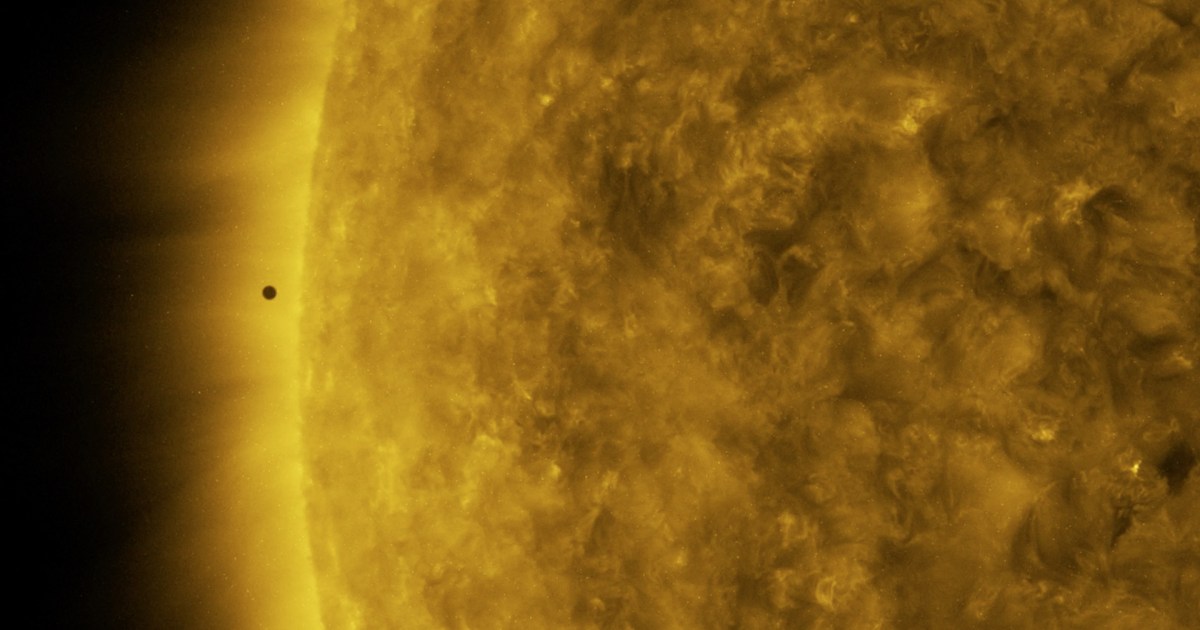
The answer depends on the world in question. The Sun wouldn’t notice a terrestrial planet, but a gas giant would have a noticeable effect. | Published: November 9, 2026 Mercury appears close to the Sun as the solar system's smallest planet transits our star in November 2011. Credit: NASA's Goddard Space Flight Center What would happen if a planet crashed into the Sun? Lindsay WhiteRio Rancho, New Mexico This is a wonderful example of a thought experiment, the ultimate “what if?” question. We should begin by pointing out that no fully formed planet will actually ever be able to crash into the Sun, as the Sun’s ferocious heat would begin to liquefy and vaporize the incoming world’s constituent matter as it approached, and tidal forces would tear it apart once it came too close. But let’s set aside that pesky astrophysical reality and imagine what would happen if a planet smashed into the Sun anyway. According to Morgan MacLeod from the Harvard-Smithsonian Center for Astrophysics, the answer depends, logically enough, on the planet in question. Cheerfully glossing over the dicey physics, we can say that if a terrestrial planet were to crash into the Sun, it is likely that we would not notice any dramatic effects — unless, of course, that planet were Earth. The consequent energy release could produce an event comparable to a fairly energetic CME, which could send a prodigious outflow of charged aurora-inducing particles speeding in our direction. In other words, it might produce a stunning sky show for us to enjoy. On the other hand, if Jupiter crashed into the Sun, the ramifications would be catastrophic to us on Earth. Even if we step outside our imaginary scenario and assume that high temperatures and powerful tidal forces would tear Jupiter’s constituent material to shreds that would initially follow a lethargic orbit around the Sun before plunging precipitously into the Sun’s outer layers, the resultant energy release of the impact would cause the Sun to swell significantly. Although the extent and duration of this expansion are uncertain and minor in relative terms — less than 1 astronomical unit over a timeframe of around a century — the resultant increased solar luminosity would most likely extinguish all life on Earth, while a physically larger Sun would swallow Mercury and Venus. (One astronomical unit, or AU, is the mean separation between Earth and the Sun, or 93 million miles [150 million kilometers].) So, toss Mercury into the Sun and we’ll see a bit of a blip. Toss Jupiter or Saturn into the Sun and we’ll see the end of life on Earth. However, be reassured: At the time of this writing, Jupiter is 5.29 AU, or 492 million miles (791 million km) away from the Sun and locked into a stable orbit for billions of years to come. If it did somehow escape its orbit, its crashing into the Sun would be the least of our worries here on Earth, as its gravity would create a solar-system-wide apocalypse long before it reached our parent star. Edward Herrick-GleasonAstronomy Educator, St. John’s, Newfoundland and Labrador
What would happen if a planet crashed into the Sun?
Full Article
Original Source
Read the full article at Astronomy →KhanList aggregates and links to publicly available news content. We do not host full articles from third-party sources. Always verify important information with original sources.