
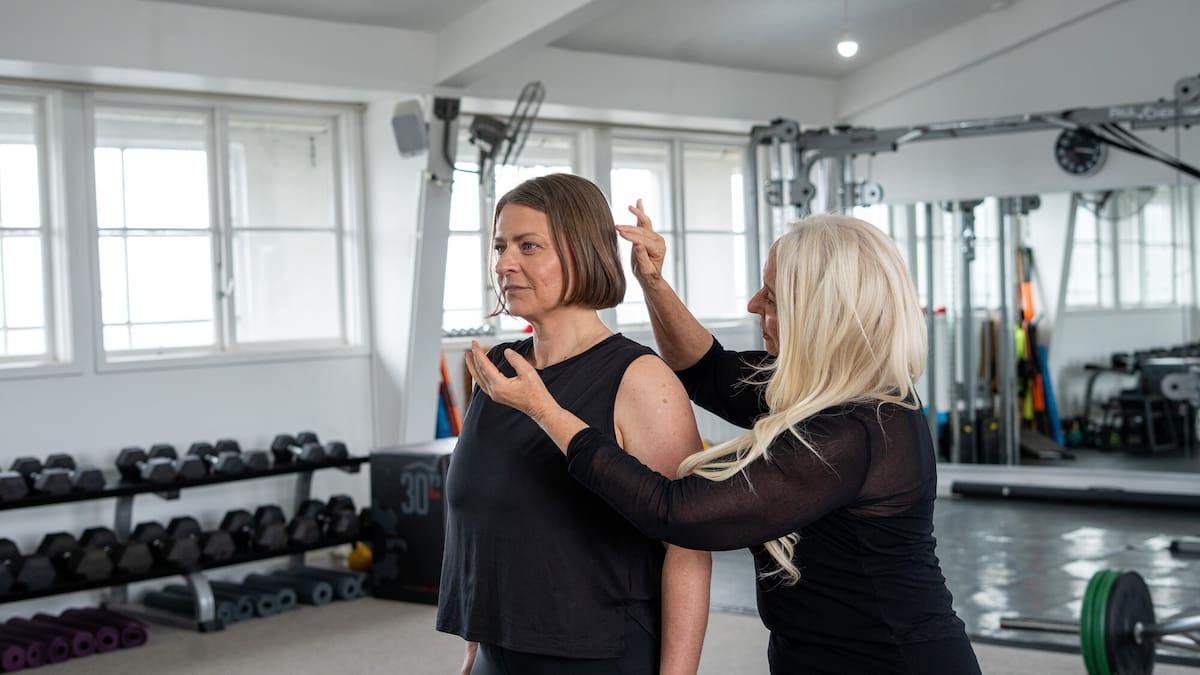
Concerned about ageing? Here’s what you should work on before you worry about your wrinkles. Ever since I ticked over into my late 40s, I’ve felt like I’m slowly crumbling. I’ve got aches and pains for no apparent reason, and I look in the mirror and see age creeping steadily Getting older as a woman also means the mental load reaches a breaking point; a constant to-do list is running through my head. Along with thoughts about work, my relationship, friendships, family and life admin, perimenopause and fighting the signs of ageing have recently entered the chat. But it seems these concerns are the least of my worries when it comes to ageing well. First, I need to address my foundational strength and posture. I discover this during a consultation with Michelle Owen, a postural and structural exercise specialist and owner of Eden Terrace’s Posturefit. Posturefit founder Michelle Owen at her studio. Photo / Alyse Wright Owen, in her 60s, has more than 30 years’ experience in the wellness industry, focusing on postural correction and performance. She’s a high-level Chek practitioner – Chek standing for corrective, holistic, exercise and kinesiology. The work is described as a bridge between standard fitness training, orthopaedic rehab and holistic coaching. Rather than treating symptoms, Owen looks at the root causes and addresses everything from body alignment to posture, breathing and movement quality. My first session is a 90-minute full-body assessment where Owen looks at how I stand, move and rest, like a Warrant of Fitness for the body. “If you’re smart, you don’t wait until your car is completely broken down before you service it,” Owen says. “You assess it, maintain it and address small issues before they become bigger ones. Our bodies deserve the same proactive approach.”We start with how I feel about my body, identifying any aches and pains or restricted movement. Given a sheet of paper with outlines of a human body from four different angles, I circle areas of concern (hips, neck, shoulders, knees, feet), and we talk through them, and anything else I think Owen should know – for me, that’s things such as recurrent migraine, the beginnings of perimenopause and a general sense of fatigue.Owen puts me on a frame with a plumb line from top to bottom, positioning me in various poses so she can look and take reference photos. That’s followed by me lying on a treatment bed while she looks at how my body moves and holds itself, using tools like callipers to take measurements. Stephanie Holmes during her initial consultation with Posturefit founder Michelle Owen. Photo / Alyse Wright “I assess the whole-body picture – how the spine, pelvis and joints are positioned and functioning, where stability or movement has been lost, and where patterns of restriction, asymmetry and compensation have developed,” Owen says. “From there, we can identify what needs attention and map out a plan.” I take a sneaky look at the notes she’s written on her clipboard and see words like “rounded shoulders”, “internally weak”, and start to worry. We move into her studio – a lovely light-filled space on the top floor of Villa Dalmajia on New North Rd – and Owen watches how I move into exercises like squats and stretches. Once the physical assessment is done, she tells me what she’s noticed. It’s revealing to look at the photos, which I’m not publishing because I was wearing only a sports bra and shorts. But when my body was positioned to line up with the plumb line in the centre, my head was way off to one side. From a different angle, the photos show my pelvis twists so my left side leans forward more than the right. In the squats, you can see my shoulders rising to my ears and my front body slouching down. “Genetically, you’ve got plenty of range but not enough control,” Owen tells me. “The head is sitting forward and when you use your arms, you’re also using your neck all the time. That could contribute to your migraines. “You’ve got a bit of rotation going with the pelvis ... so that makes sense with the uncomfortable hips. When I measure you, you’re really long through the hamstrings. That means they need strengthening up – more control, more support – and then you’re very tight through the front chain, which can be genetic [but also from] sitting all day. “When there’s a bit of twist in the pelvis and all of this tension, then of course when you’re getting up, it feels uncomfortable.” It’s a lot to take in and quite confronting. Aside from my desk-based job, I lead a reasonably active life, walking or cycling every day, occasional yoga and HIIT (high intensity interval training) classes. I thought I was doing pretty well for my age. But what Owen is showing me reveals I need to go back to absolute basics. At her PostureFit studio, Michelle Owen helps clients improve strength and functional fitness.“You don’t necessarily have to be in pain for something to be deteriorating,” she says. “The body is incredibly adaptive. It will find a way to keep you moving, often by compensating around restriction, weakness or asymmetry. Just because you can perform a movement doesn’t necessarily mean everything underneath is working as well as it could.“Being active isn’t the same as knowing how your structure is functioning.” Other issues highlighted in my assessment are pronated feet, weak shoulder girdle, a slight curvature of the spine. Owen says doing the right exercises will make a big difference, and for me, that means a lot of “inner unit work”, focusing on the pelvic floor, the transverse abdominals, the diaphragm and the multifidus (the back muscles that run either side of the spine from neck to sacrum). “When most people go to the gym, they go in and they’re working the outside muscles,” Owen says. “I work the outside muscles too, but first, the inside to stabilise and bring up the weak areas to match the rest and then strengthening the body.” So what does that look like in practice? I return for a follow-up session and Owen takes me through some exercises and stretches. Things like moving my chin forward and back and rotating my head either side to get my neck muscles and spine unstuck; lying on my front and grabbing a foot with the hand on the same side to stretch my quads; squatting with my back against a wall and concentrating on turning my knees out rather than letting them naturally sink into the centre, and lying over a medicine ball and maintaining a lift in my hips to strengthen my glutes. Owen regularly adjusts my position and encourages me to focus on certain areas – breathing, bringing my shoulders down, chin back, curling my tailbone, and more.At first, it seems like it won’t make a significant difference. The movements and adjustments are so small. But it doesn’t take long before my muscles are shaking with the effort of maintaining stability, and it highlights how much work I need to do. “For me, structural longevity is about preserving and improving the function, strength and physical capacity that allow us to keep doing the things we love as we age,” Owen says. ”It’s not about telling someone to ‘stand up straight’. It’s about re-educating the body, creating space where it’s needed, improving joint function and control, and building the strength and support to carry those changes into the way you move.” My biggest goal is maintaining my health and fitness so I can continue travelling the world as I age. In that case, I need to spend less time worrying about the ageing on my face and instead start working on what’s happening inside my body. “We’re putting enormous effort into extending lifespan, but we also need to ask what physical condition we want to arrive in when we get there,” Owen says. “If you live to 90 but your movement, strength and independence have declined for decades, that’s a very different outcome from being able to move well, travel, exercise and enjoy your life.” There’s no quick fix. It will take time and effort – and expense – to get results. Owen’s 60-minute one-on-one sessions are $300 each, after a $595 consultation.Michelle Owen trains clients in postural correction and functional strength.For a more affordable option, she has introduced an online membership for $99 per month, which gives access to a library of professionally guided programmes to help improve posture, create space around the joints and spine, improve postural support and build structural strength. Owen sees it as an investment in yourself, saying she teaches “skills for life”. “Your body is the one thing you are guaranteed to live in for your entire life,” she says. “If longevity is about having more healthy, active years, then maintaining that body has to be part of the conversation.” Exercises for postural correction and foundational strengthThese are examples of the exercises and movements Owen taught me. She creates personalised plans and areas of focus depending on individual assessments. Joint Pumping and Proprioceptive Awareness Gentle joint movements to encourage joint fluid circulation and improve body awareness, including head positioning and alignment. Gravity Line Awareness – Wall Work Using the wall to develop postural awareness, alignment and control in relation to gravity. Thoracic Extension – Foam Roller Encouraging extension through the mid-back, particularly where the thoracic spine is restricted or held in flexion. Global Postural Rotational Stretching Whole-body stretching to help normalise rotational myofascial tension and improve balance between the two sides of the body. Hip Mobility and Myofascial Stretching Joint pumping and targeted stretching through the hips, pelvis and quadriceps to normalise tension, improve tissue gliding and sliding, and restore mobility. Spinal Decompression Specific postural positions designed to encourage space and decompression through targeted areas of the spine. Shoulder and Neck Myofascial Stretching Targeted stretching to normalise tension, improve tissue glide and reduce restrictions. Swiss Ball – Glute Stability Developing glute strength, pelvic stability and control as a foundation for integrated whole-body strength. More on ageing
What Women Can Do In Their 40s & Up To Preserve Strength, Mobility & Independence
Full Article
Original Source
Read the full article at Nzherald →KhanList aggregates and links to publicly available news content. We do not host full articles from third-party sources. Always verify important information with original sources.