
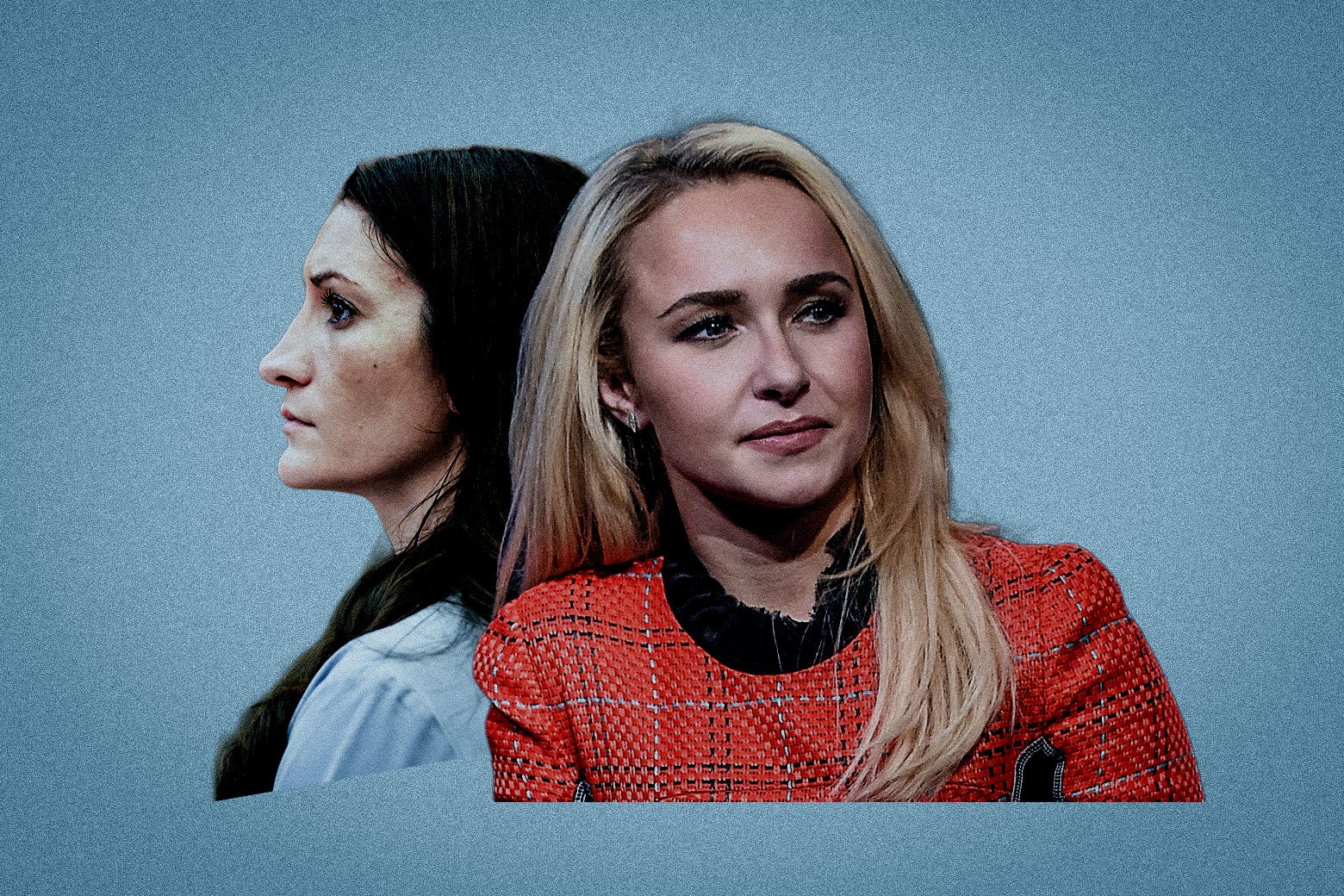
Life From Lindsay Clancy to Hayden Panettiere, we are seeing the horrific ways that motherhood can go awry. By Enter your email to receive alerts for this author. Sign in or create an account to better manage your email preferences. Unsubscribe from email alerts Are you sure you want to unsubscribe from email alerts for Shannon Palus? Aug 19, 20265:45 AM Photo illustration by Slate. Photos by Jonathan Wiggs/The Boston Globe via Getty Images and Jamie McCarthy/Getty Images. Sign up for the Slatest to get the most insightful analysis, criticism, and advice out there, delivered to your inbox daily. We have a vision of how motherhood is supposed to be: difficult, but rewarding. Full of sacrifice, but worth it. There are hardships, surely, but they are offset by the moments of pure joy. Something evolutionary and primal kicks in that makes it all possible, the story goes. You become a mom, leaving behind your old self for someone better, stronger, and more loving. Moms rise to the challenge. This is what society tells us, of our mothers, of ourselves when we become mothers. Except, this summer, we are all in a front-row seat witnessing what happens when the much-lauded natural instinct isn’t enough—and when something else kicks in instead. “I grieve that I’m not the mother I thought I’d be and definitely not the mother I want to be,” Hayden Panettiere wrote in the prologue of This Is Me, her memoir published in May. Later in the book, she describes going through labor, a cesarean section, and then three hours of surgery to repair her uterus after the birth. Of finally getting to see her daughter, she writes: “I’d always heard that mothers feel an instant rush of love the moment they lay their eyes on their baby, but I felt nothing.” Panettiere died on Sunday, in her home. (The cause of death is still being determined, but foul play is not suspected.) Though she struggled with substance abuse for a long time—as a teen actress, she was provided with “happy pills” by her management team—alcohol addiction in particular reared its head in her months postpartum. She found early motherhood to be a “total blackout of emotion, like my soul was dead.” While she didn’t find euphoria in caring for a newborn, she did find it in wine, vodka, and the 3-ounce bottles of Fireball that you can buy at a gas station. Her daughter is now a preteen, and from when the child was 3 until Panettiere’s death on Sunday at 36, she mostly parented over FaceTime, as she had ceded custody to the father, who lives in Europe. Her admission that being a mother simply did not work out how she planned is incredibly sad, and even sadder now. It’s also remarkable. Panettiere offered something we almost never see: a mom who was not a classic “good mom” or even a “bad mom.” It’s clear in the way she writes about her daughter, how she talked about her in interviews this spring, that she loved her. She was just a human being who fell short. That motherhood can fail to be transformative—or worse, can be transformative in the wrong direction—is not totally undiscussed. Rachel Yoder’s Nightbitch, a novel published in the summer of 2021, in which the mother of a young child becomes a feral dog, comes to mind. But it’s also a conversation that tends to be capped with a happy ending, a string of fridge-magnet platitudes. Nightbitch is a story, not real life, and even so, the film version ended up, as one reviewer put it, “defanged.” Amy Adams, who plays the protagonist, delivers those fridge-magnet lines well. (“Do you ever feel like the big secret is that we are gods?” she says. “We are so powerful.”) In the end, all of her ferality can be packaged up into a pleasant take-home message. But with the Lindsay Clancy trial underway, it’s been hard to escape the fact that a mother’s suffering and sacrifice do not always end with a tidy, happy lesson. In 2023, Clancy strangled her three children with exercise bands before jumping out of a second-story window. Now a wheelchair user, Clancy claims that she was experiencing postpartum psychosis, a rare but extremely serious condition; her state at the time of the killings is being hashed out in court. She has not denied killing her children, but has asked to not be held criminally responsible due to what she suggests is her postpartum-induced insanity. It seems clear that this is a loving person whose plan for motherhood ended up in the worst reality imaginable. What has been particularly remarkable to witness about this trial is that it seems like many women are on her side. There has been an outpouring of support for Clancy. These mothers point to evidence that she was a good mom, a mom who searched for a special unicorn activity for her daughter and lamented the pain of sleep-training her son, until she snapped. Women who have had postpartum psychosis themselves identify with her, in a “There but for the grace of God go I” way. The simple fact that she was not offered the help she needed postpartum is broadly relatable. I keep thinking about how CNN’s Pamela Brown chimed in as she interviewed a postpartum psychosis survivor about the Clancy case: “I felt like chopped liver after I had my baby. I had my own struggles.” This is a CNN anchor admitting this on live television. We are, I hope, entering into a different paradigm. There is something deeply good about watching women rally behind a complicated, monstrous figure. There is something deeply healing about women sharing their own complicated stories about being postpartum, and broadcasting them to the broader public. The thing I keep getting stuck on, though, is that as novel as this all feels, even this is not enough. In fact, it is maybe not a solution at all. Sharing didn’t save Clancy, who shared that she was having a hard time in Facebook groups. It didn’t save Panettiere, who publicized her experience even before writing about it in her memoir because when she was a star on Nashville, the writers wrote it into the show. Sharing is a start, not an end point. And for both Hayden and Lindsay, I grieve that they didn’t have what they needed for their stories to end another way. At the very least, I hope that they will now be a starting point in a broader understanding of what becoming a mother can mean. Addiction Crime Mental Health Motherhood Pregnancy
What Will We Learn From Our Summer of Complicated Mothers?
Full Article
Original Source
Read the full article at Slate →KhanList aggregates and links to publicly available news content. We do not host full articles from third-party sources. Always verify important information with original sources.