
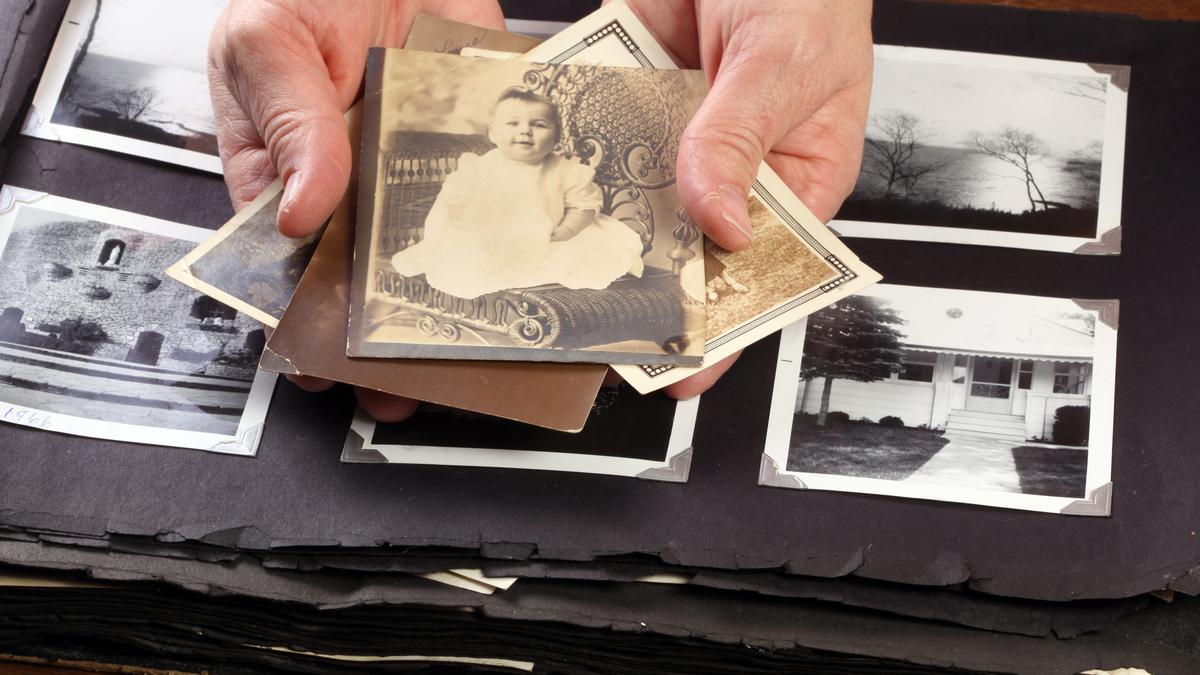
Debankita Das’s interest in personal archiving stems from her family’s direct experience of the Partition. “My grandfather and his family migrated from Dhaka to the eastern Himalayan region of Bengal in 1946, while my grandmother comes from Assam’s Tezpur region. So I wanted to look at these interlinked histories,” says the doctoral researcher at the School of Social Sciences, University of Hyderabad.The quest drove her to create a personal memorial archive of her grandmother’s life and health history. “My grandmother passed away suddenly in 2020, which was a huge shock for me, because I was very close to her. So, to talk about her ancestral history, her link with my grandfather, and then expand it to my grandfather’s history was cathartic for me,” says Debankita, who included family photographs, handwritten letters, and objects that belonged to her grandmother, such as her crochet work, ritualistic paraphernalia and a medicine box, to build this archive.A rising trend Some of the tools that are used in personal archiving | Photo Credit: Special Arrangement Like Debankita, more and more people are interested in curating personal archives, using whatever they can find that, for them, carries meaning: documents, digital artefacts, oral memories or even embodied memoriesPersonal archives, unlike institutional archives, are, by definition, deeply personalised in their form, but they too have historical significance. “The personal is not about me, my family or my community, but rather a more self-experienced and relatable way of looking at history,” clarifies Bengaluru-based Ishita Shah, the lead curator of the Constructing Personal Archives (CPA) programme. They differ from institutional archives in yet another way: rather than focus on scale, milestones, and impact, personal archives offer insights into people’s lived experiences, “their everydayness, value system and behind-the-scenes stories,” she says.In recent years, there has been a growing interest in creating personal archives, a trend Ishita says can be linked, at least in part, to COVID-19 and its aftermath. “The pandemic and the other uncertainties and fragilities of the world around us have brought this interest. Even if people are not interested in the larger idea of history, they are interested in their sense of lineage and belonging, trying to find things that they feel very connected to,” believes Ishita, who has been regularly conducting workshops on personal archiving as well as helping individuals, communities and institutions set up their own archives.Evidence of human life Ishita Shah, the lead curator of the Constructing Personal Archives (CPA) programme. | Photo Credit: Special Arrangement What seems to be driving the interest is the highly mediated world we live in, one plagued by information glut and the impermanence of memory. “In the overabundance we live in, to practice restraint and choice is an informed and conscious thought,” feels Ishita, who believes archiving helps balance the relationship between why something is important, how it should be used, how it should be preserved today, and how it will be relevant in the future. “The mechanisms of labelling, cataloguing and finding aids become very important, allowing you to keep things for the long-term, find them easily and still be very efficient about how you collect and organise them, especially in a country like ours where space is highly constrained and political”, she says.In the view of Biswadeep Chakraborty, archivist at India Foundation For The Arts (IFA), Bengaluru, the growing interest in personal and family archives is the result of the realisation “that history is not only made by governments and institutional narratives, but also by ordinary day-to-day people and their lived experience,” he says. The spurt in interest, he thinks, is also catalysed by technological change, leading to a certain democratisation of history. “Thanks to our smartphones, it is very easy to learn about history, and to understand that history is not just in the written annals of kings, queens and governments. We are also learning so much about social, cultural and personal history now because people write about it on social media,” he says.And yes, a longing to hold on to memories of slower, simpler times is yet another driver of personal archiving. From a family history project and publication, which Ishita is putting together | Photo Credit: Special Arrangement “People are realising day-by-day the importance of preservation,” says Biswadeep, who recently conducted a hands-on workshop titled Archiving the Personal at IFA, “keeping in mind that there are so many people who want to preserve their memories and artefacts, but they don’t know how to do it.” He lists the objects that participants arrived with, wanting to better understand how to preserve them and safeguard their precious memories — a pendant, purse, football memorabilia, a film reel, and an HMT watch — and says, “Material objects are central to archives, in general, and historical research because they preserve evidence of human life that written records alone cannot capture,” he says.Fareeda AM, a video editor who attended the workshop and hopes to start her own personal archive, echoes Biswadeep’s perspective. “The workshop helped me see archiving as a way of documenting ordinary things that carry personal, cultural, and historical value,” she says, adding that we often take these ordinary objects for granted until they are gone. Archiving, for her, is about preserving memories and ways of living, a way of documenting our own lives and those of our parents before those memories disappear. “It helps us understand what is being lost over time, whether through climate change, social change, or simply the passing of generations. That is why I feel now is the right time to begin preserving these stories and objects before they disappear,” says Fareeda.Beyond materiality A personal archiving workshop being held at IFA | Photo Credit: Special Arrangement For Paarvathi Om, an interdisciplinary artist and researcher based in Edayanchavadi, near Auroville, the definition of a personal archive also includes her own physical body. “When the body is approached as the archive, one begins to sense the expanse of the memories and experiences stored, submerged and knotted. I was interested in retrieval: who all am I, without my knowing,” says Paarvathi, who has been deeply involved in the CPA programme.Working through the body, a repository of somatic memory, means not generating more archival material but discovering what already exists, an insight she believes comes from her theatre practice. “Embodied archiving and its retrieval inform much of my theatre process, where they are free to interact with each other, and a fresh new archive has a chance to emerge,” explains Paarvathi, who finds this process subversive. “That is the larger frame that holds it, and allows me to make meaning,” she says.In her book, The Archive and the Repertoire, published by Duke University Press, performance studies scholar Diana Taylor writes that “embodied performances have always played a central role in conserving memory and consolidating identities in literate, semiliterate, and digital societies.” There is often a tension between “the archive of supposedly enduring materials (ie, texts, documents, buildings, bones) and the so-called ephemeral repertoire of embodied practice/knowledge (ie, spoken language, dance, sports, ritual),” she writes, further arguing that the repertoire, like the archive, is mediated. “The process of selection, memorisation or internalisation, and transmission takes place within (and in turn helps constitute) specific systems of representation,” says Diana.Lakshmana KP, who has been exploring questions about Dalit aesthetics in performance, agrees that while embodied archiving is not a conventional way of archiving, it functions as a source of inspiration. “I go back to the memories and lived experiences of not just myself, but the actors I work with. Not just traumatic experiences, but the instruments that they have seen, the songs they have heard, their mythologies…” says the founding member of the Bengaluru-based Jangama Collective, a group of actors who use theatre to create cultural, political and social awareness. From a family history project and publication, which Ishita is putting together | Photo Credit: Special Arrangement “I draw from those to build a world and construct a physicality,” he says, adding that written records are often missing when it comes to marginalised communities. “For me, the knowledge of marginalised communities exists in their ritual, in their instruments, their bodies, their voices, their food cultures. To tap into the knowledge systems of these communities, you have to get into these things, so the form of archiving is very different,” he says.Reclaiming narrative Some stories of the Partition have been overlooked, believes Debankita Das Regardless of its form, building a personal archive often helps reclaim narrative, especially for people that mainstream history leaves out. “Difficult and oppressed histories are better narrated by the people who have gone through them,” says Ishita, who thinks of personal archiving as a form of dissent. “The state or institution will choose to ignore or erase you, but you still have the power to tell your story,” she says.Debankita agrees. She says, “When you read about the history of Bengal, it is essentially focused on the Deltaic Ganga Valley region. There is this assumption that this represents Bengal’s entire space-time history, but that is not the case.”According to her, the people living along the north-eastern range of the Himalayas that fall within the modern-day boundaries of Bengal and the Brahmaputra Valley of Assam also possess vibrant cultures, languages, cuisine, histories and stories, but this is often exoticised or simply overlooked. “We never talk about these regions that equally felt significant consequences following the 1947 Partition. Personal archiving, for me, therefore helps decolonise and de-institutionalise these histories and archives, and reclaim representation.Debankita insists that it is equally critical to create a network of personal archives of people whose stories are little known. “The most important thing for me to understand is that the place where I come from was shaped into a shared living space both by the local Himalayan and foothill communities, the latter of whom were displaced and had to migrate in search of a new home and belonging following the events leading to pre-Partition and the Partition. So, if I can join other people’s stories as well, it will be more fruitful,” she says.Tips to store objects in a personal archiveSindhu Nagaraja, the chief conservator at Khandya Station, a specialised centre for art, archaeology, and conservation based in Bengaluru, offers practical tips for maintaining a personal archive. “We suggest buffering, which involves using either acid-free paper boxes or even normal good-quality, destarched cotton cloth,” she says.Objects should be wrapped in multiple layers, she says, if they need to be protected from the elements. “This way, the object is not exposed too much. Even if there is mould growth due to humidity, it will remain on the surface layers. It won’t penetrate inside,” explains Sindhu, adding that silica gel, which absorbs excess moisture, can be very useful.Among the most common objects that go into a personal archive are old photographs. In her view, keeping vintage photographs in albums is one of the worst things one can do. Instead, it is best to keep them separately, just interleaving them with archival-grade, unbuffered sheets of paper, “which are quite affordable in the Indian market.”These should then be placed in an archival sleeve or self-made archival pockets and put inside an archival box. The pockets can later go inside a small archival folder, says Sindhu, who is also a conservator at Archives at NCBS and conservation consultant at the archive of IIT Madras. And yes, labelling and providing context are also important parts of archiving, says IFA’s Biswadeep. “You need to sit down and try to think about why something, whether in the physical or digital realm, is important, and label and name it in a way that makes it easy to go back and retrieve,” he says.
What will happen to your family’s memories when you are gone?
Full Article
Original Source
Read the full article at Thehindu →KhanList aggregates and links to publicly available news content. We do not host full articles from third-party sources. Always verify important information with original sources.