
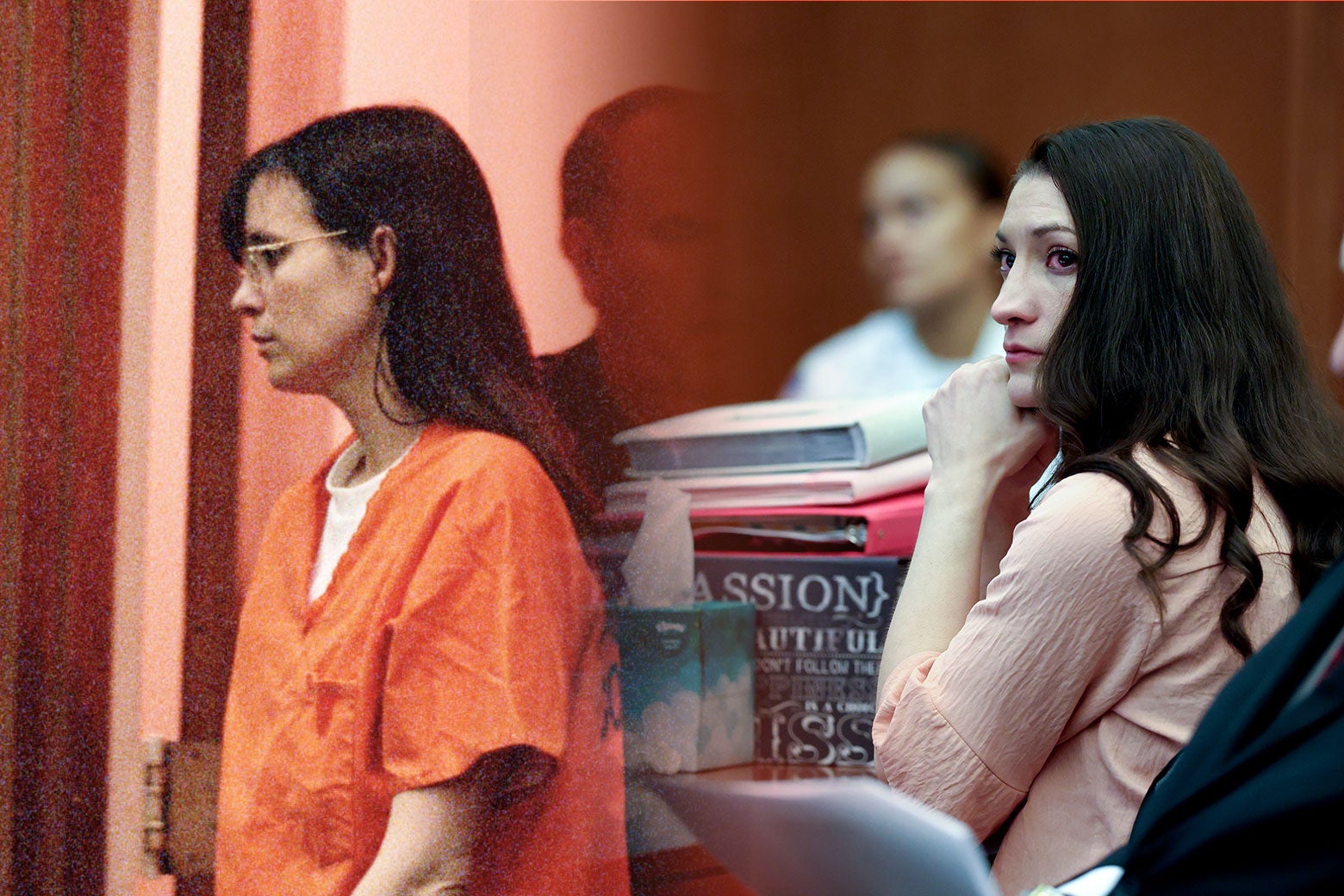
Life What We Can Learn From Andrea Yates Twenty years ago, she drowned her kids. How people talked about it is now awfully familiar. By Enter your email to receive alerts for this author. Sign in or create an account to better manage your email preferences. Unsubscribe from email alerts Are you sure you want to unsubscribe from email alerts for Rebecca Onion? Aug 24, 20265:45 AM Photo illustration by Slate. Photos by Getty Images and Jonathan Wiggs/The Boston Globe via Getty Images. Sign up for the Slatest to get the most insightful analysis, criticism, and advice out there, delivered to your inbox daily. On June 20, 2001, Russell Yates left for his job at NASA in Houston, Texas, and his wife Andrea Pia Yates fed her five kids breakfast. Then, after filling the bathtub, she drowned them one by one. The oldest was 7, the youngest just 6 months. Prior to the killings, Yates had been hospitalized multiple times for mental illness, and had attempted suicide twice. Images of the Texas mother, with her dark hair and long bangs, in orange prison garb with her arms folded across her stomach, were everywhere in 2001 and 2002, as her trial proceeded. Texas, being a death-penalty state, asked for Yates to be sentenced to execution. A jury instead sentenced Yates to life in prison, a conviction that was overturned on appeal. In 2006, she was acquitted on grounds of insanity, and today remains institutionalized in Texas.She consistently waives her right to be annually reviewed for competency, which, if proven, would lead to her release. The trial of Lindsay Clancy for the murder of her three kids, ages 8 months to 5 years old, with exercise bands has reminded many commentators of the Yates case. Clancy too has struggled deeply with her mental health, and has pleaded not guilty by reason of insanity. And both cases provoked fervent discussions about the burden placed on women in raising young children. In its curtain raiser for the Clancy trial, the New York Times even notes that the Yates case “was seen as a breakthrough in public understanding of postpartum psychosis.” I think we can take a different, less positive lesson from looking back at the public conversation the Yates case inspired, and comparing it to what’s emerged around the Clancy story. There was no social media at the time of the Yates trial—but there were think pieces, blog posts, letters to the editor, and polling. The “visibility” that emerged during the Yates trial around postpartum mental health issues and domestic division of labor seems to have helped many women feel less alone—but also inspired new antifeminist backlash among conservatives shocked at public sympathy for Yates’ situation. We’re at risk of ending up in a similar spot as these discussions recur around the Lindsay Clancy case: with women clamoring for a broader change that will not come. Like Lindsay Clancy, Andrea Yates worked as a nurse. Unlike Clancy, she quit after the birth of her first child, at which point she became a full-time homemaker. She also homeschooled her kids, and took care of her father, who had Alzheimer’s. During the trial, the world found out that Rusty Yates would not help with the kids, or hire anyone else to help with them. According to one witness, when Andrea Yates had trouble with her caregiving workload, Rusty Yates was unkind about it. At her trial, Andrea’s best friend testified that Rusty had mused to her about his wife’s insufficiency, pointing to another woman in the neighborhood: “She’s got nine kids … and does just fine. I don’t know why Andrea’s having so much trouble.” The best friend testified that she called Yates’ husband three times during the worst of her friend’s illness to try to get him to take his wife to a doctor. She remembered him saying, “She’s just sad over her dad … I’ll look into it.” There was an angle to the Andrea Yates case we don’t have with Lindsay Clancy, and one that influenced the strong reactions that both feminists and conservatives had to Yates’ story: the Yates family were fundamentalists, and both their family life and the particular shape of Yates’ psychosis were shaped by their religious beliefs. In the course of her defense, Yates’ lawyers brought a witness, a psychiatrist, who had warned the Yateses against having more children, after Andrea had her fourth. As the psychiatrist testified, “Rusty Yates and Andrea wanted as many children as nature would allow.” Three weeks after the drownings, Yates told an interviewer that Satan told her to kill her children, because she was such a bad mother, and her children were “retarded and tainted and not developing correctly,” and would go to hell if they weren’t killed. Yates also asked her jailers to shave her head to reveal the 666 she believed was on her skull. (This religious aspect of the Yates case was the subject of a new documentary that streamed on HBO Max this year.) In a Washington Post piece published in August of 2001, just when the state announced it would seek the death penalty for Yates, writer Abigail Trafford said that the Yates conversation, two months in, had “gone in cycles.” First there was “unspeakable horror at the killings”; then, “a kind of empathy” when more information came out about Yates’ life. People began having more public conversations about postpartum depression. But, next, Trafford saw a “backlash setting in,” and noted that things were “getting nasty.” Trafford cited an unnamed call-in radio host asking his listeners if Yates should “fry,” and receiving a 70 percent affirmative vote from respondents. What did those conversations about postpartum depression and psychosis surrounding the Yates trial look like? Some of it, from our 2026 vantage, seems condescending and dated. A service-y June 2001 Houston Chronicle article on the “baby blues,” pegged to the crimes, began with this embarrassing lede: “She might cry when she realizes her midsection more closely resembles her bed pillow than her once-svelte figure. She might wail when her husband speaks to her with an edge in his voice. She might scream when she changes a third diaper in five minutes or realizes the baby can’t go anywhere, which means she can’t either.” But many feminists did publicly defend Yates. In September 2001, Kim Gandy, then president of the National Organization for Women, argued that the story of the killings was being “sensationalized”: “The overheated dialogue and the repeated characterization of Andrea Yates as ‘a monster’ and ‘evil’ interfere with the kind of clearheaded dialogue we must have in order to prevent the infliction of such misery on another family.” On the Today show, Katie Couric publicized the number people could call to donate to Yates’ defense fund. And columnist Anna Quindlen published a piece in Newsweek, on July 2, 2001, that reads like many of the Lindsay Clancy–sympathetic TikToks posted this week. “Every mother I’ve asked about the Yates case has the same reaction. She’s appalled; she’s aghast,” Quindlen wrote. “And then she gets this look. And the look says that at some forbidden level she understands. The look says that there are two very different kinds of horror here. There is the unimaginable idea of the killings. And then there is the entirely imaginable idea of going quietly bonkers in the house with five kids under the age of 7.” As in the Clancy case now, there was quite a bit of a grassroots groundswell of bitterness toward the man of the house, which you can see in letters written to the Houston Chronicle in late 2001 and early 2002. “Is everybody insane? Why hasn’t the prosecution filed charges on Russell Yates for child endangerment? He should have put the children in day care instead of leaving them with his wife,” read one letter published in December. “If the state of Texas allows Russell Yates to go unpunished for his part in the drowning deaths of his children, it will be a shame,” another added in February. “While I feel sorry for Russell Yates’ loss of five children, he seems to have missed it all and now only wants the public’s pity,” judged another in March. Meanwhile, the backlash toward those who had any kind of sympathy for Andrea Yates, as a human being who had been going through something, was happening, too. Shannon May published one such post in the online magazine Rightgrrl.“The more I read, the angrier I become as I see various attempts by the liberal press to rationalize, justify, explain or sympathize with Yates’ inexcusable actions; in short, to blame everyone but her for the atrocities she committed,” May wrote. Written decades before the tradwife tendency infused our social media with performatively happy women scolding other women for voicing complaints about everyday domestic life, May’s piece seems like a harbinger of what’s to come. “No one ever said that motherhood would be easy, fun, and rewarding all of the time or even most of the time,” she wrote. “The object of motherhood, its very nature, is unconditional, sacrificial love, the pouring out of oneself for the life and enrichment of one’s children … If we as a society have forgotten this, and I certainly think we have, it is because we feel a desperate need to turn any pursuit—particularly a difficult, thankless pursuit like motherhood—into something that will bring us self-fulfillment and positive feelings.” Today, the outpouring of support for Lindsay Clancy feels way stronger than what Andrea Yates inspired in 2001—but the corresponding backlash is also wilder and more unhinged. The trial arrived on a social media landscape where “tradwife” and manosphere voices make arguments far more fundamentally antifeminist than the fare provided by your typical conservative op-ed writer working in the early aughts. On X, people (mostly men) have been ginning up all kinds of exotic new flavors of misogyny in response to the Clancy story, including dismissing the very idea of PPD. (Clancy is not claiming she killed her kids because of PPD—rather, her lawyer is trying to demonstrate the psychosis Clancy says she experienced after previous episodes of PPD and extensive medication—but social media isn’t into specificity.) Right-wing commentator Matt Walsh was probably the biggest name to make this argument: “Let’s be really clear about this. If you’re a mother who has ever entertained the idea of murdering your own children, or felt any desire to do so, it’s not because you’re a victim of ‘postpartum depression,’ ” Walsh wrote. “You aren’t a victim at all. Nobody should feel sorry for you. You’re not worthy of pity. You’re a raging narcissist and you hate your children because they impose on your lifestyle. That’s all. And you know it. It’s not ‘hormones.’ Hormones can’t cause you to develop murderous desires towards your own offspring. Your soul is the problem.” While Walsh seemed to leave room for PPD to exist, others didn’t, arguing that all PPD is just narcissism. I won’t depress you by illustrating how far this discourse developed in the fringier parts of X, but let’s just say we got all the way from Walsh’s tweet to “SIDS is also fake” and “this is why women shouldn’t have the vote.” Egged on by the algorithm, these men have arrived at a place of such deep distrust for women that any one woman articulating feelings of sympathy with Clancy’s situation seems like one too many. Why does it matter that the people pushing the frontiers of misogyny in Elon’s walled garden are pouncing on Lindsay Clancy and her supporters with such viciousness? We’ve seen time and again that hatred that starts online doesn’t stop there. These views towards women slot right in with the administration’s war on abortion rights, and cheerful promotion of baby-having without policies to support mothers to match. On a more quotidian note, reforming the healthcare system that Clancy’s supporters say let her down is expensive and difficult—driving such change would take far more than a slice of the nation talking fervently about the difficulties of early motherhood. It’s been 20 years since Andrea Yates won her appeal, and 21 since Brooke Shields wrote her groundbreaking memoir of severe PPD. Since then, PPD, PPP, and the general topic of maternal overwhelm have enjoyed waves of public recognition, inspiring a healthy crop of think pieces during the height of COVID, and giving us movies like Tully, Nightbitch, The Babadook, and last year’s magnificent If I Had Legs I’d Kick You. But the idea that increased “awareness” of postpartum mood disorders and maternal burdens could definitely result in sympathy for those afflicted hasn’t weathered the stress test of the MAGA-era gender wars. As with climate change, wealth inequality, and war crimes, some people do know it’s bad; they just don’t care. Have we come a long way? I’m not so sure. Crime Feminism History Internet Culture Mental Health Motherhood Pregnancy
What Will Happen After Lindsay Clancy’s Trial? I Looked at a Terrible Case From 20 Years Ago. I Fear History Is Doomed to Repeat Itself.
Full Article
Original Source
Read the full article at Slate →KhanList aggregates and links to publicly available news content. We do not host full articles from third-party sources. Always verify important information with original sources.