
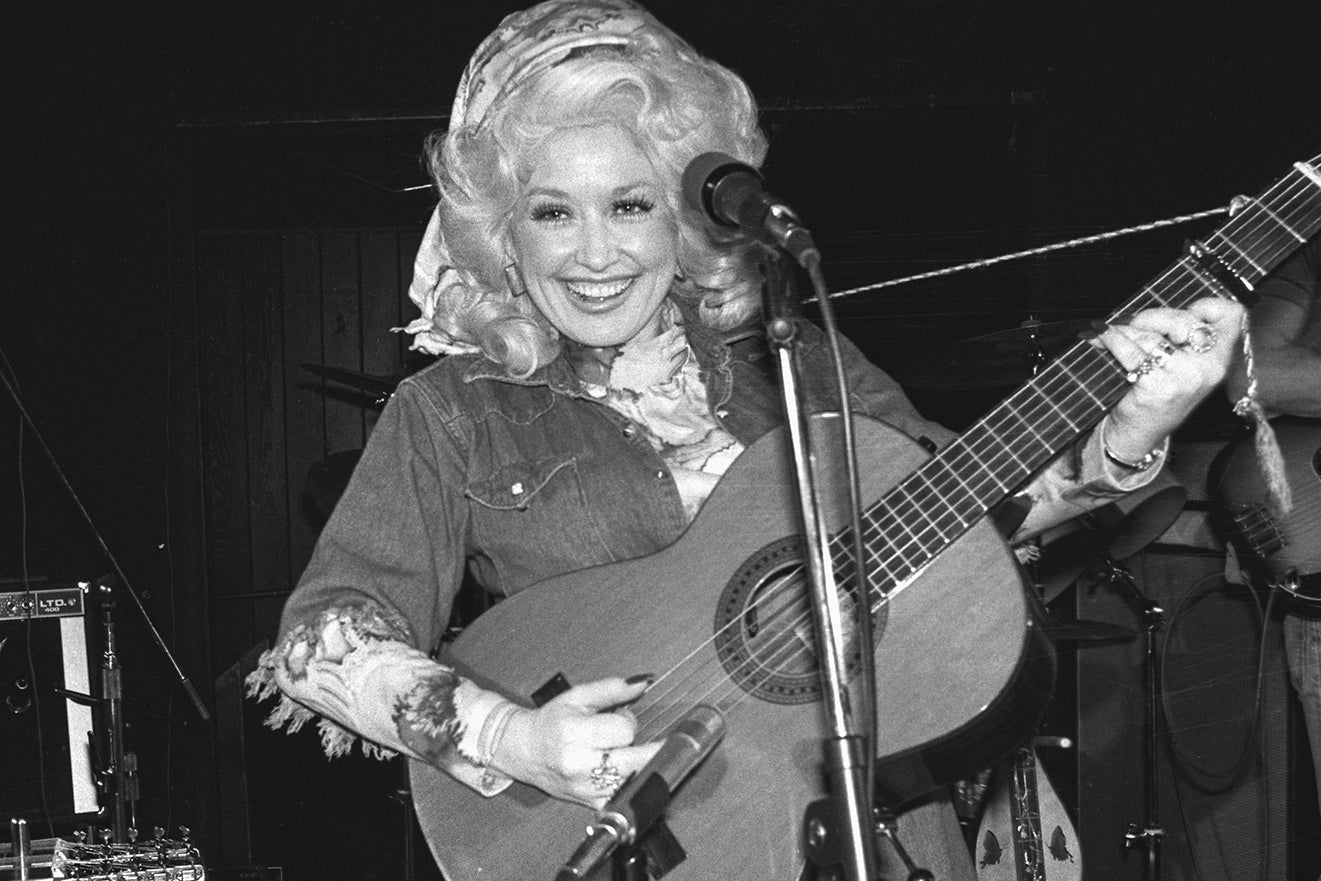
Music Where Were You When the Queen Died? Dolly Parton was no saint—and that’s all the more reason we should always love her. Dolly Parton rehearsing for her New York nightclub debut at the West Village’s Bottom Line in 1977. Bettmann via Getty Images Sign up for the Slatest to get the most insightful analysis, criticism, and advice out there, delivered to your inbox daily. With her death this week, uncountable tributes are being made now to Dolly Parton’s warmth, humor, heart, individuality, and inclusiveness, with her admirers across the globe spanning the rural to the urban—as her own life arc famously did—as well as the devout to the heretical, and nearly every other axis of culture, gender, sexuality, and ideology, all the way down the gilded slide to power-drunk potentates. People are lauding both her had-her-own-theme-park business acumen and her didn’t-need-to-be-a-billionaire generosity, from the million smackers she donated to the development of the COVID vaccine to the towering heaps she spent on promoting books and literacy for kids who needed them. We are thanking her for supporting both gay marriage (“They should suffer like the rest of us do”) and, later, Black Lives Matter (“Do we think our little white asses are the only ones that matter? No”), each of which reminds the journalists among us, at least, to give thanks perhaps most of all for her quotability. We are quietly, politely forgetting about that weird, Lost Cause–peddling Dixie Stampede tourist show her company puts on that we’re hoping she didn’t have too much to do with—granted, after Slate reported on the event, it changed it name—while simultaneously perhaps giving her too much credit for distantly co-executive-producing Buffy the Vampire Slayer. Some of us will even discuss Parton’s music. By the numbers, for a start, she reportedly wrote more than 3,000 songs, played upward of 20 instruments—mostly strings, but I’ve also witnessed her playing saxophone—and put out 243 singles as a lead or featured artist, 25 of which were No. 1 country songs, not to mention 49 Top 10 country albums, and had many of those cross over to the pop charts, in a career that touched eight different decades. Leaping genre barriers too often assumed unbreachable or enforced that way, Whitney Houston’s cover of Parton’s “I Will Always Love You” was the definitive and chart-dominating power ballad of the early 1990s. And in the new wave of country crossover that’s beginning to look like a definitive element of 2020s pop, many of the major players have sought out Parton’s co-sign, with covers and collaborations popping up from Lil Nas X, Beyoncé, Post Malone, and Sabrina Carpenter (as well as Parton’s goddaughter Miley Cyrus, of course), and this year’s newly coronated country queen Ella Langley has tagged Parton as her No. 1 role model. This is not to mention Parton’s acting roles and (short-lived) TV show or the adaptations of her songs and life into various movies, streaming series, podcasts, and, I don’t know, maybe video games? Not really, though apparently gamers love her anyway. Perhaps the only utterly uncontroversial aspect of the New York Times’ list of the 30 greatest living American songwriters earlier this year was that Parton deserved her place there. “I’ve watched Dolly writing one song while she’s singing another,” it quoted her past collaborator Emmylou Harris as saying. “I’ve never seen anyone so spontaneously creative.” Often the death of an artist is an occasion to regret that they didn’t “get their flowers” while they were still on Earth, but I’d venture that in the past two decades, Dolly Parton was practically buried in advance with avalanches of her favorite yellow roses, not to mention medals and superlatives of every other kind. She’s been set up as the last great cultural unifier in a time of poisonous division, the one thing we can all agree on, which both recalls and instantly disproves critic Lester Bangs’ statement after Elvis Presley’s death in 1977 that “we will never again agree on anything as we agreed on Elvis.” This suggests the possibility that even on this sad occasion of collective loss, perhaps we can hope that we will all get to feel that way again, though I can’t quite imagine about whom, with her juniors Prince and David Bowie, for instance, both having predeceased her by a decade. (As for her elders, well, please hold on, Willie!) I also have to acknowledge that in many of these sentences, the word we is hauling a lot of hidden freight, the way Bangs’ “we” did in Elvis’ case—Chuck D and others clearly would have wanted to get a word in there. In fact, I recall my own reaction to Elvis’ death as a little kid in the 1970s being mystification at what so many adults could possibly have found so great about this clownish figure—that puzzlement, I think, powered a lot of Gen X’s ironic fascination with Elvis iconography and impersonators. That thought also brings me back to the inchoate feelings I had about the increasing mainstream visibility of Dolly Parton herself in the period after that, and the incongruity of it with much of the contemporary mode of veneration. Though I share all your likely feelings about Parton’s extremely impressive and graceful final act, the whiff of vanilla incense that wafts around this “Saint Dolly” stereotype feels anodyne and neutered compared to the fantabulous weirdness of Parton’s career and persona in general. When I would see her on TV in the late 1970s—and she was everywhere on TV in the late 1970s and early 1980s—she seemed like another kind of difficult-to-grasp grownup fixation. But I did vaguely understand what this one was about: sex. I was too preadolescent and nerdy to get why the endless jokes about her boobs—both to her face and in her absence on talk and variety shows—were supposed to be funny. Only an accident of timing spared me that, I think, but if it had been me who grew up to clone a sheep from its mammary gland, I don’t think it would have occurred to me to name it Dolly. The shocking part to me at the time was that often she was the one making the jokes, with oft-quoted quips like, “I was the first woman to burn my bra—it took the fire department four days to put it out.” Today I understand that as one of the few moves to claw back power that a brilliant working-class woman could pull on such smug, sexually harassing city slickers as Johnny Carson while still get invited back to the TV couch. Part subversion and part appeasement, it’s a skill she would have picked up via childhood trials like the one narrated in her most famous and foundational early song, “Coat of Many Colors,” in which her mother cobbles rags together into a multicolored garment that Parton wears to school and then gets bullied for. In the song, she can only respond by doubling down on her belief in its gorgeousness, via the extremely American delusional justification, “One is only poor only if they choose to be.” It’s the same sleight of hand she used in constantly telling the story of modeling her “Backwoods Barbie” look on the trashy stylings of a sex worker back in her hometown who she thought was the prettiest lady ever: If the game is stacked (no pun intended), change the rules. But surely the talk-show banter, like so many of her 1970s songs, also represented Parton claiming and enjoying her own body and sexuality. She might not have gone to college and protested the war, but she was an early baby boomer, born in 1946, and by the 1970s, she was an avatar of the sexual revolution both as a songwriter and as a public figure (pun now intended). Loretta Lynn before her sang about the Pill, but Parton was the one who, even though she got married in 1966 and stayed that way till her (almost never seen) husband Carl Dean’s death last year, decided to pour everything into art and business and never have kids at all. That’s how high the stakes were for her career. Eric Weisbard does well in his 2014 book Top 40 Democracy to narrate her music-business journey as someone riding the waves of a slow-changing Nashville and then beginning to whip them forward by force of will. She started as a would-be teen star on barn-dance radio shows and into a fraught apprenticeship as the “girl singer” alongside sometimes progressive, sometimes reactionary country star and mentor Porter Wagoner—she wrote “I Will Always Love You” to placate him after she’d decided to go solo, and maybe to convince him to settle his lawsuit against her. Then, in a sudden-seeming turnaround, she ended up dragging a half-unwilling industry behind her in the 1970s as she invented forms of crossover no Nashville star before her had dared dream up, precisely by amplifying the new-money tackiness they often wanted to conceal, and became a major force in revealing country’s inherent pop nature to itself. She could only do it because she carried her Tennessee hillbilly pedigree so blatantly on her besequinned sleeve that no matter how pop she got or how many New York and L.A. penthouses and mansions she acquired (and sweetly thanked Johnny Carson in song for helping her obtain), nobody could deny her authenticity and accuse her of carpetbagging they way they did Colorado’s John Denver or, worse, Australia’s Olivia Newton John. But Parton’s own patter about her image—cheerfully owning up to the wigs, makeup, fake nails, cosmetic surgery—also deliberately threw that authenticity, and any system by which it could be measured, into question. As much as she liked to wax nostalgic about her hard-scrabble raisin’ as No. 4 of 12 kids with no electricity, she was always far more interested in what would come next. And there were people who would try to get in her way. When “next” in the late 1970s turned out to be Parton going disco and even appearing on the cover of Playboy, Wagoner accused her of turning her back on “her own blood” (yes, with all the tones of racial miscegenation you want to read into that), and other country loyalists called it “absolutely sickening.” They weren’t even referring to the part of the Playboy interview in which she explained that she and her siblings would bundle together to sleep on cold nights and that when the younger ones pissed themselves in the middle of the night, everybody loved it because was the only way they briefly got warm. I would not be the first to make an “islands in the stream” joke at this juncture. The combination in that yarn of naïveté and self-aware perversity, of taboo-breaking with a giggle, was typical of Parton. It’s similar to the way she talked about her introduction to sex, via her younger uncles and similarly aged cousins: “When they would come to visit us, they’d teach us all kinds of meanness or tell us about this or that. And soon as we got a chance, we’d try it. … It was not a vulgar thing. We didn’t know what we were doin’, we just knew we weren’t supposed to let Momma and Daddy know it.” Exactly how dark the undertones of that story are supposed to be is up to the listener to guess, or be afraid to guess. That instability is stitched into the fabric of many of her songs, too—like 1975’s “The Bargain Store,” in which the narrator describes her life as a warehouse of damaged psychic goods available to the highest emotional bidder, and it sounded so much to radio programmers like someone selling sex that they refused to play it. Granted, they were being obtuse about the metaphor, but I also don’t think they were hearing something that totally wasn’t there. The Parton I love most might be this unreliable-narrator Dolly, with her practiced one-liners and bank of colorful anecdotes that at once seduce and beguile and absolutely defy anyone to get a full purchase on the so-called truth. She’s going to spill her guts and pry out her own bones to make her art, but she’s making no promises to reassemble them in the same order they came. I love that for all her public flirtations and apparent private ones too, there was a black-box relationship at the center of her life, her nearly-60-year marriage to a man who almost never appeared with her in public. She referred to it as an “open relationship” but then would quickly specify that she didn’t mean that in a sexual way, daring looky-loos to wonder if either one was the other’s “beard” (there were many rumors) or to take literally her 1974 song, “You’re the One Who Taught Me How to Swing.” What a contrast with her more admonishing anti-free-love song called, what else, “Love Isn’t Free”—on 1972’s much less prudishly titled Touch Your Woman. While I can get with a good gospel track, I prefer the songs in which Parton was not recalling homespun wisdom or imparting pious lessons, the songs in which she wasn’t just Saint Dolly with a cocky tilt to her halo. So as part of my own mourning I’ve made a playlist I’ll share at the end of this piece called, “Down ’n’ Dirty Dolly.” It contains a sampling of the bloody melodramas equally inspired by old folk tunes and tabloid drama and Hollywood hokum, the kind she wrote so often in her early years. In the 2000s, she would return to the original sources, murder ballads and the like that she heard her mom singing around the house, on bluegrass albums like Little Sparrow—she said she had to get rich in order to sing like she was poor again. “Jolene” is in many ways the apex of that early style, foreshadowed in dramatic but less dynamic songs like the pregnancy crisis ballads “Down to Dover” and 1968’s “The Bridge”—the latter with echoes of its contemporary “Ode to Billie Joe”—or the bizarre youth-home-rebellion narrative “Evening Shade.” Those songs also carry the undercurrent of social protest, most often against the mistreatment of young women, that was realized on a much more pop level with “9 to 5”—but so do more direct flip-the-bird songs about sexism like her first album’s first track, “Dumb Blonde,” as well as the one after it that was her first original song on an album, “Your Ole Handy Man” (about not wanting to have to waste her time taking care of some man-baby, like a dozen current Sabrina Carpenter songs), and “Just Because I’m a Woman,” where she says it’s no more or less sinful that she slept with other people before she got married than it was for her husband to do the same. Better yet are all the songs of adult lust that Parton pushed just up to but (perhaps sadly) not over the line. Maybe my favorite of all is the total butt-focused female-gaze-fest, “Why’d You Come in Here Lookin’ Like That?” from 1989’s country comeback record White Limozeen. See also 1993’s “Romeo,” in which Dolly along with fellow cougars Tanya Tucker, Kathy Mattea, Pam Tillis, and Mary Chapin Carpenter crowd around ogling the dance moves of a young Billy Ray Cyrus. The one-night-stand celebrations of 1977’s “Two Doors Down” and “It’s All Wrong, but It’s All Right” are answered with the aching but sympathetic singles-bar ethnography “Single Women.” And my favorites of her childhood reminiscences are the ones that are a little less rose-tinted, like 1969’s “In the Good Old Days (When Times Were Bad),” in which she says you could never pay her enough to go back there, or the likely fictitious but lively “Daddy’s Moonshine Still.” (She’s said it was a fave of her father’s too.) The connection between most of these, I think, is what a Marxist might call their vulgar materialism, or what Madonna might call being a material girl. Like Madge after her, Parton was an erotic politician, a speculative investor in the zeitgeist, at her best never losing hold of a certain modernistic dirty realism no matter whether the settings were rustic or cosmopolitan. Like her get-ups, her songs advertised that they were performances with a loose, not to say promiscuous relationship with the truth. What Dolly “really” looked like, Parton said, was none of our business, as hers was the post-Warholian art of the genuine fake. She was as much his kind of superstar as any other, not a “drag queen” as any kind of parody of womanhood, but a queen of knowing that doing the expected is always a drag. Listen to this Dolly Parton playlist on Spotify, Tidal, YouTube, and Apple Music. History Obits Country Music Pop Tennessee
What We Miss When We Reduce Dolly Parton to a Saint
Full Article
Original Source
Read the full article at Slate →KhanList aggregates and links to publicly available news content. We do not host full articles from third-party sources. Always verify important information with original sources.