
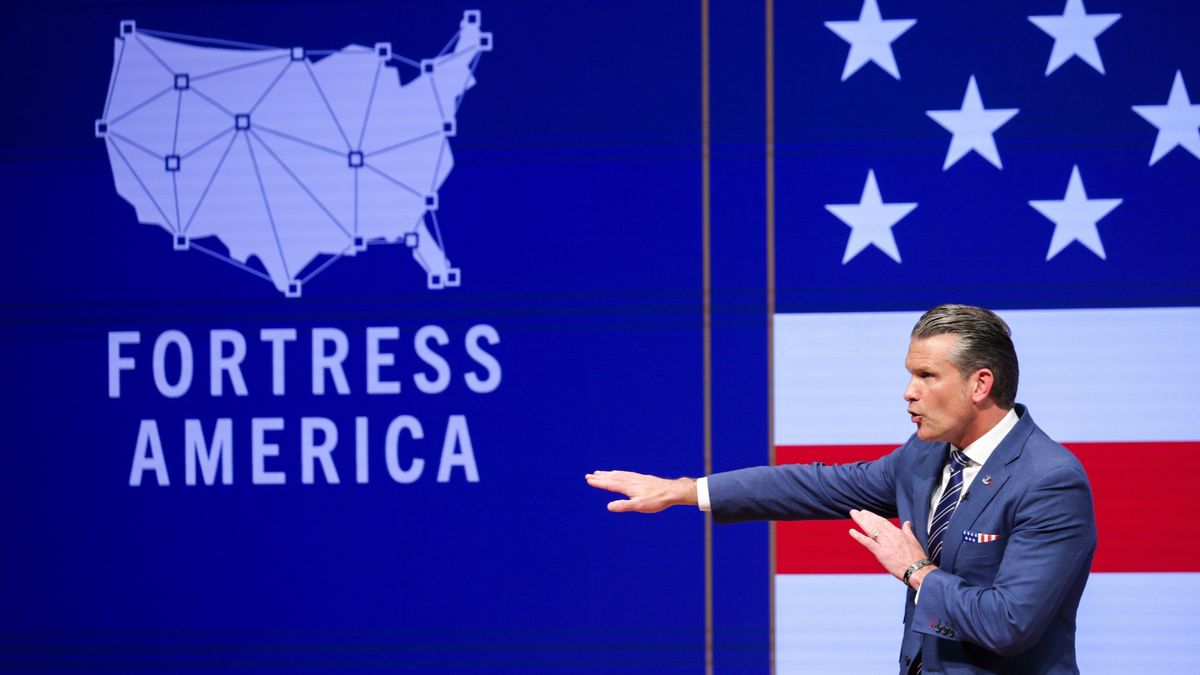
Claim: The FORTRESS initiative the Pentagon announced in September 2026 requires military bases in the U.S. to be able to operate for at least 90 days without relying on civilian power, fuel, water or supply lines. What's TrueSecretary of Defense Pete Hegseth announced the "Federal Operations for Resilience, Troop Resources, Energy, Supply, and Survivability" initiative on Sept. 30. What's UndeterminedFox News reported the 90-day requirement on Oct. 25 and quotes department spokesperson Sean Parnell throughout the article. Though Parnell shared the report on X that day, he has not confirmed the 90-day requirement. In October, a claim circulated online that the Pentagon had announced an initiative called FORTRESS that would require military bases in the U.S. to be able to operate for at least 90 days without relying on civilian power, fuel, water or supply lines. For example, one Facebook user who made and posted a video about the alleged measure wrote (archived): The Pentagon just Built a 90- Day Survival Plan. Under FORTRESS (Federal Operations for Resilience, Troop Resources, Energy, Supply, and Survivability), every major U.S. military base is being ordered to operate for 90 days with no civilian power, fuel, water, or supply chains, using portable nuclear reactors, microgrids, and stockpiles. The military is hardening itself for a grid-down war. Civilians are on their own. Snopes readers contacted us to ask about the initiative, while similar posts about FORTRESS and what it entails also circulated on Instagram and Reddit (archived, archived). FORTRESS is a real Department of Defense initiative and social media posts detailing what it involves are broadly accurate. The acronym stands for "Federal Operations for Resilience, Troop Resources, Energy, Supply, and Survivability." Though the measure itself is new, it also includes some energy and manufacturing-related programs that already exist within the DOD. Secretary of Defense Pete Hegseth announced FORTRESS during a speech in Quantico, Virginia, on Sept. 30. His speech and a department memo released that day describe the initiative as an "insurance policy" for the United States. On Oct. 25, Fox News reported more details about the measure (archived), mainly saying it would require U.S. military bases to "keep operating for at least 90 days without outside support." Fox News reported Defense Department spokesperson Sean Parnell has led the initiative. Parnell is quoted throughout Fox's report, which he posted to X (archived) that day. His posting of the article, however, does not explicitly confirm the 90-day operating requirement. Therefore, we've rated this claim mostly true. Snopes contacted the DOD for official confirmation of the 90-day requirement and any additional information it could provide about the FORTRESS initiative. We await a reply to our inquiry. FORTRESS merges existing DOD programs The Sept. 30 department memo says FORTRESS would focus on five pillars: "Energy independence; supply-chain and defense-industrial base resilience; a strategic defense reserve; installation hardening and cyber resilience; and resilience in space and spectrum." Hegseth explained the changes the initiative would bring as follows (at 32:07): Every major military installation in America is going to generate its own power independent of the civilian grid. If an adversary takes down the grid by cyber attack, by sabotage or by any means, our bases stay lit. Our aircraft keep flying. Our command centers never go dark. We're bringing our critical supply chains home: the rare earths, the specialty metals, the semiconductors, the propellants mined in America, refined in America, built in America by American workers. We are building long-overdue strategic reserves deep enough to fight through disruption. Think munitions, fuel, medicine, blood. Deep enough that if the world's supply lines break, and in a real war they're going to break, America keeps fighting anyway. We're hardening every installation on American soil against cyber intrusion, sabotage and drones. And we're securing the high ground and the airwaves, our satellites, our spectrum, our ability to see, to navigate and to talk to one another. Fox News reported that a "central concern" that FORTRESS would address is the military's reliance on the civilian power grid. Under the first pillar of "energy independence," Fox News said the measure would see the U.S. military developing its own sources of power such as "portable nuclear reactors, large-scale battery storage and microgrids." Around a month before the DOD made FORTRESS public, the department had already announced five vendors to build and operate nuclear microreactors at Fort Benning, Georgia; Fort Bragg, North Carolina; Fort Campbell, Kentucky; and Fort Drum, New York; and Fort Hood, Texas, as part of the Janus Program. That program aims to supply U.S. military bases with "the energy resilience necessary to project combat power globally, without relying on potentially vulnerable external grids," according to the DOD, and seeks to build at least 20 microreactors. FORTRESS would reportedly also use another existing DOD program — the Civil Reserve Manufacturing Network — to identify domestic factories that could switch to manufacturing for the military in a crisis even if normal supply chains are disrupted. Hegseth said during his Sept. 30 speech that FORTRESS was not meant to spread concerns about war on American soil. Rather, he said (at 33:56): We'll make certain that America cannot be starved out, shut down or cut off. A fortress is not a place where you hide from. It's a ground you stand on, the foundation you fight from, the strength that lets you reach anywhere in the world, precisely because you are fully prepared at home. It is unclear how the initiative would affect civilian disaster preparedness. Writing in The Wall Street Journal on Oct. 9, Tim Echols, who has served on the Georgia Public Services Commission since 2011, suggested the initiative could benefit consumers. Echols wrote that "the learning curve for building nuclear is paid for by the government" through microreactors for U.S. bases, whose technology could also apply to civilian power grids. Echols also suggested that lessening demand for electricity in cities that provide substantial power to military bases would allow those power companies to retire older units and replace them with more-efficient ones. Conversely, the user who made and posted the aforementioned Facebook video suggested FORTRESS would leave civilians "on their own" by taking away investment from shared resources. The U.S. government provides disaster preparedness advice for civilians on Ready.gov.
What we know about Pentagon's FORTRESS initiative to keep military bases running off-grid
Full Article
Original Source
Read the full article at Snopes →KhanList aggregates and links to publicly available news content. We do not host full articles from third-party sources. Always verify important information with original sources.