
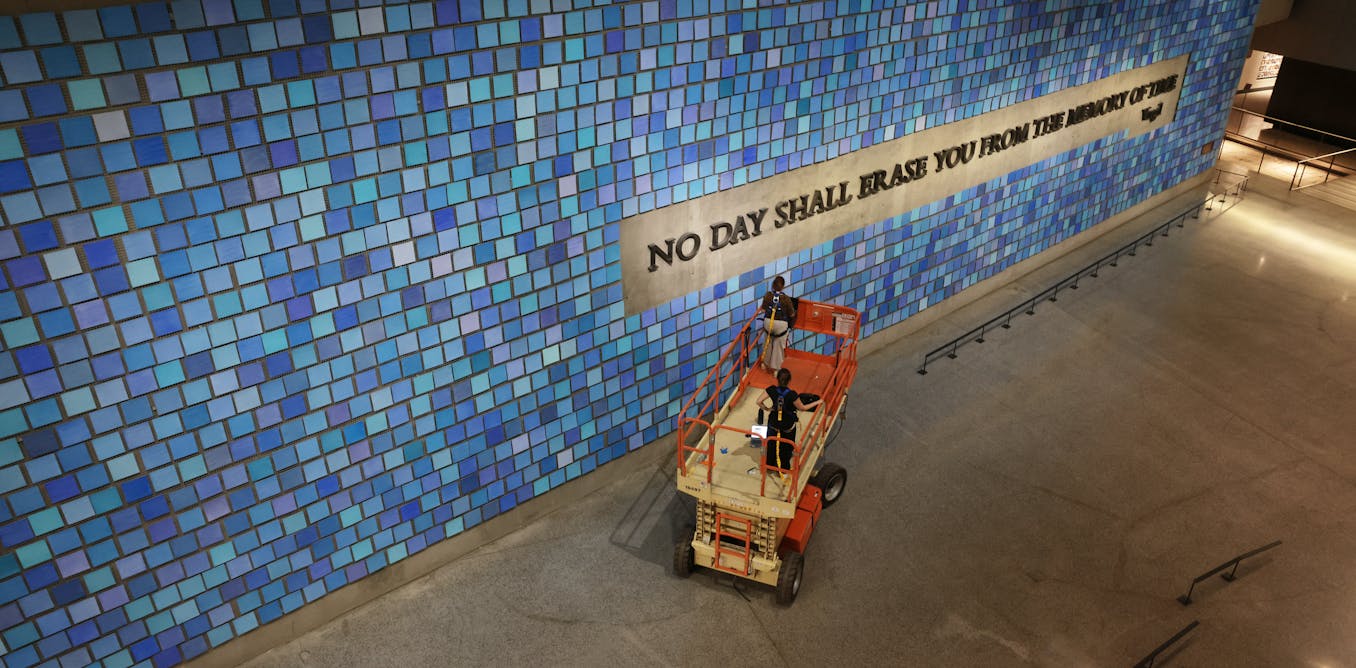
For much of the past 25 years, each anniversary of the Sept. 11 attacks has arrived with signs and stickers reminding people to “never forget.” I have always felt unsure about what those words mean. For those of us who were alive in 2001, forgetting the day itself is almost impossible. I remember the shock and fear, the replays of the second plane hitting the World Trade Center, and the moment the second tower fell. I remember seeing on television the missing-person photographs that covered New York and the awful recognition that very few of those people were likely to be found alive. I remember the bravery of the New York firefighters and police. My college students have no such memories or feelings. Most were born years after Sept. 11, 2001. They encounter what happened through photographs, documentaries, memorials, classroom lessons and stories told by people who were alive on that day. The National September 11 Memorial & Museum estimates that about 100 million Americans have been born since the attacks. The shift is ordinary and still somehow startling. An event that once felt like it had split time into a permanent before and after is fading into history itself. In my work as a professor of politics and public affairs, I pay close attention to the stories Americans tell about their past and the ways those stories shape civic identity in the present. The 25th anniversary of 9/11 is especially interesting to me because it marks a moment when an event once experienced as immediate and world-changing is increasingly being carried forward through memory, ritual and interpretation. Firefighter Gerard McGibbon prays after the World Trade Center buildings collapsed Sept. 11, 2001, killing some 3,000 people. Mario Tama/Getty Images Understanding history includes forgetting Scholars of collective memory, also called public memory, have long argued that societies do not remember the past simply by preserving it. Public memory describes how collective meaning gets made and remade through stories, institutions, rituals and political arguments. For example, the Department of Homeland Security was created in response to 9/11. Many Americans understand DHS as a structural and cultural reform made to fix the intelligence failures that the attacks made evident. Forgetting is part of the process, too. As memory scholar Paul Connerton has argued, some forms of forgetting are not failures but necessary parts of social life. No individual, school or nation can keep everything equally present forever. History accumulates faster than collective memory can accommodate it. The question, then, is not whether Americans will forget parts of 9/11. They will. The more interesting question is what remains after that forgetting takes place. From the first anniversary, commemorating the attacks has carried a careful choreography. There is the annual reading of the names of those who died, the memorial lights and the stories of first responders, each of which keeps the human loss and courage of the day in view. In a 2016 Pew Research Center survey, 76% of Americans named 9/11 as one of the 10 most consequential events of their lifetimes. Nearly 1 in 5 said the nation’s immediate response to the attacks was the moment when they felt most proud of the United States. I understand those points of view. Some of what I most want preserved about Sept. 11 is the shared grief of those first days and the ways ordinary people revealed their humanity under unimaginable circumstances. Firefighters climbed stairs and ran toward mortal danger, while a cascade of people tried as hard as they could to get down. Office workers helped colleagues and strangers. Families searched for missing loved ones long after hope had become terribly thin. And passengers on United Flight 93 fought back and forced the plane they were on to crash in a field in the middle of Philadelphia, sacrificing themselves in the hopes of saving others. Before 9/11 became a justification, a policy, a war or a political symbol, it was an experience of shared human vulnerability. Politics and its consequences No event remains sealed inside its original meaning. Sept. 11 became the starting point for a series of political choices that reshaped American life and, in turn, reshaped the memory of the day itself. The attacks led to the war in Afghanistan, which lasted for 20 years after the invasion’s initial success in dismantling al-Qaida and removing the Taliban government. Next was the invasion of Iraq, even though Saddam Hussein’s regime had no role in 9/11. And the aftermath of the attacks helped create an atmosphere that allowed for expanding government surveillance, enlarging presidential power and narrowing the space for dissent. Muslim Americans found themselves subjected to new suspicion and hostility. Those consequences now compete with the original experience of Sept. 11 for a place in its meaning. For some Americans, the attacks have become inseparable from the wars and broader official willingness to sacrifice civil liberties in the name of security that followed. From this perspective, 9/11 is remembered not only as a national trauma but also as a warning about how fear and grief can make policies that once seemed unthinkable appear necessary. For others, the day – and its aftermath – represent restored American pride and military perseverance. For still others, 9/11 remains most powerfully a story about innocent lives lost and ordinary people behaving with extraordinary courage. Each way of remembering draws a boundary around the terrorism the nation experienced, deciding how far beyond that September morning its meaning should extend. Even events once regarded as world-defining eventually have to share the historical landscape with everything that follows. Since 2001, Americans have experienced Hurricane Katrina, the 2008 financial crisis, the election of the first Black president, the rise of Donald Trump, the violence on Jan. 6, 2021, and a global pandemic. Sept. 11 has not become unimportant because those things happened. Its place in the story has changed because life – because the world – kept going. For people who were alive during the attacks, there is something sad about watching that distance and diminishment happen. When an event once remembered in minute detail becomes a date others know only from history, the passage of one’s own life becomes newly visible. There is a strange nostalgia in realizing that something once so immediate now belongs increasingly to people who know it only as the past. A week after the 9/11 attacks, the front page of USA Today runs a quote from President George W Bush – ‘The hour is coming’ – a message of imminent reprisals against al-Qaida. Richard Baker/In Pictures via Getty Images Images What are we to remember? Maybe this is why “never forget” feels both moving and impossible. What is supposed to be the subject of our remembering? The people who died? The courage? The grief? The fear? The wars that followed? The mistakes? The unexpected decency of people thrown together on an unbearable day? A society cannot keep all of those things equally vivid forever. Nor should its members confuse remembering everything with understanding anything. The task of collective memory is inevitably one of selection. For me, one part of the memory seems especially important to preserve. Before Sept. 11 became an argument about war, security, patriotism or political allegiance, it was an encounter with human vulnerability and then human resilience. The solidarity of Sept. 11 and the political choices made in its aftermath were not the same thing, even if they have become intertwined in our memory of the period. If the ongoing march of history means Sept. 11 cannot always carry the emotional weight it does for people who were alive when it happened, perhaps the best outcome would be to focus on the collective grief, along with the extraordinary human response that grief engendered. Doing so would not erase any of what followed. But it might help preserve the understanding that the day was one of imaginable horror and tragedy before it became a political inheritance.
What we forget when we remember 9/11
Full Article
Original Source
Read the full article at Theconversation →KhanList aggregates and links to publicly available news content. We do not host full articles from third-party sources. Always verify important information with original sources.