
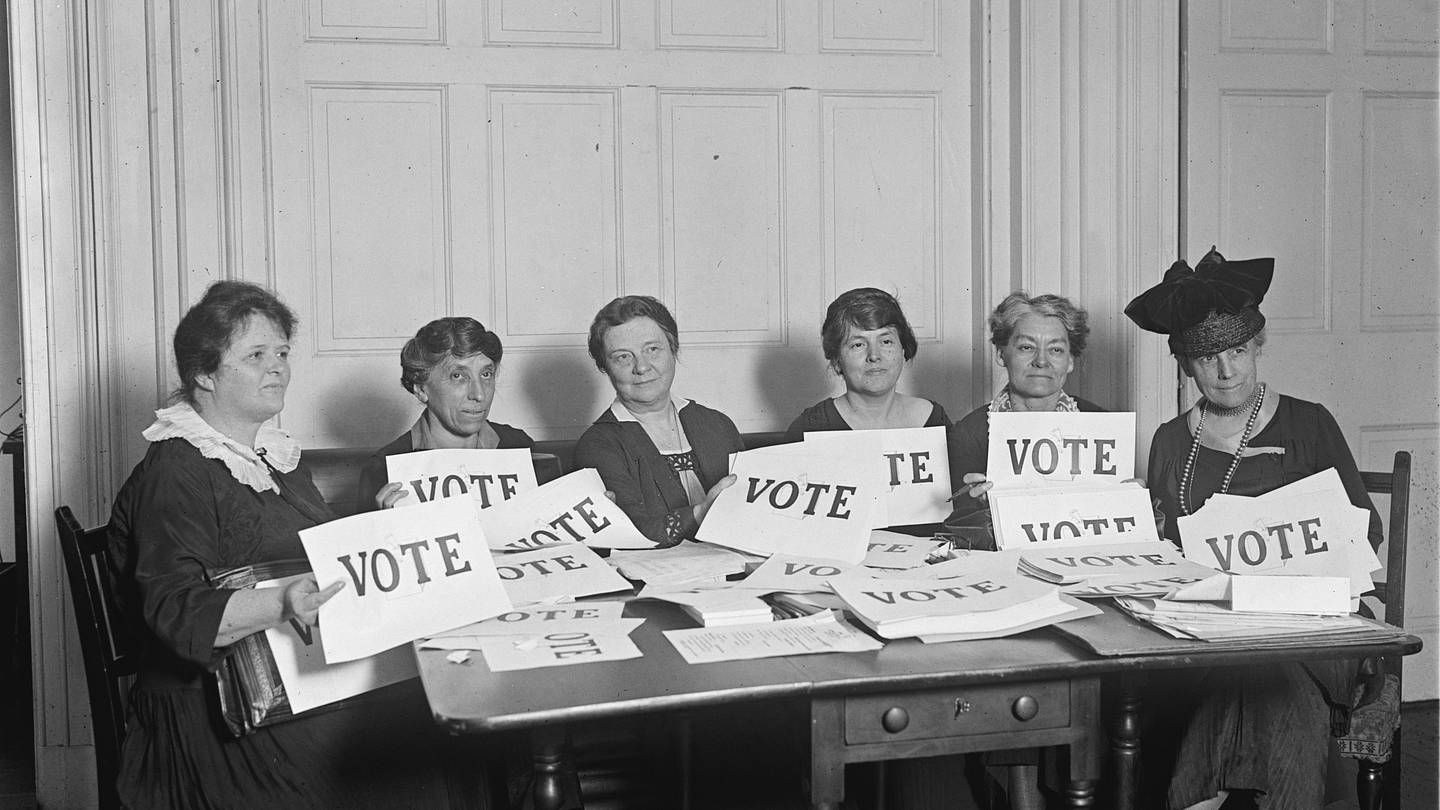
In 1926, Calvin Coolidge was in the second year of his elected term as president, Prohibition was very much in effect, and voting looked a little bit different than it does today—depending on who you were. The 19th amendment, which prohibited denying people the right to vote on the basis of sex, had been ratified a mere six years earlier, in 1920. Just around 35 to 45% of eligible women showed up to vote that year. This was due to various factors, including regulations and barriers that made it harder for many people—specifically people of color—to vote for decades to come. A brief history of American votingAcme Voting Machine, 1880s | Fotosearch/GettyImagesIn the earliest American elections, voters’ choices were recorded in polling books along with their names and addresses. Over the years, individual paper ballots became more popular, but these were often placed into glass jars—still not exactly the most top-secret of locations. Additionally, voters could often expect to find representatives from both political parties at the polls who would sometimes use intimidation and fraud to sway the elections.In the late 1800s, voting machines began to become popular in large cities. The first voting machine was patented in 1875. In 1910, Lenna R. Winslow received a patent for a voting machine that changed the ballot depending on the voter's gender. However, the machines were effectively made obsolete thanks to the ratification of the 19th amendment. Voting in the 1920sThree suffragists casting votes in New York City ca. 1917 | HUM Images/GettyImagesDuring the Roaring Twenties, most voters in large cities would have used Jacob H. Myers’ mechanical lever voting machines to cast their votes. These machines required pulling down large levers, which marked ballots. Voters could choose whether to vote individually on different questions, or whether to vote entirely in line with one political party. After the process was complete, the machines would open, revealing the results.The machines were usually kept in town halls and were hidden within booths, and people would step through curtains in order to cast their votes. Pulling the curtain open reset the machines for the next voter, though users were unaware that the machines worked this way.Voting machines typically cost thousands of dollars but were not always reliable. They could be rigged relatively easily, resulting in miscounts.Some small towns and remote areas continued to use paper ballots until the 1950s. These ballots were hand-counted by local election officials, sometimes in local stores or even private homes. It wasn’t until the 1960s that punch cards began to spread across America.Ahead of the election of 1920, there had been some concern among organizers about what would happen when women were allowed to go to the polls. Officials in Cincinnati worried that women might bring babies, whom they feared could be disruptive to voters. Because of this, staff kept a bottle of milk on hand, but when no milk was needed, they drank it themselves. By 1926, most states had become more accustomed to seeing women at the polls—but not all women were welcomed equally.Barriers to voting in the 1920sRuth Pratt, Candidate for Congress, at Voting Machine | Bettmann/GettyImagesDespite the passage of the 19th amendment, voting wasn’t always simple for everyone in the 1920s. Depending on the state, literacy tests, poll taxes, and other barriers made it much harder for people of different demographics to vote.Native Americans were not granted U.S. citizenship and voting rights until the Snyder Act in 1924. Still, some states continued to claim that people living on reservations were not residents of the state for many more years. Additionally, many Asian American immigrants did not have a pathway to citizenship until the Immigration and Nationality Act of 1952, meaning they were not eligible to vote until nearly three decades after the 19th amendment was passed. Many states also employed literacy tests at the polls, which proved an effective way to keep people who did not speak English well away. The first literacy tests were introduced in 1855 in Connecticut, specifically in order to block Irish immigrants from voting. They also disenfranchised impoverished whites and African Americans. Literacy tests were employed across the South after the Reconstruction in order to prevent African Americans from voting, though white voters were often exempted from these through grandfather clauses or rigged tests that gave much easier questions to them and more difficult questions to non-white voters.These tests remained in use across the South in the 1920s, and proved effective at blocking women of color from voting after the ratification of the 19th amendment. Additionally, women of color often faced other forms of discrimination and intimidation at the polls during this time; in 1926, four Black women were beaten while trying to register to vote in Birmingham, Alabama. Literacy tests, ballot taxes, and numerous other forms of voter intimidation were not outlawed until the passage of the Voting Rights Act of 1965.
What Was Voting Like 100 Years Ago?
Full Article
Original Source
Read the full article at Mentalfloss →KhanList aggregates and links to publicly available news content. We do not host full articles from third-party sources. Always verify important information with original sources.